


Engraving vs. Stamping Jewelry: How They Differ and Which to Choose
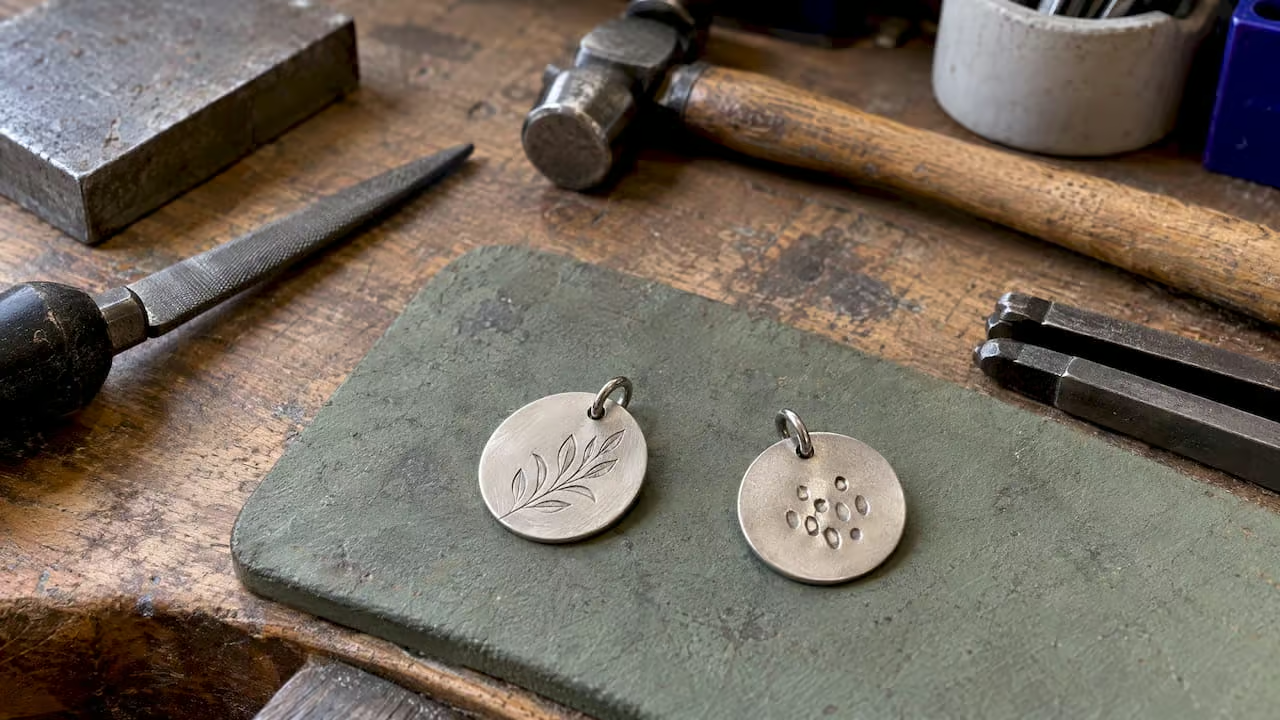
Engraving removes some of the metal, and stamping displaces it. An engraver cuts a groove with a sharp tool or a laser, so the lettering looks fine, crisp, and polished. A stamper strikes a hardened steel punch with a hammer, pressing each letter into the surface with a slightly handmade rhythm. Once you know that, the choice gets easy: engraving suits delicate, refined detail, and stamping is best for a casual, tactile, handcrafted look.
I’ll go through how each method works, which metals suit which, what it costs, how the marks wear, and how to pick for a gift or for yourself. If you love handmade pieces, as we do at HerMJ, you’ll find the difference matters more than it first seems.
TL;DR
- Engraving cuts a groove into metal (by hand, machine, or laser). Stamping presses a letter or design into metal with a steel punch and a hammer.
- Engraving gives fine, uniform lines and small, detailed script. Stamping gives a bolder, slightly uneven, handmade look.
- Stamping works best on flat, simple surfaces. Engraving can follow curves and fine detail.
- Price depends on the jeweler, the method, and the amount of lettering, so get a quote for your exact piece before you commit.
- Pearls and gemstones stay as they are. Both methods belong on the metal parts of a piece, such as a tag, bar, or clasp plate.
Engraving and stamping at a glance
Both methods leave a permanent mark, but in opposite ways. The table below is the quick version, and the sections after it explain each row.
| Engraving | Stamping | |
|---|---|---|
| What happens to the metal | A tool or laser cuts or vaporizes a groove | A hardened punch presses the shape in |
| Typical look | Crisp, fine, polished, uniform | Bold, slightly irregular, rustic |
| Best for | Small script, detailed designs, curved surfaces | Short words, initials, dates, flat tags and bars |
| Style feel | Classic and elegant | Casual and handmade |
| Skill needed | High for hand engraving, machine-driven for lasers | Practice for even alignment and depth |
How engraving works
Engraving means cutting or carving a permanent design into a hard surface, and jewelers use it for lettering, texture, and decoration, according to Rio Grande’s jewelry engraving guide. The same guide notes that hand engraving is still used in jewelry, even though modern technology has replaced it in some other fields. That tells you something: a trained hand can do things a machine can’t quite copy.
There are three main ways it’s done.
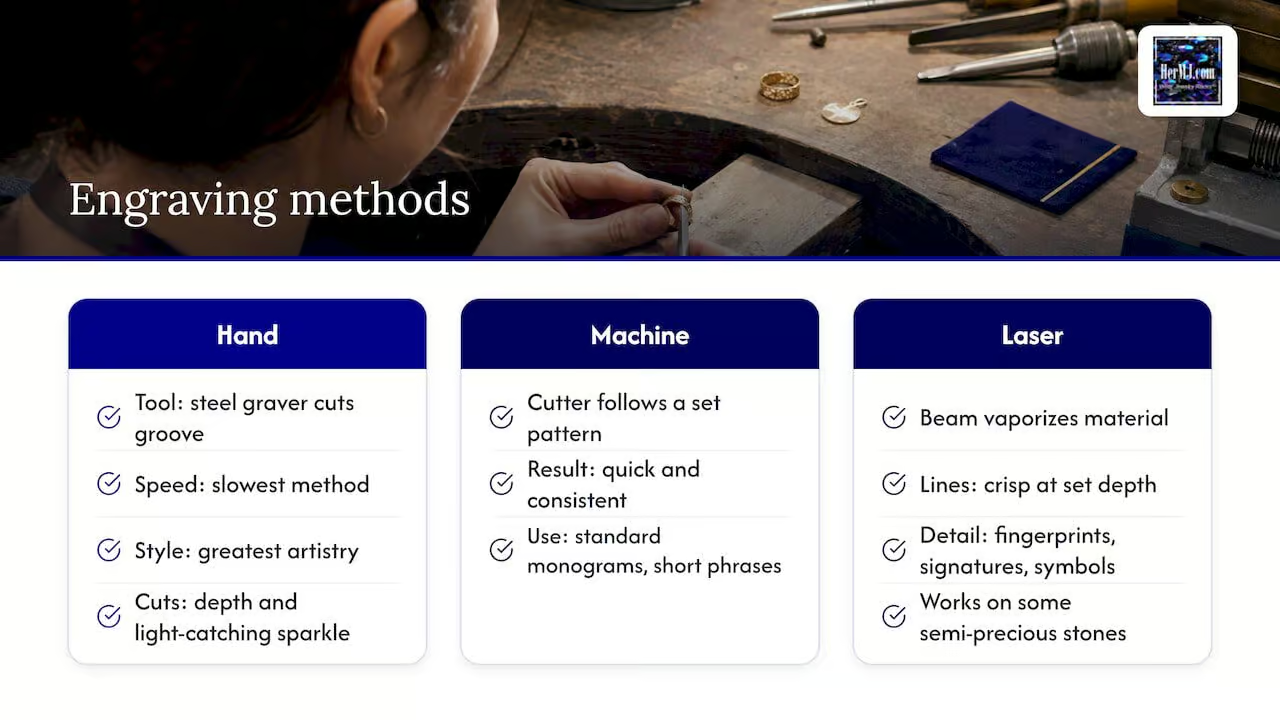
Hand engraving. The engraver pushes a small steel tool called a graver through the metal, cutting a groove as it goes. The graver’s shape and angle determine how the cut looks, which is why a skilled engraver’s work has depth and a subtle, light-catching sparkle in each line. It’s the slowest method and the most artistic.
Machine engraving. A machine drives a cutting tool along a set pattern. It’s quick and consistent, which is why many jewelers use it for standard monograms and short phrases.
Laser engraving. Here, an amplified beam of light turns to heat and vaporizes part of the material. Because a computer delivers the design, lines stay crisp at a specific depth, and tiny details like a fingerprint, a signature, or a small symbol come out cleanly. Lasers also work on a wide range of materials, including some semi-precious stones.
The common thread is control. Engraving lets you choose a font, a size, and a finish, and the result reads as polished and deliberate.
How stamping works
Stamping is simpler to picture. The Metalsmith Society’s glossary describes it as impressing letters, numbers, or designs into metal with hardened steel stamps and a hammer, and notes that it’s used to personalize jewelry, add maker’s marks, and create patterned texture, especially on flat surfaces.
Each letter is a separate punch, so the stamper places and strikes one character at a time. That’s where the charm comes from. Letters sit a hair off from one another; one may be a touch deeper than the next, and the whole line has a personal, handmade feel that machines are built to avoid.
That same handmade character is the reason people love it. A stamped bar with a name and a date looks like someone made it for you, because someone did.
A few practical details help you judge quality:
- Stampers typically use a brass hammer for lighter work, because brass is softer than the steel stamp and won’t deform its striking end.
- Alignment takes practice. Beginners are usually advised to rehearse on inexpensive copper before moving on to sterling silver or gold-filled blanks, which tells you how much skill even straight lettering takes.
- Short, simple text works best. Every extra letter is another chance for a crooked strike, so initials, a first name, or a date are the sweet spot.
If you’d like the full introduction, my beginner’s guide explains what hand-stamped jewelry is and how its marks come about.
Which metals suit each method
The metal you choose changes the result as much as the method does.
For engraving, a jeweler quoted by WeddingWire says gold and platinum are good candidates because mistakes can be polished out, while tungsten, cobalt, and coated sterling silver are harder to engrave because errors can’t be polished away. In other words, a forgiving metal lets the engraver correct a slip. A coated or very hard metal doesn’t.
For stamping, the options are broader, and the differences are practical. Halstead’s blank guide lists sterling silver, copper, brass, aluminum, gold-filled, fine silver, pewter, and 14-karat gold, each with its own working challenges. It notes that aluminum is inexpensive and soft but bends, scratches, and wears quickly, and that copper stamps clearly but tarnishes fast.
For jewelry you plan to wear for years, silver, gold-filled and gold are the sensible places to start.
If a piece is marked sterling silver, the hallmark itself is a stamp. My guide to the 925 stamp and what sterling silver marks tell you explains why that small mark matters when you’re buying.
One point matters for pearl and gemstone lovers. Pearls and stones are the star of the piece, and neither method is meant for them. Personal marks go on the metal: a small tag at the end of a necklace chain, a bar on a bracelet, a plate near the clasp. Lasers can mark some stones, and Rio Grande’s guide describes the risk to gemstones as low because the process is so precise, but most people keep the gems untouched and let the metal carry the message.
How each one looks and feels
Look at the two side by side, and the personalities are clear.
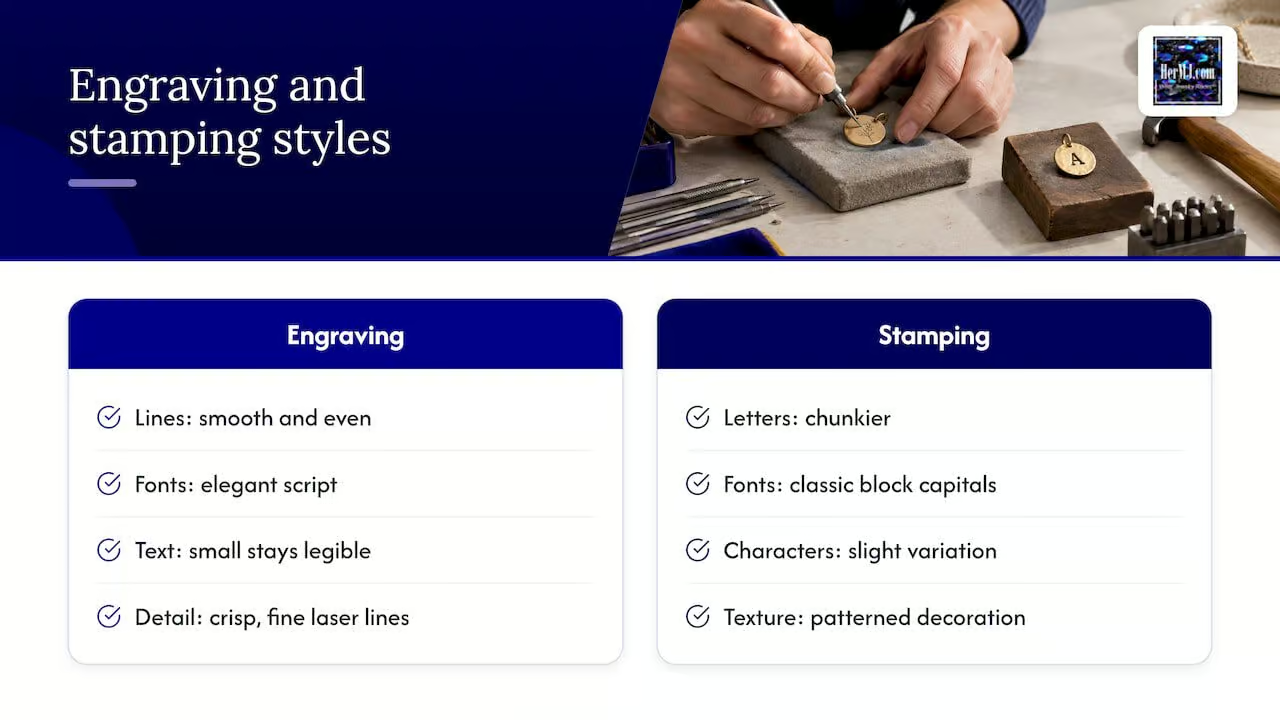
Engraved lettering is smooth and even. Script fonts look elegant; small text stays legible, and curved or irregular surfaces are no problem. Laser work adds extra detail, since computer-delivered designs allow crisp lines and fine detail at set depths. I suggest anniversary dates in a flowing script, tiny coordinates, or a miniature motif inside a pendant.
Stamped lettering is chunkier. Block capitals are the classic choice, and the slight variation between characters is part of the appeal. It’s the look of a handmade charm, a boho bracelet bar or a pendant tag with a child’s initial. Stamping can also create patterned texture, which works nicely as decoration even without any words.
A useful rule of thumb: if you want the words to feel like fine print, choose engraving. If you want them to feel like a signature on something handmade, choose stamping.
What it costs
Prices vary a lot by jeweler, metal, and amount of text, so treat any number as an example. In a United States article from April 2018, WeddingWire quotes a jeweler at $35 for in-house machine engraving and laser engraving starting at about $60, with the laser price shifting by detail and placement. The article adds that cost depends on whether you bought the piece from that jeweler, the engraving style, and the number of letters. Those fees came from named jewelers in 2018, so they’re a guide to how pricing is structured, not a current price list.
Three things reliably push the cost up:
- More characters, or a more complex design.
- A harder metal, which takes more time and wears down tools.
- Hard-to-reach placement, such as a small curved area.
Ask for a written quote that names the method, the metal, and the exact text before you hand over a piece. It saves surprises and gives you a chance to compare.
How the marks wear over time
Both methods are permanent, because both change the metal itself instead of sitting on top of it. How they age is a different story, and a few common-sense points are worth keeping in mind.
A deep engraved line holds up well, but a lightly cut script on a surface that rubs against clothing and skin every day will soften more than a deep cut. Stamped letters are pressed in with real force, which makes them bold, and the sturdiness of the metal underneath matters most. Softer metals like aluminum scratch and wear faster than sterling silver or gold, and copper darkens as it tarnishes.
Placement counts too. A tag that hangs freely wears gently, while a bracelet bar that knocks against a desk all day picks up more scratches. For everyday jewelry, choose a location that doesn’t take much abuse and a metal that suits how you live.
When the piece includes pearls, keep in mind that the metal and the nacre age differently. Our guide to pearl care covers how to keep them lustrous.
Can you combine engraving and stamping?
Yes, and it can look wonderful. A common pairing is a stamped initial on the front of a pendant with a small engraved date on the back, so the bold mark does the talking and the fine mark carries a private detail.
The thing to watch is balance.
Two very different textures on one small surface can compete, so give each its own space and keep the text modest.
Because the methods need different tools, they’re often done by different hands or at different stages, and the order matters. Plan the layout first so nothing crowds the edges.
Choosing for a gift or for yourself
Start with the person, not the technique.
- A minimalist who wears fine chains: engraving, in a small, clean script.
- Someone who loves handmade, rustic charm: stamping, in short block letters.
- A milestone gift such as a wedding or anniversary: engraving usually feels more formal and lasting. If you’re building a list of keepsakes, these wedding gift registry ideas can help you match the occasion to the gift.
- A mother or friend with a layered, casual style: a stamped tag or bar.
- A tiny, intricate detail such as a signature or symbol: laser engraving.
Then check three things before you buy: the metal, the amount of text, and the surface. Flat bars and tags suit both methods. Curved surfaces favor engraving. Very long phrases are ideal for engraving too, since stamping gets harder with every letter.
The HerMJ guide to jewelry gifts for her offers more ways to think about gifts that feel meaningful.
My perspective
At HerMJ, we believe jewelry should feel made by a person, and that’s the thread we follow through everything we offer. Whether a mark is cut or struck, what we love about it is the same: it shows that a maker was there.
That’s also why we’re drawn to genuine freshwater pearls, natural gemstones and crystals. Each one is slightly different, and each one is set into a handmade piece that keeps that individuality. A pearl necklace or a gemstone bracelet doesn’t need much more than that to feel personal.
My advice when you’re weighing engraving against stamping is to let the piece lead. If the design is already rich with texture and stones, keep any added marking small and quiet. If the design is simple, a bold stamped detail can give it character. Either way, you’re choosing how a piece will tell its story.
Veronique
Find handmade pieces worth wearing
If you’re looking for handmade jewelry with real character, we’d love to show you our collection of freshwater pearl and natural gemstone pieces. Browse our necklaces, bracelets, and modern drop earrings, or visit HerMJ’s pearl and gemstone jewelry collection to see everything at once.
US orders ship free with no minimum, and international orders ship free on orders of $150 or more.
For home, The HerMJ Room Jewelry collection brings the same gemstone beauty to shelves and tabletops.
FAQ
What’s the main difference between engraving and stamping?
Engraving cuts a groove into the metal with a graver, a machine, or a laser. Stamping presses a hardened steel punch into the metal with a hammer. Engraving looks finer and more uniform, while stamping looks bolder and more handmade.
Which lasts longer, engraving or stamping?
Both are permanent because they alter the metal itself. How well they hold up depends mostly on the metal, the depth of the mark, and where it sits on the piece. Silver, gold-filled, and gold resist wear far better than soft metals such as aluminum.
Can you engrave or stamp pearls and gemstones?
Personal marks are usually placed on the metal parts of a piece, like a tag, bar, or clasp plate, so the pearls and stones stay untouched. Lasers can mark some semi-precious stones with low risk of damage, but most wearers prefer to leave gems as nature made them.
Is stamping or engraving cheaper?
It depends on the jeweler, the metal, and how many characters you want. In one 2018 US example, machine engraving was quoted at $35 and laser engraving started at about $60. As with most things, prices increase, so it’s best to get a written quote for your exact piece.
Sources
- Jewelry Making Glossary, Metalsmith Society
- Rio Grande Guide to Engraving for Jewelers
- Guide to Hand Stamping Metal Blank Options, Halstead
- Wedding Ring Engraving 101, WeddingWire
Recommended
- What Is Hand Stamped Jewelry: A Beginner’s Guide
- 925 Stamp Meaning: What Sterling Silver Marks Tell You