


Earring Drop Length: How Long Should Your Earrings Hang?
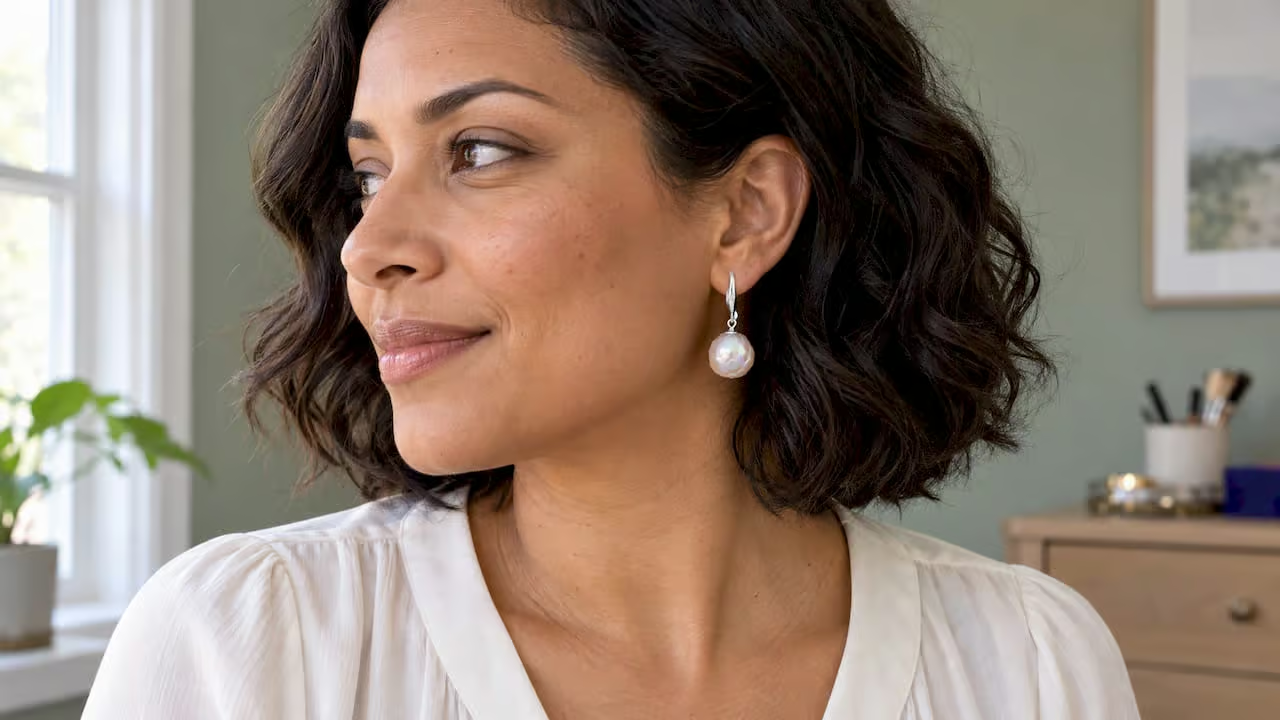
Earring drop length is the distance from the top of the earring, where it attaches to your ear, to its lowest point. Most people wear a drop between 1 and 2 inches (25 to 50 mm) every day, and save anything longer for evenings and occasions. I’m going to show you how to measure it, how to read the numbers on a product page, and how to pick a length that flatters you and still feels good at hour ten.
I design and wear handmade pearl and gemstone earrings all the time, so I think about length constantly. A pearl that looks delicate at 30 mm can look dramatic at 60 mm, and the difference is usually in the drop, not the stone.
TL;DR
- Drop length runs from the top of the hook or post to the bottom tip of the earring, so it’s longer than the part you actually see below your lobe.
- Under 1 inch (25 mm) is a short drop, 1 to 2 inches (25 to 50 mm) is the classic everyday range, and past 2 inches (50 mm) you’re in statement territory.
- Measure an earring you already love with a millimeter ruler, then use that number to shop with confidence.
- Weight, wire thickness, and where your piercing sits change how a length feels, so treat the number as a starting point.
- Pearl and gemstone drops look their best when the length suits the neckline, hair, and occasion you’re dressing for.
What drop length actually means
Jewelers use a few words that sound alike, and they trip up a lot of shoppers. Drop length is the vertical measurement of the whole earring. One earring-size glossary defines it as the full distance from the top, where the earring attaches to the piercing, to the bottom tip. So a 40 mm drop hangs 40 mm below the piercing point.
Total length and drop length are usually the same thing on a hook or post earring. They differ when a listing counts only the dangling part and leaves out the stud, the ear wire, or the connector. If a product page doesn’t say what it’s measuring, look at the photos and any dimensions, and assume the number covers the full piece.
A few other terms are worth knowing:
- Stud: sits flat against the lobe with no drop at all.
- Drop earring: hangs in a fixed, fairly straight line just below the lobe.
- Dangle earring: moves more freely and is usually longer or more elaborate.
- Chandelier: a wider, tiered design that usually runs long.
The lines between drop and dangle blur, and that’s fine. What matters is knowing the number, because length is the one detail that predicts how an earring will look on you.
How to measure earring drop length
You don’t need special tools. You need a ruler with millimeter markings, or a soft tape if that’s what you have, and about two minutes.
- Lay the earring flat. Put it on a table with the hook or post at the top and the design hanging straight down. Don’t let the wire curl.
- Start at the top of the finding. For a hook, that’s the highest point of the wire where it will rest in your piercing. For a post, it’s the top of the post where the earring begins to hang.
- Run to the lowest point. Follow the ruler down to the bottom tip of the earring, whether it’s a pearl, bead, stone, or metal charm. A common measuring guide puts it the same way: from the top of the hook or post to the bottom tip, using a caliper for maximum precision or a millimeter ruler for everyday use.
- Convert if you need to. Divide millimeters by 25.4 to get inches. A 38 mm earring is about 1.5 inches.
- Write it down. Keep a note on your phone for the earrings you reach for most. That list becomes your personal shopping guide.
Here’s a worked example. Say you own a pair of pearl drops you wear constantly. You measure 35 mm from the top of the wire to the bottom of the pearl. That’s a little under 1.4 inches, solidly in the everyday range. When you shop for new earrings, aim for something within about 10 mm either side of 35 mm if you want the same feel, and go longer only when you want a different effect.
Be careful with online photos. Screens shrink and enlarge pieces unpredictably, so judge by the stated measurement, not by how big the earring looks on a model. Hold a ruler against your ear, with the zero mark at the top of your piercing to see in seconds where a given length will end.
Short, medium and long: the length chart
There’s no single official standard, but jewelry sizing charts agree on rough bands. TheSize.net’s earring chart groups drops like this, and I find the bands useful in practice:
| Category | Drop length (mm) | Drop length (inches) | Where it ends |
|---|---|---|---|
| Short drop | Under 25 mm | Under 1 in | Just below the lobe |
| Classic drop or dangle | 25 to 50 mm | 1 to 2 in | Between lobe and jawline |
| Long drop | 50 to 75 mm | 2 to 3 in | Jaw to neck |
| Shoulder duster | Over 75 mm | Over 3 in | Toward the shoulder |
The jawline is a good limit for most daily wear. Once an earring passes it, you start noticing the piece every time you turn your head.
How far will it really hang below your earlobe?
This is where shoppers get surprised. Your piercing isn’t at the very bottom of your lobe, so the visible hang is shorter than the listed drop. One style guide notes that a 2-inch drop hangs roughly 1.5 inches below the ear, and that around 1 inch reads as everyday, while past 2.5 inches the earring reaches the jawline.
That gap changes with your anatomy. A higher piercing on the lobe leaves more room, so the same earring ends lower on your neck. A larger lobe makes a given length look shorter and neater, and a small lobe makes it look longer. If you have a second or third piercing higher up, a drop there will dangle near your face rather than past it, so choose shorter lengths for upper holes.
So don’t ask only how long the earring is. Ask where the bottom tip will land on you.
Choosing a length for your face, hair and neckline
I’m cautious about rigid face-shape rules, because a good earring works for many faces. Still, a few patterns hold up well.
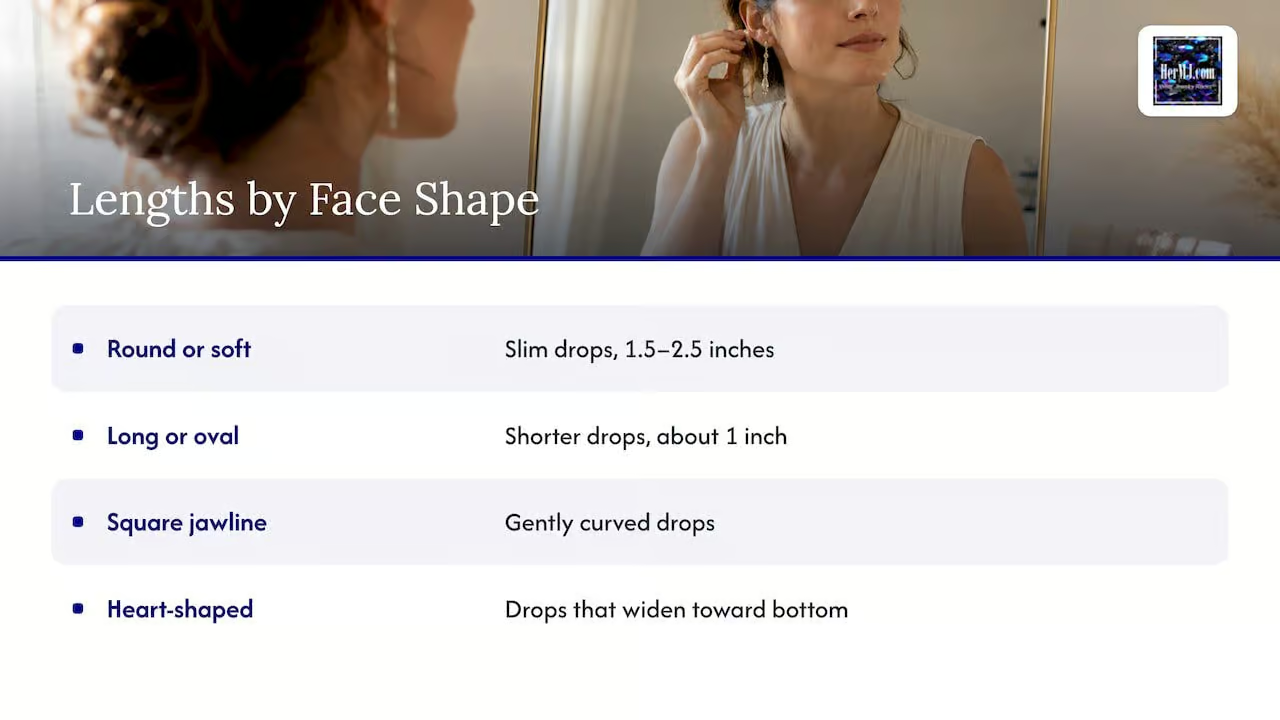
Round or soft faces. Slim drops in the 1.5 to 2.5 inch range (about 38 to 64 mm) draw the eye downward and add a vertical line. Narrow shapes like teardrops or a single pearl on a fine wire work especially well.
Long or oval faces. You can wear nearly anything. Shorter drops of about an inch keep proportions balanced, while longer drops make a dramatic choice if you enjoy the contrast.
Square or strong jawlines. Gently curved drops soften the angles. Pearls are wonderful here because their roundness echoes the curve you want to add.
Heart-shaped faces. Drops that widen toward the bottom, like a fuller pearl or a gemstone cluster, balance a narrower chin.
Hair matters just as much as face shape. With hair down, long drops can disappear or tangle, so a short or classic drop shows off better. With your hair up, a braid or a sleek bun, longer earrings take the spotlight, and that’s when I reach for statement lengths.
Necklines count too. A crew neck or high collar goes well with short to classic drops. A scoop, V-neck, or off-the-shoulder top gives a long drop room to move. If you plan to wear a necklace, keep the earrings shorter or simpler so the two don’t compete. I wrote about balancing pieces in my guide to pearl earring styles, which covers studs, drops, and hoops from 4 to 12 mm.
Weight, thickness, and comfort matter as much as length
Two earrings of the same length can feel completely different. TheSize.net points out that a 50 mm hoop made from thin wire feels airy while the same size in thick tube feels bold and heavy.
The same idea applies to drops: a single slender freshwater pearl on a fine wire is far lighter than a long drop of several large stones.
Here’s how I think about comfort:
- Count the elements. More beads, stones or metal links mean more weight, even when the length is identical.
- Think about your day. If you’re at a desk or traveling for twelve hours, choose a lighter earring at a shorter length. Save heavier statement drops for dinners and events.
- Watch for snags. Long drops catch on scarves, high collars and hat brims, so winter outfits usually call for shorter earrings.
- Notice how your ears feel. If your lobes ache or the earring pulls, go shorter or lighter next time.
If you want length without bulk, take a look at my notes on lightweight statement earrings. If your ears react to certain metals, our page on hypoallergenic earrings is the place to start before you choose any length.
Matching drop length to the moment
Here’s the cheat sheet I use when I’m getting dressed.
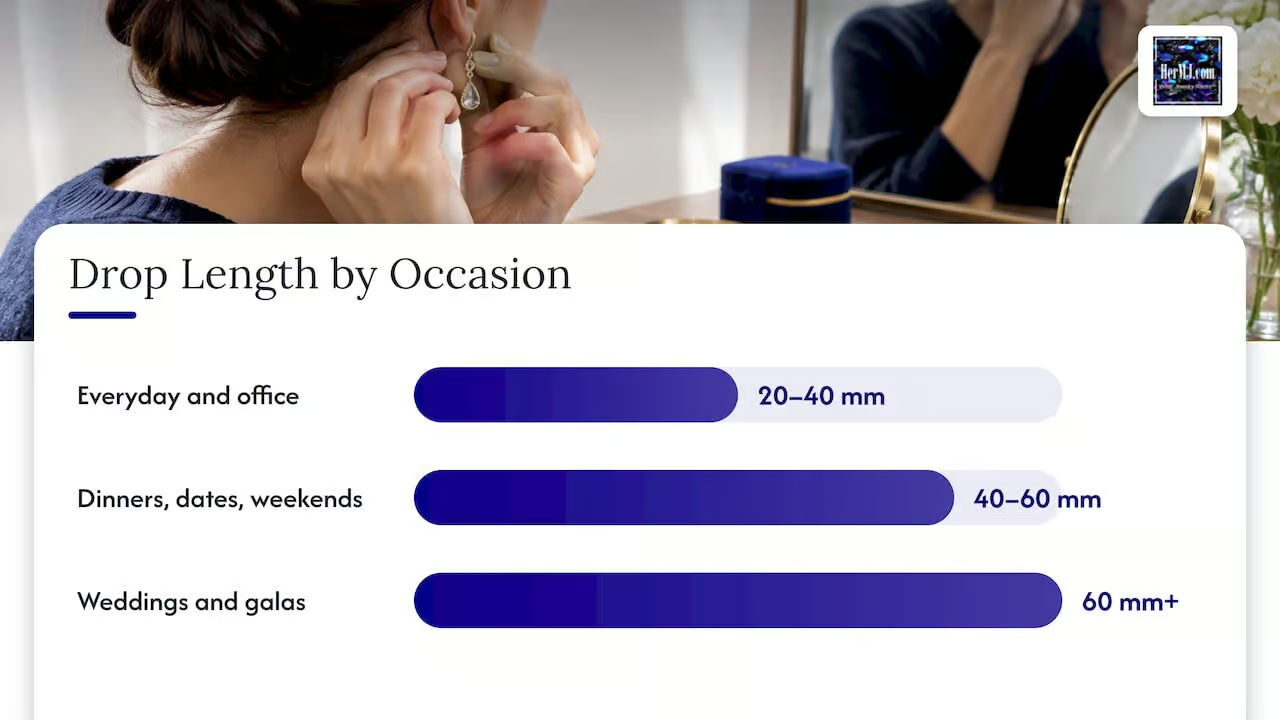
Everyday and office: 20 to 40 mm (about 0.8 to 1.6 inches). These lengths frame your face without demanding attention. A short freshwater pearl drop is the classic choice. If you’re building a daily wardrobe, everyday elegant jewelry helps you pull it together.
Dinners, dates and weekends: 40 to 60 mm (about 1.6 to 2.4 inches). This is where drops start to move and catch light. Gemstone beads and pearls look beautiful here because they add color and glow at eye level.
Weddings, galas, and special nights: 60 mm and up (about 2.4 inches and more). Go long when the outfit is simple and the moment deserves a showpiece. Pair with an updo so the earrings aren’t hidden.
Gifts. If you’re shopping for someone else, a drop between 1 and 2 inches is the safest, most flattering choice. It suits nearly every face, hairstyle, and wardrobe, and it rarely feels too small or too showy. Pearl drops in this range are an easy gift to get right.
Pearl and gemstone drops: what changes
Pearls and stones add their own sizing considerations, because the bead itself takes up part of the length. A drop with a 10 mm pearl uses 10 mm of the total just in that one bead, so a 35 mm earring with a large pearl shows less wire and feels fuller than a 35 mm earring with a tiny one. Freshwater pearls also vary in shape, from round to oval to teardrop, and an elongated shape reads as longer even at the same measurement.
For gemstone drops, color matters. Deep stones like carnelian or amethyst look strong even at shorter lengths, while pale stones like rose quartz or moonstone can take a little more length before they feel heavy. Once you’ve picked a pair, protecting them is simple, and our guide to pearl care covers everything you need.
What we’ve learned about getting drop length right
We design our earrings knowing that length is the first thing a wearer feels. A drop that’s too short can look like an afterthought, and one that’s too long can wear you out by evening. That’s why we think in proportions: the size of the pearl or stone, the thickness of the wire, and how the whole piece sits against the face.
HerMJ handmade pieces use genuine freshwater pearls and natural gemstones, and we want them to feel easy to wear and special to own. We aim to offer superior craftsmanship at accessible prices, so you can build a collection of lengths, from a short everyday pearl to a longer evening drop, without stretching your budget.
Here’s my advice: Start with the length you reach for most, measure it, and let that number guide you. Then add one longer pair for the nights you want to feel a little extra.
Veronique
Find your length in the HerMJ collection
If you’d like to put these numbers to work, our Modern Drop Earrings collection brings together handmade drops and dangles made with genuine freshwater pearls and natural gemstones.
Browse from understated pieces to more dramatic ones, and compare them with the measurements you took at home. If you’d like to see a specific style, check out the Modern Drop Pearl Earrings. US orders ship free with no minimum, and international orders ship free on orders of $150 or more.
Common mistakes when choosing drop length
After years of fitting earrings to faces, I see the same slip-ups.
Trusting the photo. A model’s ear and a flattering angle can make any length look right. Rely on the millimeters.
Forgetting the hardware. The hook, ear wire, or post adds length that’s easy to overlook. Check whether the listed number includes it.
Ignoring your lifestyle. If you wear scarves, headphones, or a seatbelt-clipped collar all day, extra-long drops will keep getting in your way. The same chart warns about catching on scarves and hat brims, and it’s a real daily annoyance.
Buying only one length. One pair can’t cover every outfit. A short drop, a classic drop, and one longer pair give you a wardrobe that works from Monday meetings to Saturday dinners.
Skipping the wear test at home. Put them on in front of a mirror, turn your head, and see how they move. If you like what you see, you’ve found your length.
FAQ
How do you measure the drop of an earring?
Lay the earring flat and measure from the top of the hook or post to the lowest point of the design. Use a ruler with millimeter markings for the most accurate number. Divide by 25.4 to convert millimeters to inches.
What is a good drop length for everyday earrings?
Most people find 1 to 1.5 inches (25 to 40 mm) comfortable and flattering for daily wear. It frames the face without catching on collars or scarves. Choose a lighter design if you’ll wear them all day.
What’s the difference between drop and dangle earrings?
Drop earrings generally hang in a fixed position just below the lobe. Dangles move more freely and are often longer or more detailed. Both are measured the same way, from the top of the finding to the bottom tip.
How long is too long for drop earrings?
For daily wear, anything past the jawline, roughly 2.5 inches (64 mm), starts to feel like a statement. Beyond 3 inches (75 mm) you’re in shoulder duster territory. Those lengths are wonderful for special occasions and updos.
Sources
- Glossary of Terms, Earring Size Visualizer
- Frequently Asked Questions, Earring Size Visualizer
- Earring Size Chart: Stud mm, Hoop Diameters and Gauges
- Drop Earring Style: Measurements and Best Uses
Recommended
- Earring Backs Types: A Complete Guide to Every Style
- Pearl Earring Styles: When to Wear 4–12mm Studs, Drops, and Hoops
- Choose The Best Lightweight Statement Earrings