


Amethyst Meaning: An Artisan Buying Checklist

Amethyst is the purple variety of quartz, and its name comes from the Greek amethystos, meaning “not intoxicated.” Across cultures its core symbolism centers on sobriety, mental clarity, and spiritual insight, themes rooted in ancient belief rather than laboratory proof.
The stone’s calming reputation is culturally rich and genuinely old, but no clinical research confirms the physical healing powers often claimed for it.
The Edit
- Amethyst’s color varies from pale lilac to deep violet depending on iron impurities and natural irradiation during formation.
- Its historical symbolism of sobriety and protection has shifted from rarity-based exclusivity to widespread accessibility after 19th-century Brazilian deposits flooded the market.
- The stone is mainly used in jewelry and decor, with high-quality pieces featuring deep, evenly saturated purple and minimal inclusions.
- There is no scientific evidence supporting amethyst’s claimed physical healing properties, but many find psychological comfort in its wellness applications.
- When buying, prioritize color quality, clarity, provenance, and light-shift characteristics, and avoid overly dark or unevenly colored stones.
What Is Amethyst Meaning Rooted In Geologically?
Amethyst belongs to the quartz family, specifically alpha quartz, and its violet color comes from trace iron impurities that shift toward purple after natural irradiation during formation deep in the earth.
That explains why amethyst can range from pale lilac to deep grape, depending on how much iron got trapped and how much radiation reached it over thousands of years.
You’ll typically encounter amethyst in a few distinct forms:
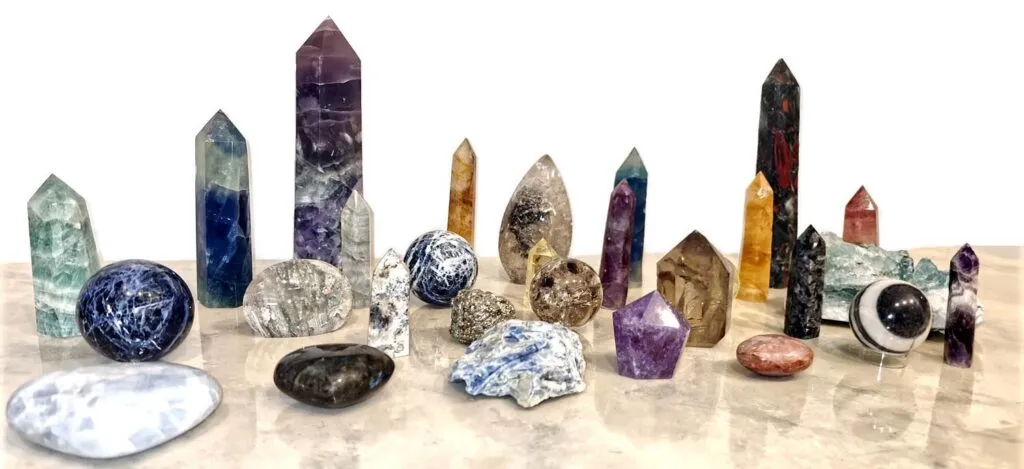
- Geodes, rounded rock formations with hollow interiors lined in crystal points, which likely inspired amethyst’s old symbolic link to hidden value and truths revealed under pressure.
- Clusters, raw crystal groupings prized for decor and left largely unpolished to show natural growth patterns.
- Faceted gems, cut and polished for rings, pendants, and earrings, where clarity and saturation drive value.
Modern supply shifted dramatically in the 19th century, when large deposits discovered in Brazil moved amethyst from a rare royalty-associated gem priced alongside ruby and emerald into something far more accessible.
Today, major sources include Brazil, Uruguay, Zambia, and Madagascar, each producing slightly different tonal ranges that collectors and jewelers learn to recognize by eye.
How Did Amethyst’s Symbolism Develop Through History?
The story starts with language. The Greek word amethystos combines a- (not) with methysko (to intoxicate), and ancient Greeks and Romans carved wine goblets from the stone, believing it would keep the drinker sober no matter how much they poured. That single etymological root still shapes how people talk about amethyst today, thousands of years later.
From there, the stone’s cultural weight only grew:
Ancient Greece and Rome treated amethyst as protection against drunkenness and its consequences, embedding it in jewelry, amulets, and drinking vessels alike.
Medieval Christianity adopted amethyst for episcopal rings, associating the purple hue with piety, humility, and the fasting seasons of the church calendar.
European royalty wore amethyst as a mark of status for centuries, a habit that held steady while the gem remained genuinely rare and costly.
The 19th century changed everything. Once Brazilian deposits flooded the market, amethyst’s price dropped and its symbolism shifted from exclusive luxury toward something a much wider range of people could wear and give as gifts.
That transition from rarity to accessibility is part of why amethyst still carries a whisper of old-world prestige while sitting comfortably in everyday jewelry boxes.
What Does Amethyst Symbolize Spiritually?
Amethyst’s spiritual reputation builds directly on its sobriety lore, expanding from “keeps you clear-headed” into a broader set of meanings people still reach for today.
The stone’s most consistent symbolic threads include:
- Sobriety and self-control, the original meaning, extended metaphorically to emotional restraint and clear decision-making.
- Calm and stress relief, a natural extension of its anti-intoxication reputation into general nervous-system soothing.
- Spiritual insight and intuition, tied to its cool violet tone, a color long linked with contemplation across a variety of traditions.
- Protection, particularly for travelers seeking guarded, steady energy in unfamiliar situations.
In crystal practice, amethyst is most often placed at the third eye or crown chakra, the two energy centers associated with intuition and higher awareness.
People who practice that belief, commonly hold or wear the stone during meditation, believing it supports mental quiet and deeper focus, though this remains a belief system rather than a measured outcome.
Amethyst is also the official February birthstone, and many astrological traditions link it to Pisces and Aquarius, two signs associated with intuition and independent thinking.
Pro Tip: If you’re new to working with crystals in meditation, start by simply holding an amethyst piece for five quiet minutes before deciding whether it changes your focus. Notice what shifts, rather than expecting a dramatic effect.
Does Amethyst Have Any Proven Healing Properties?
People commonly credit amethyst with easing headaches, improving sleep, supporting recovery from addiction, and lifting mood. Those are the most cited claims in alternative wellness circles, and they trace back loosely to the stone’s ancient anti-intoxication reputation.
Here’s the caveat worth sitting with:
There is no scientific evidence to support amethyst’s physical healing properties. The scientific community views these benefits as unproven, even though the stone remains widely used in alternative medicine for exactly these purposes.
That doesn’t make the stone’s properties any less valuable to people who find comfort in it. A psychological or ritual benefit from holding, wearing, or simply looking at a meaningful object is real, even without a clinical trial behind it.
What matters is knowing the difference: amethyst can support a calming routine or a personal ritual without functioning as medicine. On the practical side, amethyst rates 7 on the Mohs hardness scale, solid enough for daily jewelry, though softer than sapphire or diamond.
How Should You Wear, Display, and Care For Amethyst?
Buying amethyst jewelry comes down to three things: color saturation, clarity, and cut. Deep, evenly saturated purple with minimal visible inclusions commands the highest value, while paler or zoned stones (where color bands unevenly) are still beautiful but priced more modestly.
A few practical notes for living with the stone:
- Wear faceted amethyst in rings, earrings, or bracelets for everyday elegance; it handles regular wear well thanks to its Mohs 7 hardness.
- Use amethyst clusters or geodes as room decor, often placed in bedrooms or meditation spaces where practitioners want a calming visual anchor.
- Clean amethyst with mild soap, warm water, and a soft cloth. Skip ultrasonic cleaners and harsh chemicals, which can dull the surface over time.
- Remove amethyst jewelry before heavy manual work, gym sessions, or swimming, since repeated impact can chip facet edges despite the stone’s decent hardness.
An Artisan’s View On Choosing Real Amethyst
Veronique, editorial contributor at HerMJ, has spent years studying how gemstones move from raw material to finished jewelry, and that process shapes how she evaluates amethyst for design work.
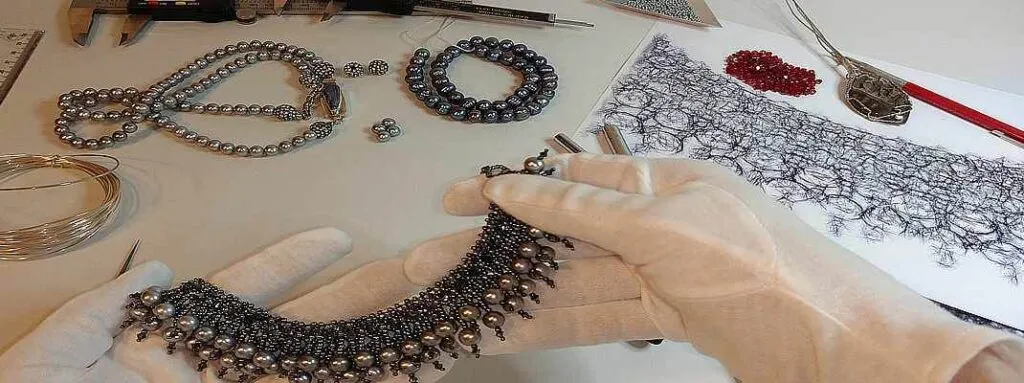
The brand specializes in artisan jewelry made from genuine pearls and gemstones, offering handmade accessories that blend elegance with personal style at accessible prices, with a focus on customizing pieces for individual tastes.
When selecting amethyst for bracelets and decor pieces, the priority is consistent color saturation across every bead or facet, since mismatched tones are the fastest way a finished piece looks cheap regardless of the raw material’s quality.

Buyers should look for clean facets without visible fractures, and settings that let light pass through the stone rather than trapping it against dark metal.
A well-cut amethyst should show a slight color shift as it moves, deep violet in shadow, brighter lilac in direct light. That’s the mark of a stone cut with the grain, not against it.
What Does Amethyst Mean In Cultures Beyond The West?
Western history tends to dominate amethyst’s popular story, but the stone carries its own symbolic weight well outside Greek and Roman lore.
In parts of East Asia, purple has long signaled nobility and spiritual attainment, and amethyst gets folded into that broader color symbolism in feng shui practice, where practitioners sometimes place the stone to support focus and calm within a room’s energy layout.
That use overlaps with Western chakra framework, but isn’t identical to it, since feng shui organizes meaning around spatial flow rather than the body’s energy centers.
Various African mining communities, particularly in Zambia, which supplies a significant share of the world’s deep violet amethyst, have built modern economies around the stone’s extraction.
This gives it contemporary economic significance alongside older spiritual associations tied to protection and ancestral connection in some regional traditions.
Indigenous communities across the Americas have historically used quartz varieties, amethyst included, in ceremonial and healing contexts, treating crystal formations as objects with inherent natural power worth respecting rather than simply decorative material.
None of these traditions map perfectly onto each other, and that’s worth sitting with rather than smoothing over.
Amethyst’s meaning shifts depending on who’s holding it and what belief system they’re standing inside, which is part of what makes the stone genuinely interesting rather than a single flat symbol.
How Does Amethyst Compare To Other Purple Gemstones?
Amethyst isn’t the only purple stone on the market, and knowing the differences helps you understand what you’re actually buying.
Tanzanite, mined only in Tanzania, shifts between blue and purple depending on the angle of light, and it carries a rarity premium amethyst doesn’t share since it comes from a single geographic source.
Purple sapphire, a corundum variety, ranks far higher on the Mohs scale at 9, making it more durable for daily rings, though it typically costs significantly more than amethyst at comparable sizes.
Iolite, sometimes called “water sapphire” despite not being a sapphire at all, offers a softer grayish violet and lacks amethyst’s deep saturation range.

Symbolically, these stones diverge too. Tanzanite carries a modern, glamour-driven reputation since its discovery only dates to the 1960s, with none of amethyst’s ancient sobriety lore attached.
Purple sapphire inherits sapphire’s broader symbolism around wisdom and royalty rather than amethyst’s specific anti-intoxication history.
Amethyst’s real advantage isn’t based on its rarity or hardness. The stone’s depth of documented cultural meaning stretching back thousands of years, paired with a price point that keeps it genuinely wearable rather than reserved for special-occasion-only pieces.
What Common Myths Surround Amethyst?
One persistent misconception treats amethyst as a rare, precious gem on par with ruby or emerald. That was true before the 19th century, but Brazilian deposits changed the market permanently, and amethyst’s modern classification places it reliably in the semi-precious category, prized for extreme beauty rather than its scarcity.
Another myth claims all amethyst forms identically in nature, when color intensity actually varies enormously by deposit, heat exposure, and iron content, which is exactly why geographic origin matters to gemologists and collectors alike.
A third misconception assumes amethyst’s calming reputation is a recent wellness-industry invention.
It isn’t.
The calming and sobriety associations trace back to actual Greek and Roman practice, not a modern crystal-shop marketing angle, even though the specific health claims made about it today go well beyond what that ancient lore actually promised.
Finally, some assume darker amethyst is always more valuable. Saturation matters, but evenness of color and clarity often outweigh raw depth of tone when gemologists assess quality.
What Actually Matters When You’re an admirer who appreciates Amethyst’s Meaning.
The gap I keep noticing between what’s written about amethyst online and what actually holds up is this: most sources either lean entirely into mystical claims or dismiss the symbolism altogether as marketing fluff.
Neither approach should be used as the standard.
The etymology is real. The Roman and Greek anti-intoxication lore is documented, not invented for a product listing.
The royal history is verifiable through gemological records. What isn’t verifiable is any physical healing mechanism, and treating those two categories, documented cultural history versus unvalidated medical claims, as separate is the single most useful thing you can do.
Where conventional advice falls short is treating amethyst as either purely spiritual or purely decorative.
It’s both, and neither framing alone explains why the stone has held meaning across so many unrelated cultures for so long. If you’re choosing a piece, prioritize what you can actually verify: color quality, cut, and provenance, then let the symbolism add meaning on top of a stone you’d want to wear anyway.
— Veronique
Where To Find Amethyst Pieces Worth Wearing
Each amethyst piece is built around the same standard Veronique described above: even color saturation, clean cuts, and settings that let the stone’s natural light-shift show through. That’s a different starting point than mass-produced jewelry, where consistency across a batch matters more than any single stone’s character.
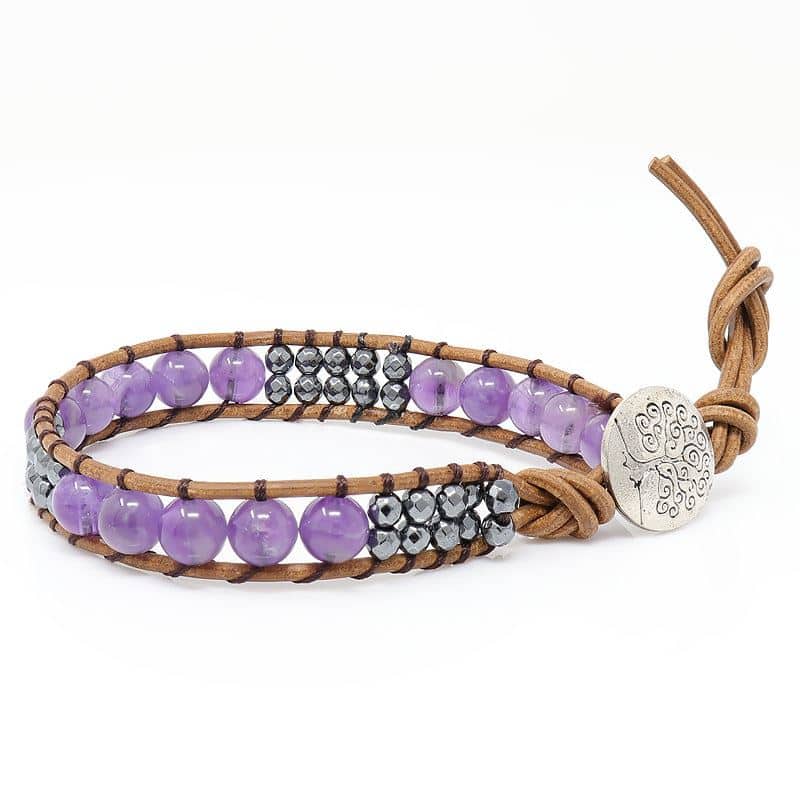
The Amethyst Stone Bracelet works well as an everyday piece, small enough for daily wear while still showing the deep violet tone that makes amethyst recognizable at a glance.
If you’re drawn to complementary gemstone tones, the Faceted Garnet Gemstone Necklace pairs warm red against amethyst’s cool purple for layering, and the Australian Opal Necklace and Moonstone Pendant offers a softer, iridescent contrast for those who want variety across a jewelry collection.
For decor rather than jewelry, browse HerMJ’s amethyst cluster pieces for meditation spaces or shelves.
US orders ship free with no minimum, and international orders ship free at $150 and above.
Check color photos closely before buying, and browse the full pearl and gemstone collection or dedicated bracelet and necklace categories to compare settings side by side before you commit.
Sources
FAQ
What Is The Spiritual Meaning Of Amethyst?
Amethyst’s spiritual meaning centers on clarity, calm, and protection, rooted in ancient Greek and Roman beliefs that the stone prevented intoxication. Practitioners today extend that into broader themes of intuition and emotional steadiness, often using it at the third eye or crown chakra during meditation.
What Does Amethyst Symbolize?
Amethyst symbolizes sobriety, mental clarity, and spiritual insight, meanings that trace directly back to its Greek name, amethystos, or not intoxicated. It also carries historical associations with royalty, protection, and, in Christian tradition, humility and piety.
What Is Amethyst Crystal Good For?
People commonly use amethyst for meditation support, stress relief, and as a symbolic reminder of clear thinking, though no clinical evidence confirms physical healing effects. It’s also simply popular as jewelry and decor thanks to its rich violet color and durability at Mohs 7.
What Is The Significance Of Wearing Amethyst?
Wearing amethyst signals a connection to its historic themes of calm and clear-headedness, and many people choose it as their February birthstone for personal or sentimental reasons. HerMJ’s Amethyst Stone Bracelet offers an everyday way to carry that symbolism without needing a special occasion.
Is Amethyst A Rare Or Expensive Gemstone?
Amethyst was as costly as ruby and emerald until the 19th century, when large Brazilian deposits made it widely available. Today it’s classified as semi-precious and priced accessibly compared to its historical rarity.
Recommended
- Meaning Of Amethyst Crystal
- Philosophy Of The Stone – Amethyst Crystal Benefits
- Amethyst Crystal Benefits
- Amethyst Cluster Decor: What It Is and How to Use It