



Labradorite Meaning: Transformation, Intuition, and How to Use It
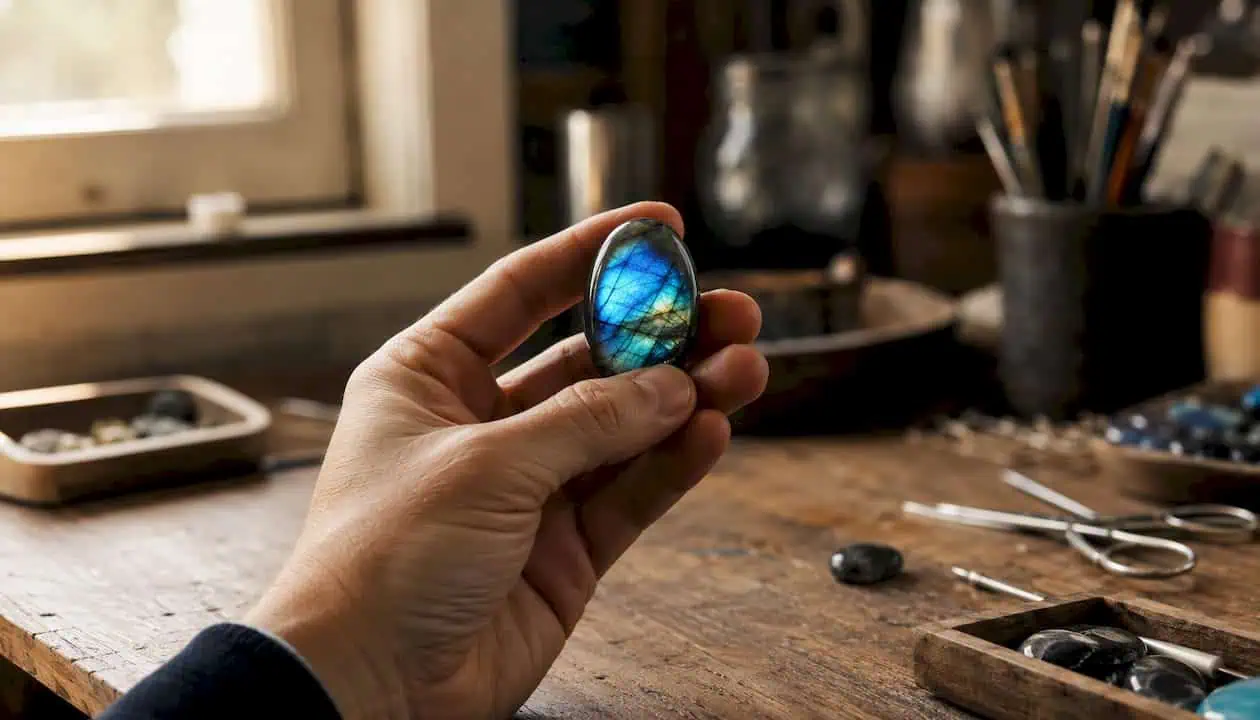
Labradorite is widely regarded as the stone of transformation, intuition, and energetic protection — and that reputation is rooted in something you can actually see. The iridescent flash inside every piece, hidden until light hits it at the right angle, has made this stone a natural metaphor for hidden potential and inner knowing.
Practitioners reach for it when they’re navigating change, sharpening intuition, or looking to shield their energy from outside noise.
Quick ways to work with labradorite:
- Wear it as a necklace or bracelet to maintain an energetic boundary throughout the day
- Hold it in your palm during breathwork or grounding exercises for somatic focus
- Place it on your desk or altar during creative work to support clarity and inspiration
- Meditate with it resting on your third eye or throat chakra to open intuitive channels
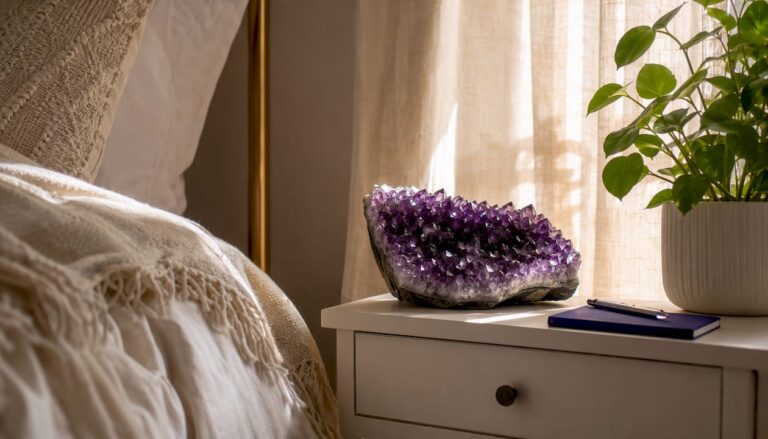
- Keep a piece near your bed to support vivid dreaming and subconscious processing
Key Takeaways
Labradorite’s spiritual meaning centers on transformation and intuition, grounded in a real optical phenomenon that makes the stone’s metaphor unusually literal: the light is always there, but you have to engage with it to see it.
| Point | Details |
|---|---|
| Stone of transformation | Labradorite is widely used for intuition, energetic protection, and navigating change. |
| Labradorescence is optical | The flash comes from internal lamellar layers, not a coating; not every specimen shows it equally. |
| Third eye and throat chakra | Most practitioners work with labradorite at the third eye for intuition and the throat for clear expression. |
| Buy for flash quality | Look for a strong, even, shifting glow and ask sellers about origin and treatments before purchasing. |
| HerMJ for handcrafted pieces | HerMJ offers genuine labradorite jewelry built for daily wear, with free US shipping and customization options. |
What is labradorite, and what makes it unique?

Labradorite is a calcium-enriched plagioclase feldspar, part of the same mineral family as moonstone and sunstone. Its anorthite content typically falls within the range common for plagioclase minerals, placing it near the middle of the series.
That chemistry, combined with the way the stone cools within igneous rock, creates its signature optical effect.
Where it’s found:
- Labrador, Canada (the original and most widely sourced deposit)
- Madagascar (popular for its strong blue flash)
- Finland (home of spectrolite, a richer, rarer variety)
- Mexico and Russia (smaller commercial deposits)
Quick identification cues:
- Base color: typically gray, dark gray, or smoky black
- Flash: a shifting iridescent glow in blue, green, gold, orange, or violet
- Hardness: 6–6.5 on the Mohs scale
- Common forms: cabochons, free-form slabs, and tumbled stones for jewelry
The Mindat specimen records show how dramatically the flash shifts with viewing angle, which is exactly what you want to observe when shopping for a piece in person or online.
What causes labradorescence?
Labradorescence is an optical interference effect, not a surface coating or dye. Light enters the stone and reflects off microscopic internal layers, called lamellar twinning planes, that formed as the mineral cooled slowly inside igneous rock like basalt, gabbro, or anorthosite. The spacing between those layers determines which wavelength of light bounces back to your eye, which is why one stone might flash deep blue while another shows gold or violet.

Not every labradorite specimen shows the effect. Stones with thicker or more irregular layers may appear dull or simply gray. When you’re shopping, tilt the stone under a single light source and look for a clean, even glow that shifts across the surface.
What controls the flash:
- Thinner layers tend to produce blue and violet tones
- Thicker layers shift toward green, gold, and orange
- Irregular or sparse layers produce little to no visible flash
Labradorite vs. spectrolite
Spectrolite is a specific, higher-grade variety mined in Finland that displays a broader, more saturated color range than typical labradorite.
Sellers sometimes misapply the term to describe any colorful labradorite, regardless of origin. True spectrolite is rarer, commands a higher price, and shows the full spectral range from deep blue through red, which common labradorite rarely achieves.
| Feature | Labradorite | Spectrolite |
|---|---|---|
| Origin | Worldwide | Finland only |
| Color range | Blue, green, gold, orange | Full spectrum including red |
| Rarity | Common | Rarer, higher value |
| Flash intensity | Moderate to strong | Typically stronger and broader |
What does labradorite mean spiritually and metaphysically?
The dominant metaphysical theme is transformation paired with intuitive clearing. Crystal practitioners describe labradorite as a stone that helps you move through change without losing your footing, clearing the mental fog that accumulates during transitions and opening the channels through which intuition speaks.
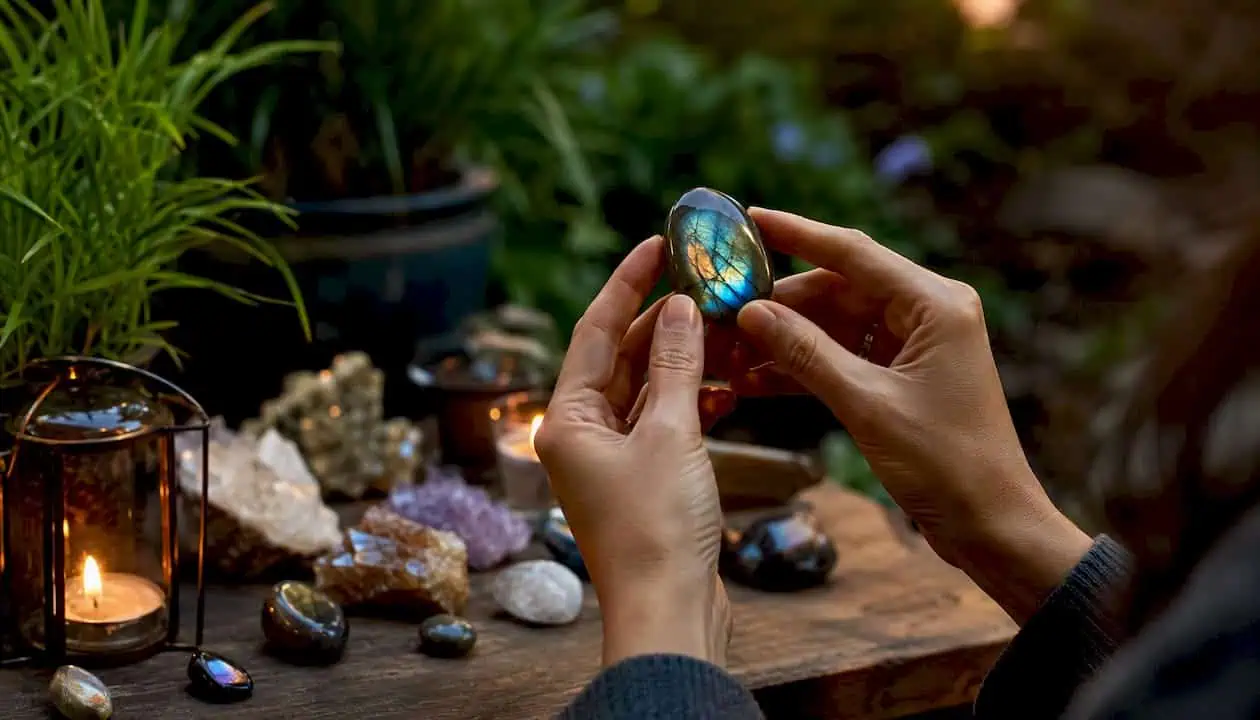
Spiritual and intuitive properties
Labradorite is most commonly associated with psychic opening, dream work, and protection of the energy field.
Practitioners use it to strengthen the connection between conscious thought and deeper knowing, particularly during periods of uncertainty. Its protective quality is described as a kind of energetic shielding: the stone is said to form a barrier around the aura that filters out draining or destabilizing influences without closing you off entirely.
Emotional and mental benefits
On the emotional side, labradorite’s significance centers on clearing self-limiting beliefs and building resilience during change.
It’s often recommended for people who feel stuck in repetitive thought patterns or who are moving through a major life shift, for a career change, a relationship transition, or a creative block. The stone doesn’t promise comfort so much as clarity: a sharper sense of what’s true and what’s just fear talking.
Chakra and zodiac associations
Labradorite is most commonly linked to the third eye chakra (Ajna), which governs intuition, inner vision, and perception.
Some practitioners also work with it at the throat chakra to support clear, authentic communication. Zodiacally, it’s most often associated with Leo, Scorpio, and Sagittarius, signs that tend toward intensity, transformation, and visionary thinking.
Practical ways to use labradorite’s metaphysical properties:
- Hold it during journaling when you’re working through a decision or a recurring fear
- Place it on your third eye during meditation and set an intention for clarity
- Keep a piece in your pocket on days when you need to hold your own energy in a crowd
- Pair it with a written intention and revisit both at the new moon
Pro Tip: Tilt the stone slowly in your palm while breathing and focus on finding the flash. The slight, deliberate movement required to locate it pulls your attention into the present moment and interrupts repetitive thought. Practitioners use this as a simple somatic anchor, no formal meditation required.
History and legends of labradorite
The most enduring origin story belongs to the Inuit people of Labrador, Canada, where the stone was first documented by Western mineralogists in 1770.
Key moments in labradorite’s history:
- 1770: Moravian missionaries document the stone in Labrador, Canada, bringing it to European attention
- Late 18th and 19th centuries: Labradorite becomes fashionable in Europe, used in jewelry and decorative objects; the Victoria and Albert Museum holds examples from this period
- 1940: Finnish spectrolite is formally named and recognized as a distinct variety after deposits are discovered in Ylämaa during World War II
- Late 20th century onward: Labradorite enters the modern crystal-healing tradition, becoming one of the most widely used stones for intuition and protection work
How to use labradorite in daily practice
The most effective everyday uses are wearing it close to the body, holding it during focused breathwork, meditating with it, and placing it in spaces where you do creative or reflective work. For home placement, a labradorite free-form piece on a desk or windowsill catches natural light and keeps the stone’s energy present in the room.
Basic meditative practice with labradorite:
Find a quiet seat and hold the stone in your non-dominant hand, or place it on your third eye if you’re lying down
Take three slow breaths, exhaling fully each time, to settle your nervous system
Set a clear intention: name what you’re seeking, if it’s clarity, protection, or openness to change
Spend 5–10 minutes in stillness, noticing any images, feelings, or thoughts that arise without forcing them
Close by thanking the stone (a simple acknowledgment of the practice) and writing down anything that surfaced
Cleansing options:
- Running water: A brief rinse under cool water works well; don’t soak it, as prolonged water exposure can affect some settings
- Smoke: Pass the stone through sage, palo santo, or cedar smoke for a few seconds
- Moonlight: Leave it on a windowsill overnight during a full moon, a gentle and reliable method
- Sound: A singing bowl or tuning fork held near the stone clears energy without any physical contact
For a broader look at how crystals fit into home and wellness routines, the HerMJ crystal uses guide covers placement and care across a range of stones.
Safety notes:
- Avoid leaving labradorite in direct sunlight for extended periods; some pieces can fade or develop micro-fractures over time
- Don’t use salt baths if the stone is set in metal, as salt can corrode settings
- Crystal practices are complementary, not a substitute for medical or psychological care
Common physical healing claims and what you should know
Physical healing claims exist around labradorite, but they’re rooted in traditional and anecdotal practice rather than clinical research. Treat them as part of a complementary wellness approach, not a medical protocol.
Commonly attributed physical benefits (traditional/anecdotal):
- Supporting hormonal balance and regulating the endocrine system
- Easing respiratory discomfort and supporting lung health
- Assisting with metabolism and digestive regulation
- Reducing sensitivity to cold and supporting the immune system during seasonal transitions
Validating the effects some experience as real in a physiological sense isn’t something crystal tradition claims to prove. The science on crystals and mood suggests that intention, ritual, and focused attention may contribute to wellbeing, but that’s a different claim than treating a medical condition.
When to see a professional: Seek medical attention for persistent pain, respiratory symptoms, hormonal irregularities, or any condition that’s worsening. A crystal won’t diagnose or treat illness, and delaying care for a serious symptom is never worth it.
How to choose quality labradorite jewelry
A quality piece shows a strong, even flash that moves cleanly across the surface when you tilt it under light. The base stone should be well-polished with no visible pits or cracks, and the setting should hold the stone securely without obscuring the flash.
Buying checklist:
- Flash quality: look for a clear, shifting glow rather than a dull or patchy shimmer
- Color range: broader color range (blue, green, gold) generally indicates better material
- Polish: the surface should be smooth and reflective, not matte or scratched
- Treatments: ask if the stone has been dyed, coated, or stabilized; natural labradorite needs none of these
- Setting stability: check that prongs or bezels hold the stone firmly
- Return policy: a reputable seller will offer one
Questions to ask a seller:
- Where was this stone sourced, and can you confirm the locality?
- Has the stone been treated, coated, or enhanced in any way?
- What’s your return or exchange policy if the piece arrives damaged?
- Is this described as spectrolite, and if so, can you confirm Finnish origin?
On the spectrolite question specifically: true spectrolite comes only from Finland and commands a premium. If a seller labels a piece spectrolite without confirming Finnish origin, that’s a red flag worth pressing on.
Care tips: Clean labradorite jewelry with a soft, damp cloth and mild soap. Skip ultrasonic cleaners, which can stress the internal layers. Store it separately from harder stones like quartz or topaz to prevent scratching.
Stones that pair well with labradorite
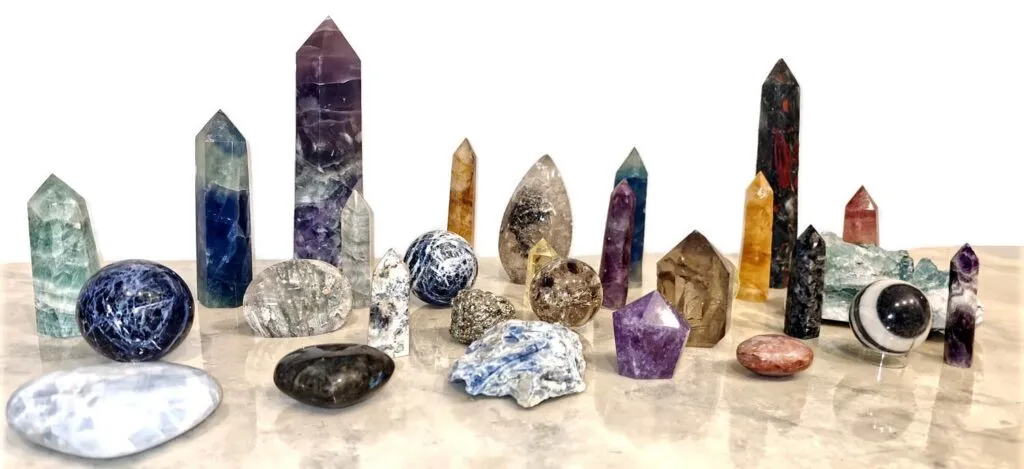
The best pairing logic is simple: choose a stone that either grounds labradorite’s visionary energy or amplifies a specific intention. Labradorite sits at the visionary end of the spectrum, so pairing it with a grounding stone creates balance, while pairing it with another intuitive stone deepens the focus.
Commonly paired stones and why:
- Moonstone: Both stones work with intuition and the subconscious; together they’re often used for dream work and emotional clarity. HerMJ’s grey moonstone bracelet pairs naturally with a labradorite piece for this purpose.
- Tiger eye: Grounds labradorite’s expansive energy and adds practical focus; a good combination for creative work that needs to produce real results. The HerMJ tiger eye bracelet works well alongside a labradorite necklace.
- Aquamarine: Supports clear communication and calm; useful when labradorite’s intuitive insights need to be expressed. The pearl and aquamarine necklace from HerMJ shows how aquamarine pairs with other stones in a single piece.
- Rose quartz: Softens labradorite’s intensity and adds emotional warmth; a good pairing for anyone working through grief or relational transitions.
- Black tourmaline: Doubles down on protection; used when energetic shielding is the primary goal.
For jewelry pairings, a labradorite necklace with a tiger eye or moonstone bracelet keeps the energies layered without overwhelming the look.
In meditation, holding labradorite in one hand and a grounding stone like black tourmaline in the other creates a circuit between visionary and grounded awareness.
For room placement, labradorite near a window and black tourmaline near the door is a classic protective arrangement.
What working with labradorite has taught me
There’s a tendency in crystal culture to treat every stone as either purely decorative or purely mystical, and labradorite gets caught in that split more than most.
What I find genuinely interesting is that the geology and the metaphor are unusually well matched. The flash really is hidden until you move. You have to engage with the stone actively to see what it holds. That’s not a poetic stretch; it’s just how the mineral works.
That physical quality is what makes labradorite’s association with hidden potential and intuition feel earned rather than assigned.
When you work with it, finding the flash becomes a small practice in attention and presence. If you approach it as a spiritual tool or simply as a beautiful object, that quality is real and repeatable.
The metaphysical community sometimes oversells the protective aspect in ways that can make people passive, as if wearing the stone is enough.
The practitioners I find most credible treat it as a prompt, not a shield. It reminds you to pay attention, to check in with your own knowing, to notice what’s shifting. That’s a different and more useful frame.
HerMJ handcrafted labradorite jewelry worth wearing every day
HerMJ makes labradorite jewelry by hand using genuine stones, so the flash you see in the product photo is the flash you get. Each piece is crafted to wear daily, not just for ritual, which means the settings are built to hold and the stones are selected for consistent, visible labradorescence.

The Labradorite Blaze Necklace and Labradorite Wanderer Necklace are both designed to keep the stone visible and active throughout the day.
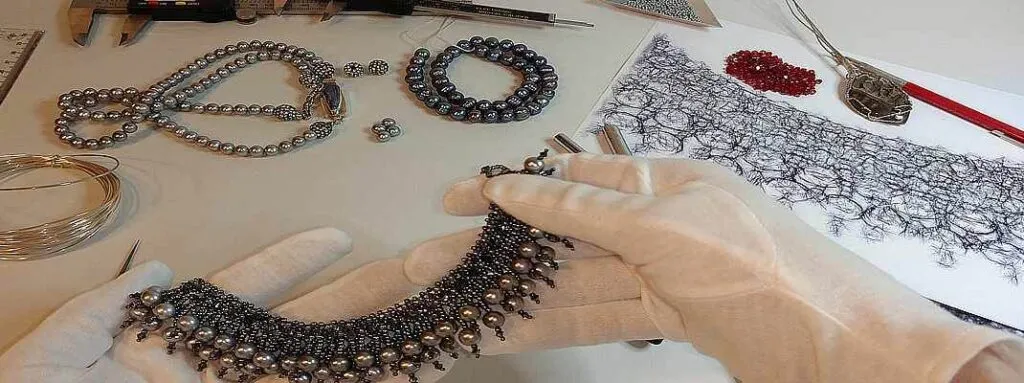
HerMJ also carries complementary pieces in pearl, garnet, and aquamarine, including the Elegant Freshwater Pearl Necklace, the Lustrous Freshwater Pearl Bracelet, the Faceted Garnet Gemstone Necklace, and the Strawberry Quartz Gemstone Bracelet, so you can build a layered set around your labradorite anchor piece.
US orders ship free with no minimum; international orders ship free on orders of $150+. Browse the full collection and find your piece at Hermj.
Sources
- Labradorite – Wikipedia
- Geology
- Crystal Almanac: Labradorite
- Difference between spectrolite and labradorite – GemrockAuctions
This article is for general informational purposes only and is not a substitute for professional medical, psychological, or legal advice. For any health concern, please consult a qualified healthcare provider.
Recommended
- How the Sodalite Gemstone Meaning Can Quiet Your Mind
- Labradorite Wanderer Necklace ✺ HerMJ
- Labradorite Blaze Necklace ✺ HerMJ
- Lapis Lazuli Properties, History, And Meaning ✺ HerMJ