



The Origin Of A Mystical Crystal – Moonstone Spiritual Meaning
Article Brief
In this article, I share the spiritual meanings and historical traditions of moonstone, from emotional balance to intuitive insight. Along with the crystal’s aesthetic, this piece presents the crystal in a new light to deepen your understanding based on the narratives behind the gem. Whether you are adding one to your collection or are an admirer, I hope this guide adds a new layer of appreciation to your journey.
Moonstone is cherished for its ethereal beauty and profound spiritual significance. Known as a stone of calmness and emotional balance, moonstone carries the soothing energy of the moon, fostering intuition and inner peace.
Its calming influence is believed to enhance clarity and vision, particularly in decision-making, aligning wearers with true intentions and providing a shield against negative energies.
For those drawn to the philosophical aspects of gemstones, moonstone spiritual meaning offers both an aesthetic allure and a deep connection to cycles, much like the phases of the moon, and the natural ebb and flow of life’s energies.
Wearing moonstone jewelry is an invitation to embrace inner harmony, inviting a reflective perspective on the spiritual dimensions of life
Moonstone Gemstone Characteristics
With the inner layers creating a soft, shimmering effect reminiscent of the moon’s glow, moonstone crystals typically range in color from blue to white.
These stones exhibit a subtle luminosity that makes them highly desirable for jewelry such as pendants and earrings. With a durability rating of 6-7 on the Moh scale, moonstones are resilient enough for everyday wear, making them ideal for crafting into striking pieces.
Their distinct beauty and rare optical characteristics make moonstone gemstones a captivating choice for those who appreciate the aesthetic and natural allure of gemstones in jewelry.
The Magic Of Moonstone Adularescence
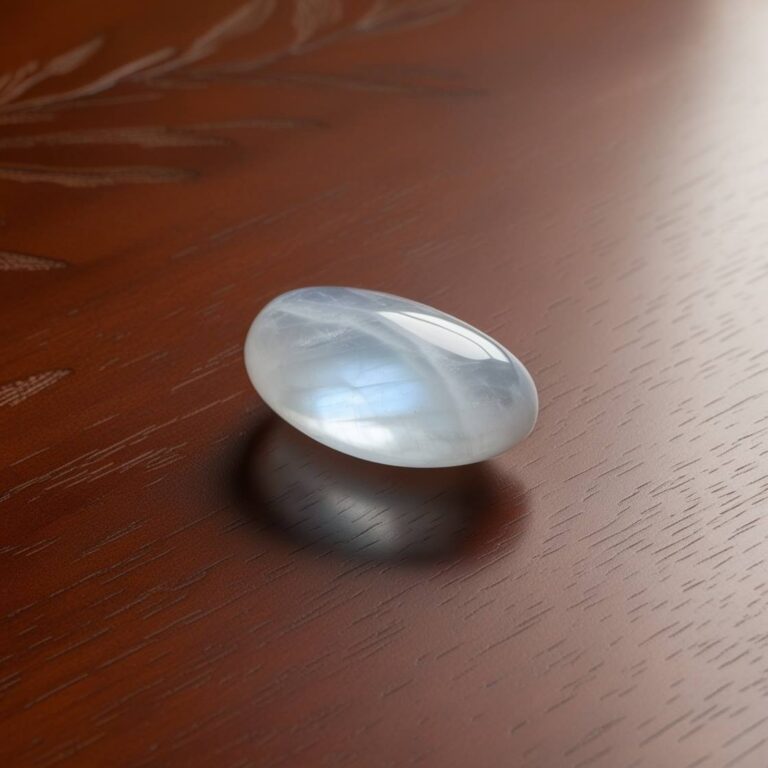
As I look up at the waning moon, I think of the magical gem. Belonging to the feldspar family, moonstones are feldspars and feldspar-like minerals that are the most common of all crystalline minerals and constitute approximately 60 percent of the Earth’s crust.
The stone’s rainbow shimmer possesses an optical phenomenon known as adularescence, which is visible in the presence of light.
This phenomenon, in honor of Mount Adular in Switzerland, was named after the valuable feldspar reserves found at the mountain’s foot.
The translucent blush from deeper within the gem’s surface is at once romantically captivating and breathtaking, like light floating on the water.
Adularia Moonstone
Sometimes called “adularia,” the stone’s luminance, or light of the adularescence, dances across it, creating a wondrous inner glow, evoking the image of ancient balconies, roses, and reflections shimmering on a lake. Quite mystically, this effect is only revealed once the stones are cut and polished.
Adularia moonstone, characterized by its semi-transparent, pale gray, silvery-white, or blue luster, is primarily found in Sri Lanka, Burma, India, and Madagascar.
Canada’s Albite moonstone, also in the feldspar group, is semitransparent and known for its pale, muted reflection. In the United States, the history of the gemstone can be traced back to New Mexico in the 1960s and well beyond.
Selene the Goddess: Moonstone Metaphysical Properties
During the early centuries, the moonstone’s spiritual meaning was prized by Roman and Greek societies, which associated it with lunar Deities. Famous among them was Selene, the Greek Goddess of the Moon, who fiercely drove across the nighttime skies.
There was even a Roman belief that Moonstone’s formation came from drops of moonlight, as well as its direct association with love itself.
It was believed that the gemstone’s appearance transformed in conjunction with the waxing and waning of the moon. Some also saw the moon Goddess, Diana, looking out from her captured dwelling within the stone itself.
To this day, moonstone is widely believed to bring good luck to its owner.
Considered sacred in India, where it has been used in jewelry for centuries, it is often given as a traditional wedding gift, transferred from the sacred yellow cloth of their tradition, to become a prized gift at a wedding ceremony.
Moonstone Origins And Discovery: Lalique, Pioneer of Modern Jewelry

Moonstone became extremely popular during the Art Nouveau period (c. 1890-1910), made famous by French Goldsmith René Jules Lalique (6 April 1860- 1 May 1945), known as a pioneer of modern jewelry.
His exploration of the depths of Moonstone focused on ways to make a new statement, causing him to turn away from more commonly used stones such as diamonds. Using stones for their power, light, and color, whether they were precious or not, his creativity inspired him into the world of glass, for which he and his immortal works are today known simply as “Lalique.” His beautiful jewelry creations include moonstone tiaras, brooches, rings, necklaces, and pendants.
Rainbows And Colors In Moonstone Gemstone Characteristics
Moonstone can be found in various colors, including peach, gray, brown, black, pink, and blue, as well as the rarest green. The June birthstone has a hardness of 6 to 6.5 on the Mohs scale. It is among my favorites and is often used in my designs.
Rainbow Moonstones frequently possess heavy inclusions, particularly in their larger specimens. Resembling centipedes, internal perpendicular lines form inclusions that cause the stones to produce their rainbow sheen, which has become their hallmark.
Ironically, when Rainbow Moonstone shows fewer inclusions, the result is correspondingly fewer colors, so a cleaner gemstone will tend to exhibit a blue sheen, rather than the coveted rainbow-colored reflections.
Of the various varieties, the Blue Flash Moonstone is primarily from Sri Lanka, while the Rainbow Moonstone is commonly associated with India, which is also home to the more abundant, though less glamorous, pastel-colored translucent Moonstone variety.
Moonstone Crystals In History
The largest Moonstone on record was found in 1918, discovered by the first Japanese Expedition to Mt. Kilimanjaro, the highest mountain in Africa.
The stone, weighing approximately 450 carats, was extracted from Mount Kilimanjaro in Tanzania, near the border with Kenya. It must have been an experience finding a stone of that magnitude, not to mention the task involved in carrying it back down the mountain.
Moonstone’s prodigious history also made it the Florida State Gemstone from the 1970s, due to the Moon landings launched from Florida’s Kennedy Space Center.
Knowing all of this, the next time you look at this brilliant gem, consider its spiritual meaning, and you’ll probably see it in a whole new light.
Frequently Asked Questions
Discover The Beauty Of Natural Gemstones
Explore HerMJ’s collection of gemstone crystals