


Mother of Pearl vs Pearl: What Sets Them Apart
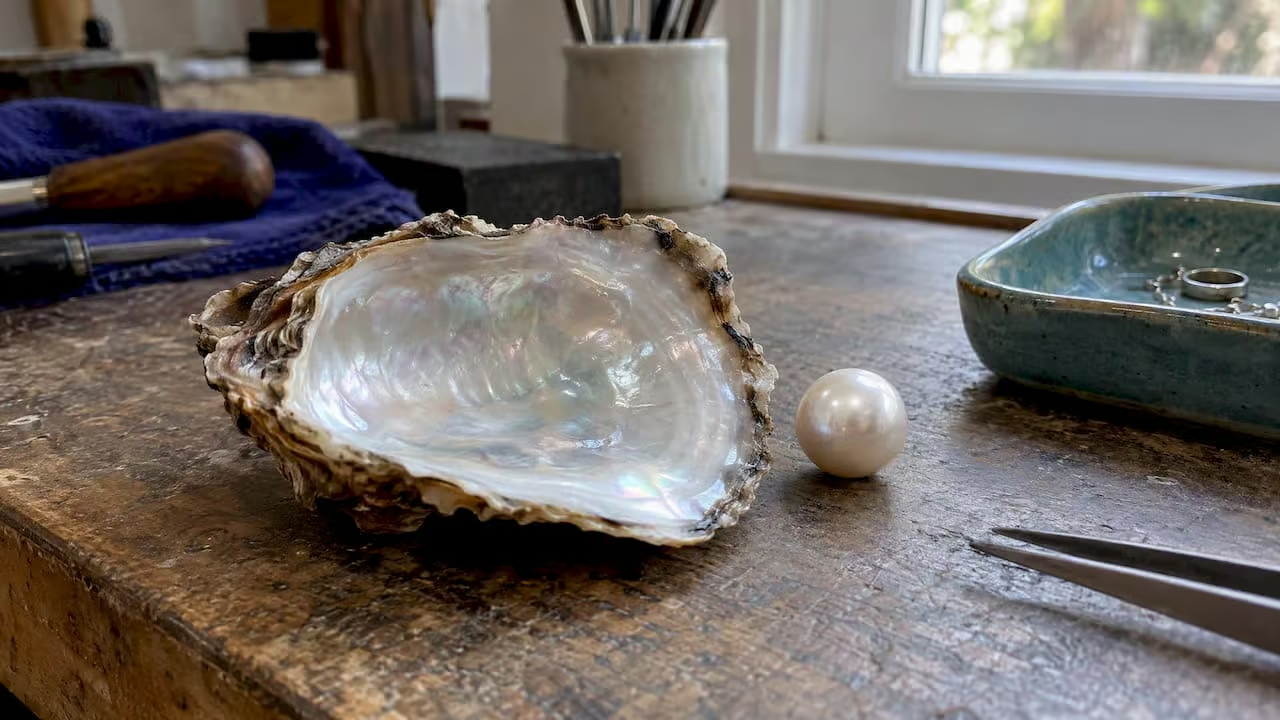
Mother of pearl and pearls are made of the same material, but they aren’t the same thing.
Mother of pearl is the iridescent inner layer of a mollusk’s shell.
A pearl is a separate, rounded gem that grows inside the animal. Both are nacre, which explains the shared glow, yet they differ in how they form, how they look, what they cost, and how you wear them.
I’m a jeweler and designer, and I get this question all the time. Below, I’ll explain the difference in plain terms so you can shop with confidence and choose the one that suits your style.
TL;DR:
- Mother of pearl is the shell’s lining, described by the International Gem Society as the iridescent inner nacre layer. A pearl is a separate concretion formed inside the mollusk.
- Pearls have a soft, glowing luster and a dimensional shape. Mother of pearl is flat and shows shifting, rainbow-like color.
- Pearls are generally the more valuable of the two, and their price depends on size, shape, color, luster, surface, nacre, and matching.
- Both are soft and organic, so both like gentle handling, but a pearl’s nacre is absorbent and reacts to perfume, hairspray, and chlorine.
- Choose pearls for classic, sculptural jewelry. Choose mother of pearl for flat, shimmering accents like inlays and pendants.
The simple difference: shell lining versus gem
Picture an oyster or mussel. The inside of its shell is smooth and shimmering.
That’s mother of pearl.
The animal’s mantle tissue builds it layer by layer, and research on shell formation shows that the inner nacreous layer is formed by the mantle’s inner zone.
A pearl is something else. The same mantle tissue forms a small sac inside the animal and deposits shell-like material around a center.
The scientific review in Current Biology offers a lovely way to picture it: a pearl is essentially an inside-out shell.
That’s why you might have heard the old saying that “if pearls are the babies, mother of pearl is the mother.” It’s an interesting image, and it holds up. One is the home, the other is the treasure grown inside it.
How each one forms
How a pearl forms
GIA explains that natural pearls form in a mollusk’s mantle tissue, usually around a microscopic irritant, without any human help.
Cultured pearls begin differently: a person implants mantle tissue, and that tissue secretes nacre to form the pearl.
The Natural History Museum frames this as a defensive response. The animal coats an irritant or injury in nacre to isolate it. Layer after layer, a gem appears.
That’s why I call pearls “living” gems. They’re grown, not mined or cut, and each one carries the story of how its host built it.
How mother of pearl forms
Mother of pearl doesn’t need an irritant. Most mollusks line their shells with it as a matter of course, which makes the material far more common than a pearl.
Artisans harvest it from shells, then cut, polish, and shape it into pieces such as buttons, inlays, pendants, and beads.
How rare is each?
The rarity gap is dramatic. The International Gem Society says that in wild populations, only one in several million mollusks ever produces a pearl.
AGTA estimates natural pearl formation at about one pearl per 10,000 shells and notes that most pearls sold today are cultured.
Those two figures measure different things, but the message is the same: natural pearls are scarce, and cultivation made pearl jewelry accessible.
Mother of pearl sits in the shell of most mollusks that make nacre. It’s abundant by comparison.
Appearance: soft glow or rainbow shimmer
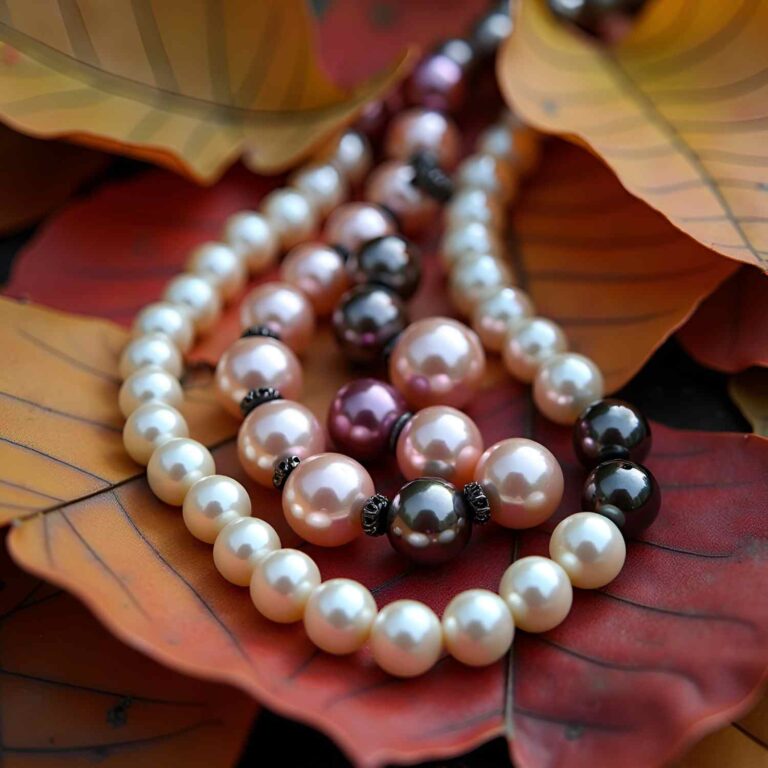
Put a strand of pearls beside a mother-of-pearl pendant, and the difference is easy to see.
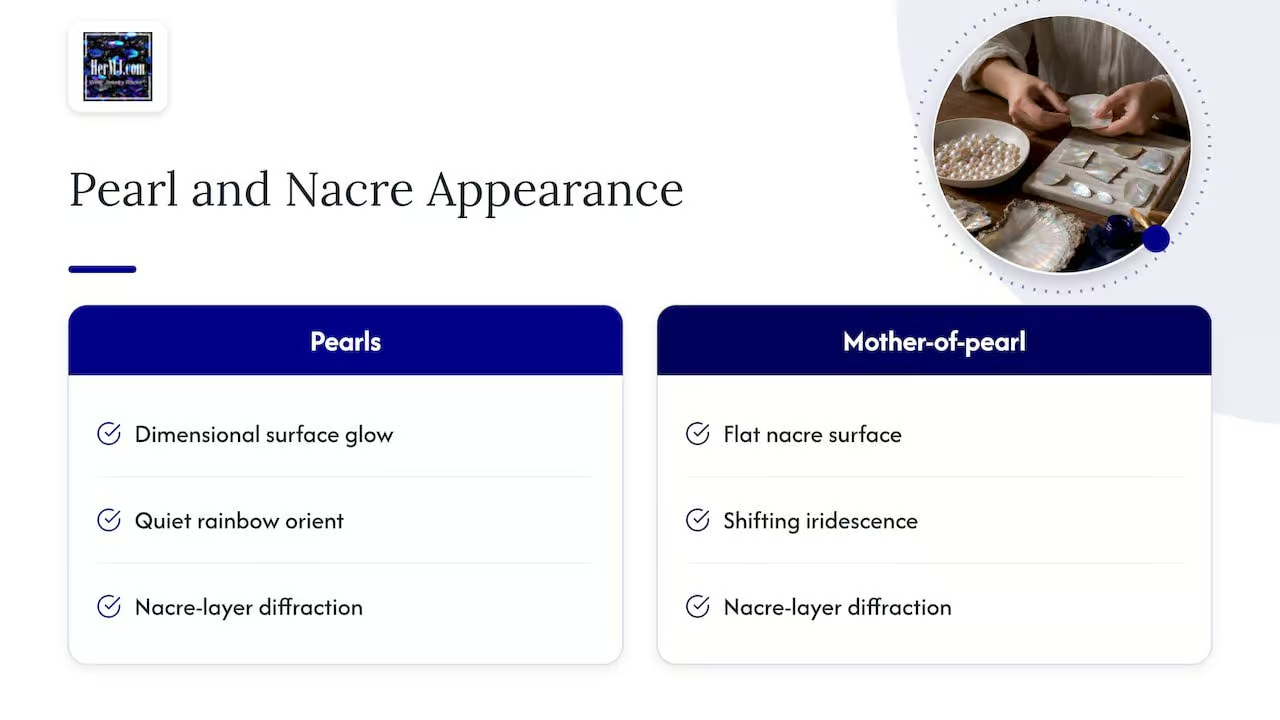
Pearls glow. GIA defines luster as the intensity of light reflected from the surface, and excellent luster gives sharp, bright reflections.
Many pearls also show orient, the iridescent rainbow colors at or just below the surface. On a fine pearl, though, the effect is quiet, like light resting on silk.
Mother of pearl shimmers. Because it’s a flat surface, it throws color around as you move it, shifting between pinks, greens, blues and creams. The International Gem Society notes that nacre’s thin aragonite layers create diffraction, which produces a pearl’s luster, and that mother of pearl is likewise valued for its iridescence. Same physics, different stage.
Shape and dimension
Shape is the biggest visual clue. Pearls come in a variety of colors and forms, from perfect spheres to baroque shapes, according to GIA‘s. The group classifiies and sorts pearl shapes into round, near-round, button, drop, oval, semi-baroque and baroque.
Mother of pearl has no such range of natural forms. It’s a flat sheet, so its shape comes from the carver. You’ll see discs, petals, carved flowers, tiny tiles and polished slices.
That’s the simplest rule I give customers: if it’s round, domed or irregularly sculptural, it’s a pearl. If it’s flat and shimmering, it’s likely mother of pearl.
Side-by-side comparison
| Feature | Pearl | Mother of pearl |
|---|---|---|
| What it is | A gem grown inside the mollusk | The iridescent inner lining of the shell |
| Shape | Round, drop, oval, button, baroque | Flat; shaped by the carver |
| Look | Soft, deep luster, sometimes with orient | Bold, shifting iridescence |
| Rarity | Natural pearls are rare; most are cultured | Common in nacre-producing shells |
| Value drivers | Size, shape, color, luster, surface, nacre, matching | Color play, thickness, craftsmanship of the carving |
| Typical use | Strands, earrings, pendants, bracelets | Inlays, pendants, buttons, decorative objects |
Is mother of pearl or pearl more expensive?
Pearls usually cost more, and the reasons are logical. A pearl is a one-of-a-kind grown object, and finding a matched set takes time.
GIA lists size, shape, color, luster, surface quality, nacre thickness and matching as the factors that affect pearl quality and value.
Spherical pearls are generally the most valued, though symmetrical drops are also sought.
That list is why a quick glance isn’t enough. Two pearls of the same size can sit at very different prices because one has a cleaner surface or a brighter luster.
If you want to go deeper into this framework, my guide to the seven GIA value factors in cultured versus natural pearls covers each one.
Mother of pearl is generally the more modest material. Its price tends to follow the quality of the carving, the depth of the color play and the metal it’s set in, rather than the scarcity of the raw material.
Neither is simply “better.” A well-made mother of pearl piece will beat a poor pearl every time. The question is what you want to wear.
Durability and everyday wear
Both materials are organic, and both are softer than most gemstones. Treat them like fine art, not like a diamond.
Where they differ is exposure. A pearl is a full sphere, so every side meets the world: your skin, your perfume, your clothes. AGTA warns that a pearl’s nacre is absorbent and can be affected by cosmetics, hairspray, perfume, ammonia and chlorine.
Mother of pearl pieces are often flat and set in a bezel or glued onto a backing, so less of the surface is exposed, but the same chemical cautions apply. My piece on wearing pearls and perfume together explains how to do it without regret.
Caring for each one
The care routine for both comes down to gentleness. I’ve covered the full pearl method in our guide to cleaning pearls safely, so I won’t repeat it here. The short version for either material: avoid ultrasonic and steam cleaners, because the International Gem Society points out pearls are heat-sensitive, and keep the jewelry away from harder gems and metals that can scratch it.
AGTA recommends storing pearls separately for exactly that reason, and our pearl storage tips show practical ways to do it.
If you’re worried about discoloration, here’s how pearls and tarnish actually interact.
How they’re used in jewelry and decor
Pearls are the natural star of strands, necklaces, bracelets and earrings. The International Gem Society notes that they appear commonly in strands, rings, earrings and other jewelry, while mother of pearl is cut or shaped for jewelry and decorative objects, including inlays and ornamental pieces.

There’s also a meeting point. Some pearl styles use both materials together.
The University of Texas gem notes explain that mabe pearls may have a mother-of-pearl backing, and blister pearls are hemispherical and used where only a half-pearl is needed, as in earrings.
This means that you may own a pearl piece including a little mother of pearl without knowing it.
If you want pearl earrings that match your face and occasion, this guide to pearl earring styles from 4 to 12mm will help you choose between studs, drops and hoops.
Who can wear mother of pearl?
Almost anyone. Mother of pearl is a natural, lightweight, smooth material, and it suits every skin tone because its iridescence picks up the colors around it. It works for daytime and evening, and it layers well with other pieces.
A few practical points make wearing it easier:
- Allergies: The shell itself is rarely the issue. Reactions are more commonly linked to the metal it’s set in. If your skin is sensitive, ask about the metal before you buy, and see a dermatologist if you’ve had reactions to jewelry before.
- Knocks and chemicals: By now, you know the rule: take it off before the gym, cleaning, swimming or anything that involves chemicals or hard impacts, just as you would with pearls.
- Flat surfaces scratch: A large flat piece shows scratches more readily than a rounded one, so store it away from other jewelry.
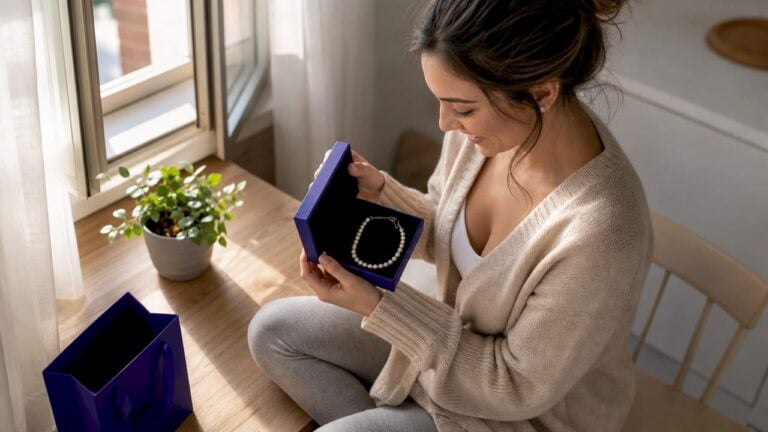
- Gifting: Both materials carry a gentle, timeless message, which is part of why they’re so popular for gifts. They’re almost a staple for milestone moments, with mother of pearl for casual, playful pieces.
How to tell whether mother of pearl is real
This is a question I get from people who’ve inherited a piece or bought one online. A few clues help, though none is a lab test.
- Look for shifting color. Real nacre shows changing hues as you tilt it. Plastic imitations tend to show a flat, uniform sheen.
- Check the edges. On a real shell, you can sometimes see fine layering at a cut edge, and the surface has slight natural variation.
- Feel the temperature. Shell feels cool and stays cool longer than plastic against your skin.
- Expect imperfection. Perfectly identical pieces in a bulk lot are a hint of molded or coated material.
For anything valuable or antique, a qualified gemologist can confirm what you have. The same goes for pearls: because pearl value depends on so many factors working together, an appraisal from a trained professional is the reliable way to know.
HerMJ’s perspective
I work with freshwater pearls every day, and love them for the same reasons you probably do: they’re real, they’re individual, and they flatter nearly everyone.
When customers ask me to choose between pearls and mother of pearl, I ask a different question: what do you want the piece to do?
If you want a piece that frames the face, catches soft light and feels classic, a pearl is hard to beat.
Freshwater pearls are especially approachable, because they bring that depth of luster at prices that don’t require saving for years.
That’s central to what we do at HerMJ: handmade pieces with genuine pearls and gemstones, made to feel special without the luxury markup.
If you want a flat shimmer, a graphic shape or a playful accent, mother of pearl is lovely, and we think it deserves respect rather than dismissal as a “lesser” material.
The mistake we see most is a shopper paying pearl prices for something that isn’t a pearl, or ignoring a beautiful pearl piece because they assumed all nacre is the same.
Knowing the difference protects your budget and your taste.
One more thought from the bench: whichever you choose, wear it. Pearls in particular enjoy being worn, because skin’s natural moisture helps keep them in good condition. A piece kept in a drawer is a piece nobody enjoys.
— Veronique
Choosing pearl jewelry that fits your life
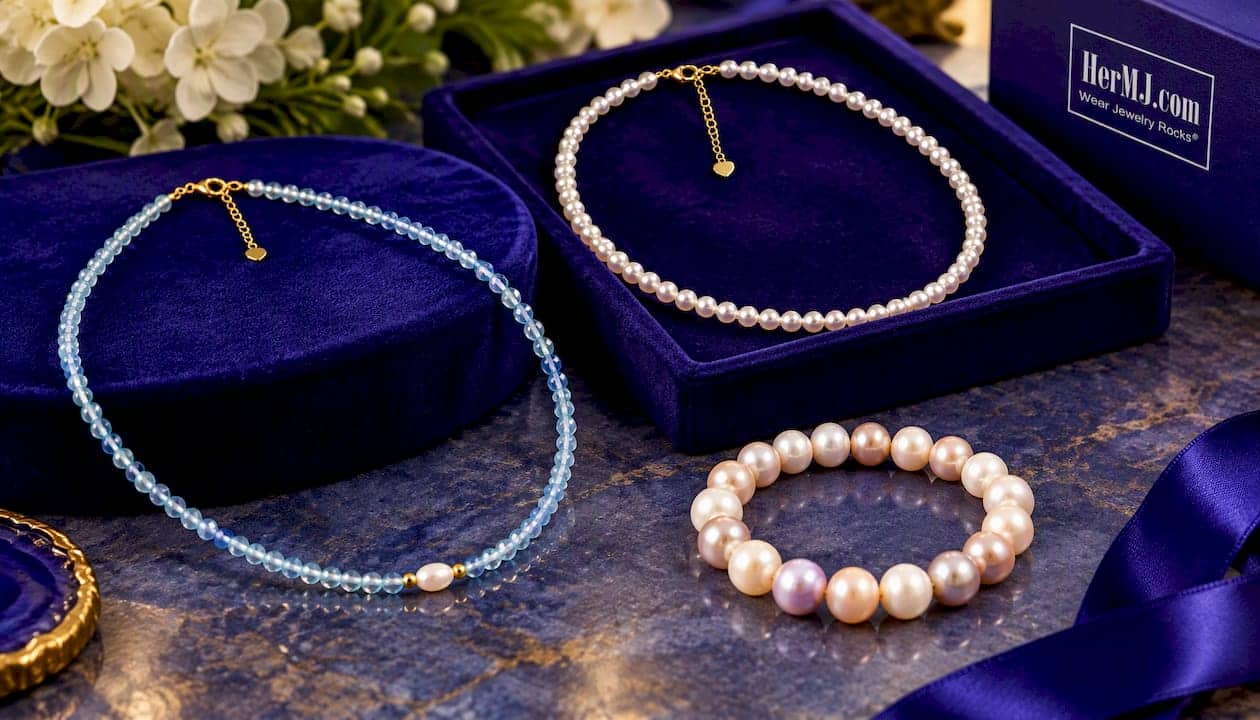
If you’ve decided pearls are what you’re after, we make it simple. HerMJ designs handmade pearl and gemstone jewelry, and you can browse necklaces, bracelets and modern drop earrings.
Good places to start are the Elegant Freshwater Pearl Necklace for a timeless look, or the Pearl and Aquamarine Necklace if you like a little color. US orders ship free with no minimum, and international orders ship free at $150 or more.
You can see everything on HerMJ’s main shop page.
Quick tips for choosing
Start with the occasion. For weddings, anniversaries and daily staples, pick pearls. For beach days, casual outfits and artistic statement pieces, mother of pearl is a fun choice.
Next, think about the shape you like. If you love rounded, dimensional jewelry, pearls fit. If you like flat, graphic shapes, mother of pearl does.
Finally, weigh your lifestyle. If you can put pieces on last and take them off before activities, either material will last. If you want to learn the full range of pearl varieties first, our visual guide to different types of pearls is a good companion.
FAQ
Is mother of pearl the same as a pearl?
No. Mother of pearl is the iridescent nacre that lines the inside of a mollusk’s shell. A pearl is a separate gem that grows inside the mollusk. Both are made of nacre, which is why they share a glow.
Is mother of pearl or pearl more expensive?
Pearls generally cost more. Their value depends on size, shape, color, luster, surface, nacre thickness and matching, and fine natural pearls are rare. Mother of pearl is more abundant, so its price mostly reflects the carving and the setting.
How rare is mother of pearl?
Most mollusks that make nacre line their shells with it, so it’s far less rare than pearls. AGTA reports that natural pearl formation in the wild is about one pearl in 10,000 shells, and most pearls sold today are cultured.
Can you wear mother of pearl every day?
Yes, with sensible habits. Put it on after makeup and perfume, remove it before exercise or cleaning, and store it away from harder gems. If your skin reacts to some metals, check what the piece is set in.
Sources
- GIA: Pearl types and colors
- GIA: Pearl gemstone overview
- GIA: Pearl Quality 101
- International Gem Society: Pearl value, price and jewelry information
- AGTA: Pearls
- Current Biology: Pearls
- Natural History Museum: How do oysters make pearls?
- University of Texas: Pearl gem notes
Recommended
- Saltwater vs Freshwater Pearls – A tale of Two Pretties
- Akoya vs Freshwater Pearls: How to Choose Yours
- Different Types of Pearls: Your Complete Visual Guide
- The difference between freshwater and saltwater pearls