


Pearl Luster vs Nacre: What’s the Difference?
Nacre is the substance a pearl is made of, built up layer by layer. Luster is what you see when light bounces off those layers. One is the material, the other is the glow, and they’re so closely linked that a pearl with poor nacre rarely shines the way you’d hope. I’ve spent years handling pearls, and this distinction helps buyers most because once you understand it, you can pick a pearl you’ll love for a long time.
TL;DR:
- Nacre is the layered material that forms a pearl. Luster is the intensity of light reflected from its surface and its inner layers.
- Thicker, well-formed nacre generally gives a deeper, more dimensional glow. A dull, chalky look or a visible nucleus points to thin nacre.
- GIA rates luster on a five-step scale from Excellent to Poor, and since 2025, it has used the same five-step scale for nacre.
- You can judge both at home: look for sharp reflections, an even glow as you turn the pearl, and a surface free of heavy marks.
- Luster is your quickest clue to nacre quality, which makes it a smart first check when you shop.
What nacre actually is
Nacre is also called mother-of-pearl. The Natural History Museum explains it as a product of oysters and mussels that slowly secrete layers of aragonite and conchiolin. The same materials that make up their shell. The mollusk wraps an irritant to protect itself from the intruder. Over months and years, those layers build up into a pearl.
I like to call pearls “living” gems for exactly this very interesting reason. No cutter shapes them. A mollusk builds each one, coat by coat, and that growth pattern determines much of what you’ll see later. GIA describes nacre as the substance that makes up a pearl, and it stresses that thickness matters when you evaluate nacre, so cultured pearls turn out durable as well as beautiful.
If you’d like to see how this material differs from the pearl itself, my guide to mother of pearl vs pearl walks through it.
What luster actually is
Luster is how a pearl handles light. The GIA defines it as the intensity of light reflected from the pearl’s surface, and it notes that different pearl varieties have their own standards for luster. A bright pearl shows clear, crisp reflections of nearby objects. A weak one looks flat, like a pale bead.
The glow doesn’t come only from the surface. GIA explains that luster results from light reflecting off the surface and from the concentric inner layers of nacre, much like light bouncing off a convex mirror. That’s why a fine pearl seems to glow from within instead of simply shining on the outside.
There’s an iridescent side to this, too. GIA’s research team notes that nacreous pearls show a distinctive glow and iridescence as light diffracts through microscopic layers of calcium carbonate. Those tiny layers are why a pearl can carry soft hints of rose, cream, or green that shift as you move.
Luster vs nacre: how they connect
Think of nacre as the cause and luster as the effect. Nacre is the building material. Luster is how well that material returns light to your eye.
| Nacre | Luster | |
|---|---|---|
| What it is | The layered material a pearl is built from | The light a pearl reflects |
| How it forms | Mollusk secretes layers over time | Results from surface and inner layers working together |
| What you notice | Thickness, continuity, a visible core or none | Brightness, sharpness of reflections, glow |
| What it affects | Durability and appearance | Beauty and value |
| How it’s graded | GIA nacre scale, Excellent to Poor | GIA luster scale, Excellent to Poor |
GIA’s Pearl Quality Factors page confirms that luster and nacre quality are closely related. If a nucleus shows through, or the pearl looks dull and chalky, you can assume the nacre is thin, and that affects both luster and durability.
So can a pearl have fine nacre and middling luster? Yes, and that’s where the two ideas separate. Luster also depends on surface smoothness and how regularly the layers formed. A pearl with good material can still look softer if its surface is rough in places. That’s why I never judge by one factor alone.
What thin nacre looks like and why it matters
Thin nacre is the one flaw that shows up in both looks and longevity. Here’s what I watch for.
A visible core
When the nucleus shows through the coating, the pearl can look slightly gray or flat in one area. As you turn it, you may see a faint shadow or a color change. A May 2026 buyer guide on assessing nacre depth says the same: thin nacre lets the central core cast a shadow, and color and luster shift as you turn the pearl, while thicker nacre transmits light evenly.
A dull, chalky surface
Chalkiness is the other clue. The pearl looks pale and papery instead of luminous. Reflections are blurry, and you can’t quite make out the shape of a window or lamp in the surface.
Durability
GIA’s chief laboratory officer, Tom Moses, said in a May 2025 announcement that nacre formation shapes factors like size, shape, luster, and surface quality, and that nacre thickness and continuity also affect a pearl’s durability. In everyday terms, a pearl with sturdy nacre is better prepared for the small knocks of regular wear.
How GIA grades luster and nacre
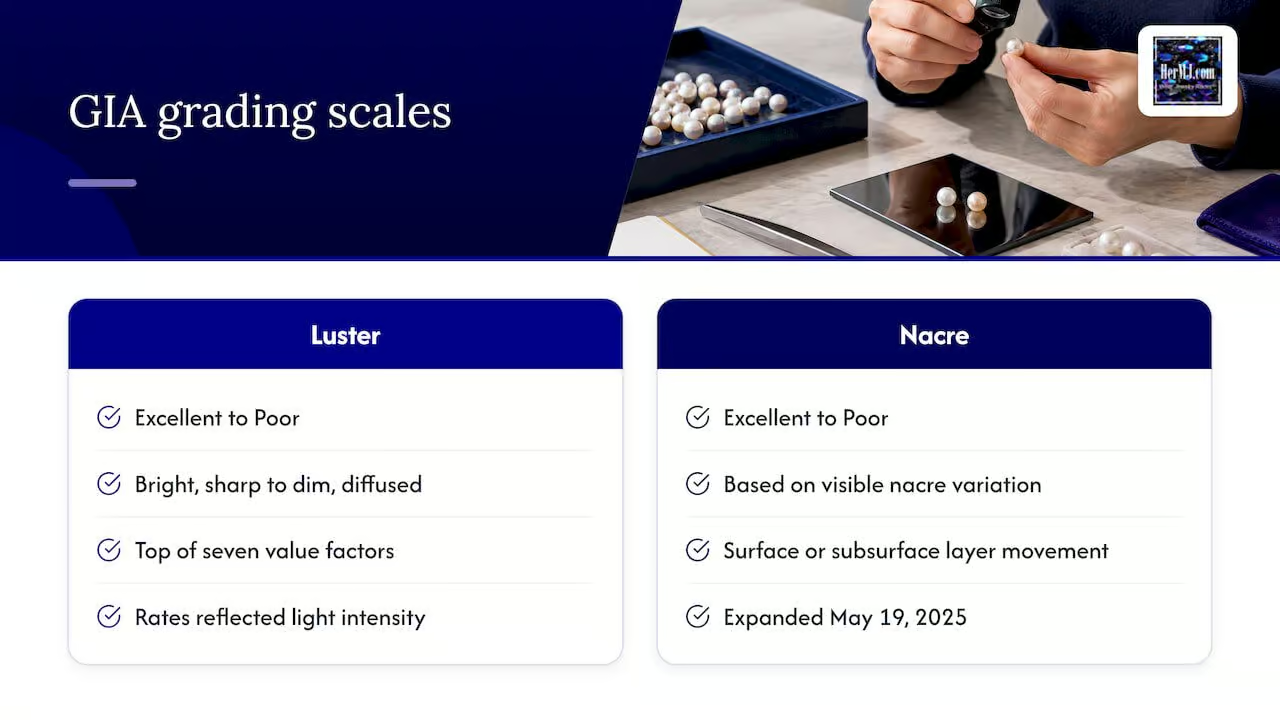
If you want a shared vocabulary for shopping, GIA’s scales are the best reference. GIA ranks luster as the most important of its seven pearl value factors. The luster scale runs from Excellent, where reflections look bright and sharp, down through Very Good, Good, and Fair, to Poor, where reflections look dim and diffused.
Nacre has its own scale now. On May 19, 2025, GIA announced an expanded nacre scale that replaced the old Acceptable and Unacceptable labels with five ranges: Excellent, Very Good, Good, Fair, and Poor. The ranges are based on eye-visible movement (what GIA calls nacre variation) on the surface or subsurface layers.
You won’t see a lab report on every strand you shop for, and that’s fine. What matters is that you now know what the professionals look at. For a wider look at how all the value factors fit together, see my overview of pearl grading.
A surface quirk that fools the eye
Sometimes a pearl with perfectly good nacre looks a little softer than it should. GIA’s Summer 2025 Gems & Gemology coverage describes a feature called hammering, a hammered-metal look on the surface. It disperses reflections, so luster seems softer than it really is, and it’s commonly associated with very rapid pearl growth rather than steady, regular crystal formation.
Surface marks in general deserve a sensible perspective. GIA notes that if surface characteristics are numerous or severe, they can strongly affect durability and value. If they’re few or minor, or hidden by a drill hole or mounting, they have much less effect on beauty and value. A tiny mark near the drill hole shouldn’t worry you. A cluster across the face of the pearl is another story.
How to judge luster and nacre yourself
You don’t need a loupe. You need decent light and a minute of patience.
- Find a window or a bright lamp. Hold the pearl a few inches from your eye and look for the reflection. On a bright pearl, you’ll see its outline clearly.
- Check the edges of the reflection. Sharp edges signal strong luster. Fuzzy, washed-out edges suggest a softer finish.
- Turn the pearl slowly. The glow should stay even. If the color flickers or you catch a darker patch, a core may be showing.
- Look for chalkiness. A pearl that looks powdery in daylight usually means its nacre is thin.
- Compare several pearls on one strand. A good strand looks consistent. Pearls that vary widely in brightness can make a necklace look uneven.
- Scan for surface marks. Note where they sit. Near the drill hole is forgivable. Across the center isn’t.
I also tell customers to look at pearls against skin. A pearl on a white cloth can look brighter than it will at your collarbone, so check it against something closer to how you’ll wear it.
Does pearl type change the answer?
It does, because different pearl varieties carry different luster standards, as GIA points out. A bold, mirror-like shine is one style, and a softer, silkier glow is another. Neither is wrong. What you want is a clean, even glow for that type of pearl.
If you’re still choosing between types, my comparison of Akoya vs freshwater pearls covers the differences in look and wear. And if you’re curious why shoppers sometimes overlook pearls entirely, why pearl jewelry is undervalued explains what buyers miss.
Keeping luster alive
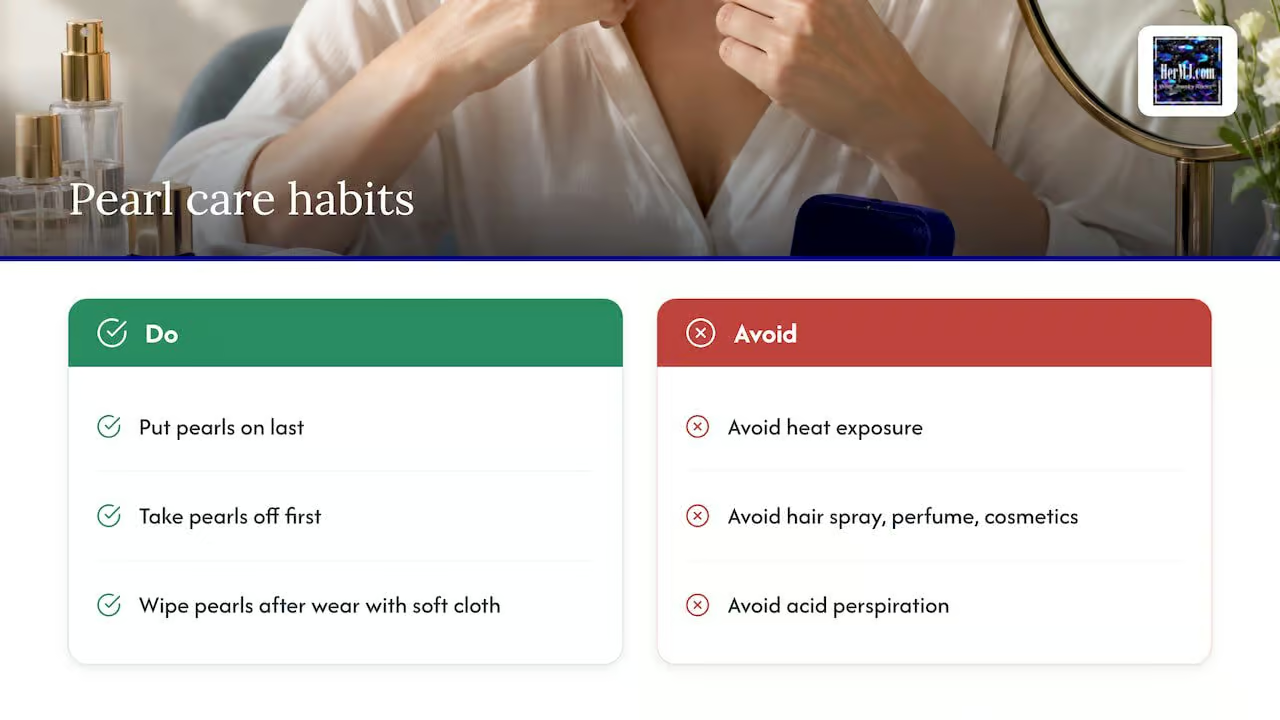
Nacre is organic, which makes it susceptible to everyday chemistry. GIA’s buyer’s guide says pearls can be damaged by heat and exposure to hairspray, perfume, cosmetics, and acidic perspiration, and it recommends wiping them with a soft cloth after wear. My golden rule is simple: pearls go on last and come off first.
For storage and maintenance beyond that, I’ve gathered everything on one page about pearl care, so you’ve got a single place to return to.
Our perspective on luster and nacre
When I design a piece, luster is the first thing I look at, because it’s the quickest way to read a pearl. A bright, clean reflection tells us the material has been well formed, and that the pearl will look alive against your skin.
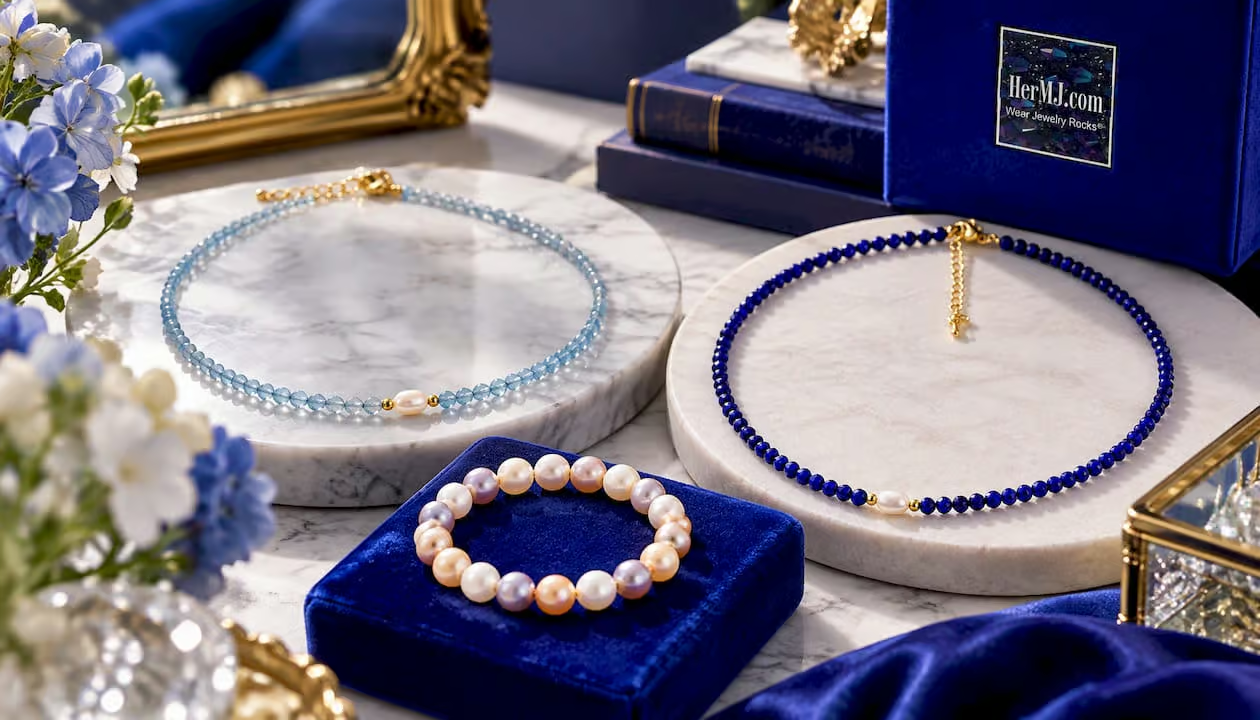
At HerMJ, we work with genuine freshwater pearls, natural gemstones and crystals, and we pair them so each stone lifts the other. A lapis lazuli blue next to a creamy pearl, or the pale water tone of aquamarine beside a soft white glow, shows how much a pearl’s luster can do when it’s given the right company.
Our aim is superior craftsmanship at a price that feels accessible. Fine pearl jewelry shouldn’t be reserved for milestone occasions. A pearl that glows deserves to be worn on a Tuesday, and we build our pieces with that kind of everyday elegance in mind.
What I’d tell any friend is this: trust your eyes first. If a pearl makes you stop and look, and the reflection is crisp and the glow stays steady as you turn it, you’re holding something worth wearing.
Veronique
Pearl pieces where the glow takes center stage
If you’d like to see luster for yourself, start with our lustrous freshwater pearl bracelet, a simple piece that lets the pearls do the talking. Prefer something with color? The pearl and aquamarine necklace and the lapis lazuli pearl necklace pair genuine pearls with natural gemstones.
You can also browse our necklaces, bracelets, and modern drop earrings, or explore the full collection at HerMJ. US orders ship free with no minimum, and international orders ship free on orders of $150 or more.
A closer look at mother of pearl
Many readers arrive here after seeing “mother of pearl” on a label and wondering how it relates. It’s the same family of material, and it shows up in jewelry in its own right. Our article on mother of pearl nacre and its many shades shows the range of color you can find. And if you’re weighing pearls against other soft-glowing stones, pearl vs moonstone compares how each one wears.
FAQ
Is luster the same thing as nacre?
No. Nacre is the layered material that forms a pearl, and luster is the light that material reflects. They’re connected, since thin nacre often leads to a dull, chalky look, but you judge them differently. Luster is what you see first, and nacre quality is what you infer from it.
How can I tell if a pearl has thin nacre?
Look for a visible nucleus under the surface or a chalky, flat appearance. GIA says either sign suggests thin nacre, which affects both luster and durability. Turn the pearl under a bright light, and watch for shifting color or a shadow where the core might be showing.
What is inside a pearl?
A pearl is made of nacre, built up in layers around an irritant or a nucleus. The mollusk secretes aragonite and conchiolin, the same materials as its shell, to coat that center. Over time, thousands of microscopic layers create the glow you see.
Does higher luster always mean a better pearl?
Luster is the most important of GIA’s seven pearl value factors, but it isn’t the only one. Size, shape, surface quality, and color all count too. The best choice is a pearl with bright luster that also suits your style and the way you’ll wear it.
Sources
- How do oysters make pearls? | Natural History Museum
- Pearl Quality 101: How GIA Examines and Classifies Pearls
- Pearl Gemstone | GIA
- Pearl Quality Factors | GIA
- GIA Introduces Expanded Nacre Scale to All Pearl Classification Reports
- GIA 7 Pearl Value Factors: An Update on Nacre Classification | Gems & Gemology, Summer 2025
- Pearl Buyers Guide | GIA
Recommended
- Mother of Pearl vs Pearl: What Sets Them Apart
- Understanding Nacre Growth: Anatomy Of A Pearl
- Mother of Pearl Nacre Benefits: 50 Shades Of Pearl Jewelry
- Akoya vs Freshwater Pearls: How to Choose Yours