


Nacre Thickness in Pearls: What It Means and How to Judge It
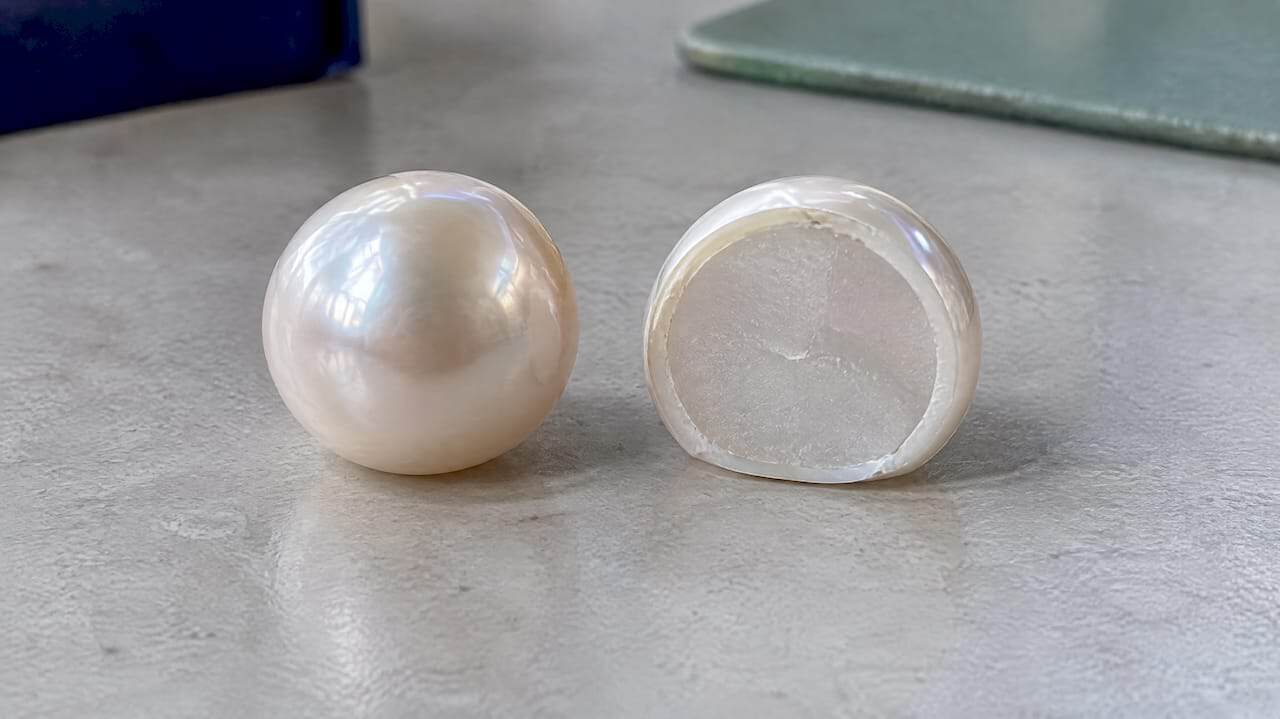
Nacre thickness is the depth of the shimmering mineral coating around a pearl’s center. Gemologists generally consider 0.25 to 0.35 mm good commercial grade and 0.35 to 0.5 mm gem grade. Thicker nacre gives a pearl a deeper glow and more protection for everyday wear. I’m going to show you what those numbers mean, how labs evaluate nacre, and how you can read a pearl’s nacre with nothing more than good light and a little patience.
TL;DR:
- Nacre is the layered coating that gives a pearl its luster. Its thickness affects both how the pearl glows and how well it holds up to wear.
- Professional gemologists consider roughly 0.25 to 0.35 mm good commercial grade, and 0.35 to 0.5 mm gem grade.
- A visible core, a dull or chalky look, or a flat, glassy shine can all point to thin nacre.
- GIA grades nacre quality on a five-tier scale, and its reports disclose nacre too thin for normal wear.
- You can judge a lot at home by looking at luster, the drill hole, and how reflections behave.
What nacre actually is
I like to think of a pearl as a “living” gem because a living creature builds it layer by layer. Nacre is the material that makes up those layers.
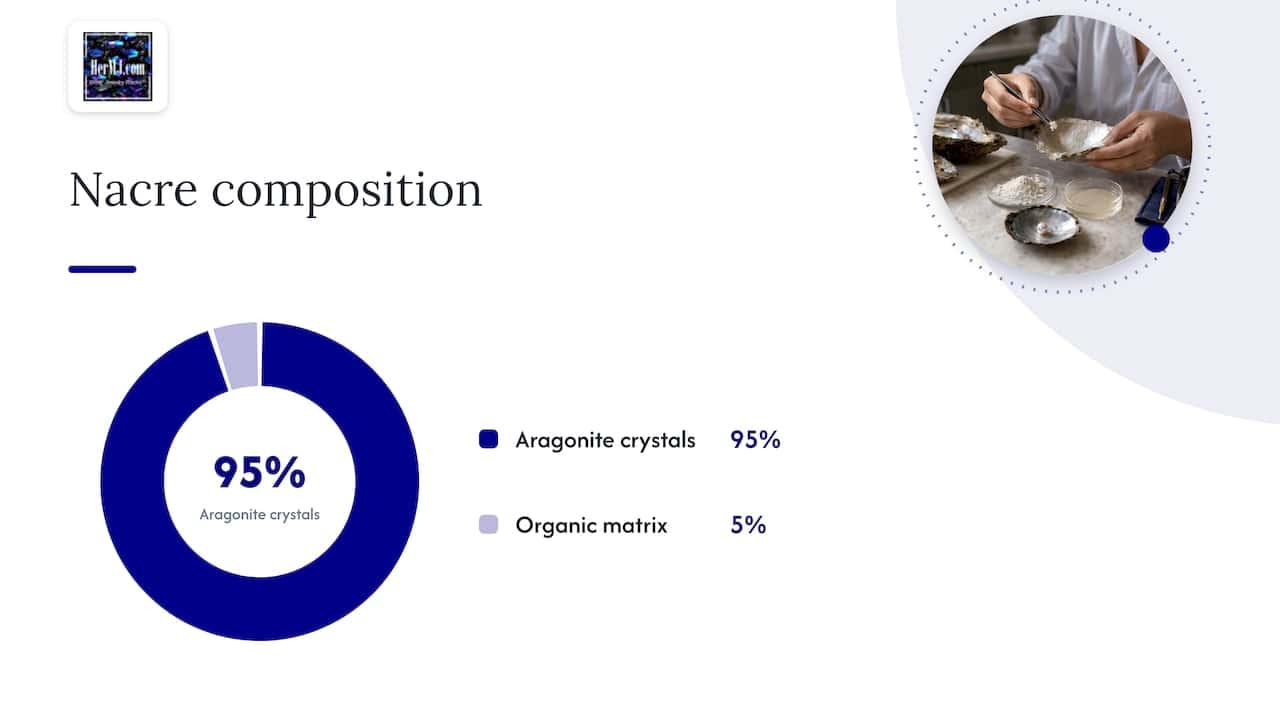
According to a 2024 research review on pearl formation, nacre is about 95% calcium carbonate as aragonite crystals and about 5% organic matrix, including conchiolin and proteins. The aragonite crystals are hexagonal and stack in a brick-wall pattern, with the organic material acting like mortar between them.
The same research describes how the mollusk builds it. Cells in the mantle tissue secrete substances that guide calcium into tiny aragonite tablets, which then grow into mature crystals. The mollusk deposits nacre throughout its life, so a longer pearl generally collects more layers.
If you’d like to learn more about the full anatomy, my guide to nacre growth and pearl structure walks through it in more detail.
What “nacre thickness” really measures
Nacre thickness is the distance from the pearl’s surface to whatever sits at its center. In a bead-cultured pearl, that center is a small bead placed in the mollusk.
Nacre is the coating that grows over it. In a pearl with no bead, the nacre extends much deeper from the surface and into the gem’s center.
The measurement is tiny. Pearl nacre is measured in fractions of a millimeter, and a 0.1 mm difference can change how a pearl looks and how long it lasts. That’s why a pearl that looks fine on some product pages can behave very differently after a few years of wear.
How nacre thickness changes luster
Most of us notice luster first. It’s the sharp, bright reflection that makes a pearl look lit from within. Nacre thickness shapes it because light doesn’t just bounce off the surface. It passes through the translucent layers and reflects back from several depths at once.
The International Gem Society explains that aragonite plates in nacre range from roughly 300 to 1500 nanometers thick, close to the wavelength of visible light, which is what can produce iridescence.
When the plates in the outer layers grow too thick for that diffraction, the pearl looks chalky rather than iridescent. So it isn’t simply a case of thicker always meaning better. Thickness and layer quality work together, and well-organized layers create that ethereal glow.
GIA describes luster on a scale from Excellent, where reflections look bright and sharp, down to Poor, where they look dim and diffused. Within a pearl type, when other factors are equal, higher luster means a more valuable pearl.
How nacre thickness affects durability
This is the part that matters most if you plan to wear your pearls often. GIA states that nacre thickness and continuity affect a pearl’s durability. A thicker coating gives the pearl more of a cushion against everyday knocks and rubbing, and it keeps the center out of sight.
Thin nacre has less margin. Over years of wear, skin oils, friction, and the occasional bump can wear through a thin coating, and you may start to see the core or patchy spots. If you wear a necklace weekly, durability matters far more than if you wear it twice a year. Our designer’s look at pearl durability and care covers how to wear pearls with confidence.
The numbers gemologists use
Here’s how the ranges commonly break down. The International Gem Society reports that 0.25 to 0.35 mm counts as good commercial grade, 0.35 to 0.5 mm as gem grade, and that the highest grades now typically top out around 0.4 mm.
| Nacre thickness | Typical classification | What it often means for wear |
|---|---|---|
| Under about 0.2 mm | Poor grade for Akoya, per one trade reference | Greater chance of the core showing as the pearl ages |
| 0.25 to 0.35 mm | Good commercial grade | Suitable for regular wear with sensible care |
| 0.35 to 0.5 mm | Gem grade | The most protective cushion, with deeper luster |
The under-0.2 mm row comes from a trade reference on cultured pearl grades that describes Akoya pearls with nacre between 0.2 and 0.3 mm as commercial grade, and anything thinner as poor. Treat these figures as guideposts, not hard cutoffs. A pearl with 0.3 mm of well-formed nacre can outperform one with more thickness and poor structure.
Does it differ by pearl type?
Yes, in general, though I’d rather you understand the principle than memorize a chart. Pearls grown around a bead, which includes types like Akoya, South Sea, and Tahitian, depend heavily on how much nacre the mollusk deposits over that bead. Nacre thickness is a key quality factor because the bead sets a fixed starting point, and the coating is whatever grows on top.
Longer growing time usually means more nacre. The International Gem Society notes that cultivation challenges often lead to faster harvests, which affects nacre thickness. That’s why two pearls of the same size and type can have very different durability.
At HerMJ, we work with freshwater pearls most often, and they’re a lovely choice for daily jewelry. Because a pearl’s size can’t tell you how much of it is nacre, the same visual checks below apply to every pearl type, freshwater or saltwater.

How labs grade nacre
If you’re buying a significant piece, lab reports add more confidence to your purchase. GIA’s system looks at nacre in two ways.
First, it classifies nacre quality. Under GIA’s updated approach, nacre is rated on a five-tier scale of Excellent, Very Good, Good, Fair, and Poor, based on structural or textural features on or just under the surface, sometimes called “movement.”
It replaced the older Acceptable and Unacceptable categories. GIA says the update followed requests from the global pearl trade, and that most pearls submitted will now be classed as Good.
Second, it can measure thickness. On GIA’s identification and classification reports, you can request the average nacre thickness of bead-cultured pearls for an additional fee. If the nacre is too thin to withstand normal wear, the report comments disclose that, and every classification report evaluates nacre condition at no extra charge.
Surface condition matters alongside nacre. GIA’s surface scale runs from Clean to Heavily Spotted, and numerous or severe surface characteristics can affect durability and depress value. For the bigger picture of how all these factors fit together, see our guide to pearl grading and our overview of the GIA value factors in cultured and natural pearls.
How to judge nacre at home
Most of us don’t have an X-ray machine on the dresser (including me). The good news is that your eyes can tell you a great deal. The International Gem Society points out that when measuring nacre isn’t feasible, you can gauge its thickness by assessing luster and orient, the soft rainbow shimmer that plays across the surface.
Here’s the routine I use.
- Look at the reflections. Hold the pearl under a bright, steady light. Sharp, mirror-like reflections of the window or lamp suggest healthy, thick layers. Blurry reflections suggest the opposite.
- Check for a chalky or flat look. GIA says a visible nucleus or a dull, chalky appearance means the nacre is thin, which affects luster and durability.
- Study the drill hole. Under magnification, the hole’s edge can reveal a line between the bead and the nacre. Keep in mind this is a clue, not a measurement.
- Look for a glassy, plastic shine. A pearl with a uniform, too-perfect gloss and no depth may not be a true pearl at all. Our six tests for real pearls versus shell pearls help here.
- Roll a strand. In a necklace, the pearls should show a similar glow from one to the next. Odd ones out can signal uneven nacre.
A word on a common mix-up: the shimmering lining of a shell is nacre too, but it isn’t a pearl. If you’ve wondered how the two differ, read about mother of pearl versus pearl.
Choosing pearls for everyday wear
Here’s my practical advice. If you’ll wear a piece every week, prioritize luster and surface quality, because those are the visible signs of well-built nacre. Choose pearls with bright reflections and an even glow, skip any that look chalky, and look for smooth surfaces without large blemishes.
For a piece that’s worn less often, such as a special-occasion strand, you have more room to prioritize shape, size, and color, since the pearls will see less friction.
Whatever you choose, daily habits protect nacre. Put pearls on last after perfume and hairspray, and take them off first. Our page on pearl care covers cleaning, maintenance and storage so you don’t have to guess. If a favorite strand has gone a little quiet, pearls can lose luster when they’re not worn, and there are gentle ways to bring the glow back.
My perspective on nacre
I believe nacre is the most underrated part of a pearl’s story. Shoppers tend to ask about size, color and shape first, yet the layers are what make a pearl glow and what make it last. When I design a piece, I look at how a pearl catches light before I think about anything else, because luster tells me how the layers were built.
At HerMJ, we work with genuine freshwater pearls, natural gemstones and crystals, and we pair them in handmade necklaces, bracelets and earrings. Our goal is superior craftsmanship at accessible pricing, so that a pearl with real depth doesn’t have to be a luxury reserved for special occasions. Our customers’ reviews often mention the quality and beauty of each piece, and that’s the feedback we care about most.
My golden rule: trust your eyes first. A pearl that makes you stop and look twice, with sharp reflections and a soft inner light, is telling you something good about what’s inside.
Veronique
Shop pearl jewelry with real luster
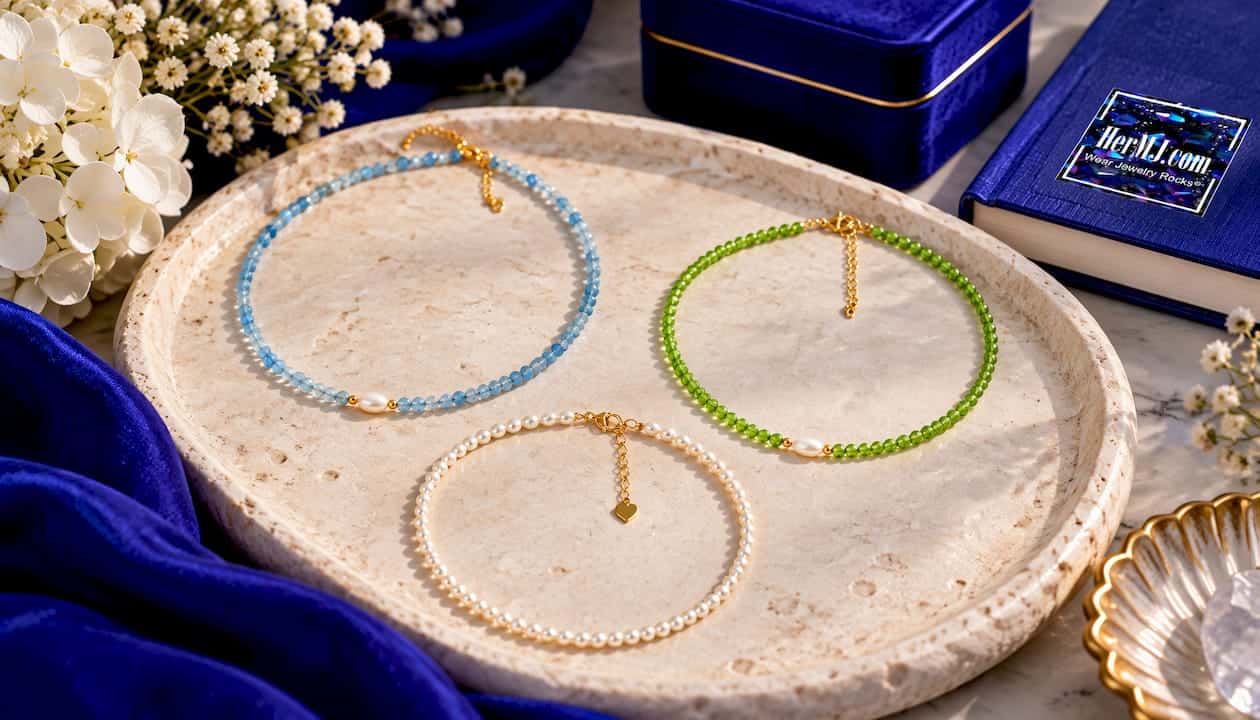
Ready to see these qualities? Explore our collection of pearl and gemstone jewelry. HerMJ pearl jewelry is handmade with genuine freshwater pearls and natural gemstones, from everyday strands to statement designs. The Elegant Freshwater Pearl Necklace is a lovely place to start, and you can also browse our necklaces, bracelets, and drop earrings.
US orders ship free with no minimum, and international orders ship free on purchases of $150 or more.
FAQ
How thick should nacre be on a good pearl?
Professional gemologists consider about 0.25 to 0.35 mm good commercial grade and 0.35 to 0.5 mm gem grade. The highest grades typically top out around 0.4 mm. Thickness works together with luster and surface quality, so look at all three.
Can you see nacre thickness with the naked eye?
You can’t measure it, but you can read the signs. Sharp, bright reflections point to healthy nacre, while a dull, chalky look or a visible core suggests thin nacre. Under magnification, the drill hole can offer extra clues.
Does thicker nacre always mean a better pearl?
Not always. Thickness matters for durability and glow depth, but layer structure matters too. When the outer plates grow too thick, a pearl can look chalky rather than iridescent, so nacre quality matters as much as quantity.
How do I get a pearl’s nacre thickness measured?
GIA’s identification and classification reports can include the average nacre thickness of bead-cultured pearls for an additional fee. Every classification report also evaluates nacre condition and flags nacre that’s too thin for normal wear.
Sources
- Research progress on formation mechanism of pearl (PMC, 2024)
- Pearl Quality Factors (GIA)
- GIA Introduces Expanded Nacre Scale to All Pearl Classification Reports
- GIA 7 Pearl Value Factors: An Update on Nacre Classification
- Does the GIA Pearl Identification and Classification Report include nacre thickness? (GIA)
- Pearl Quality 101: How GIA Examines and Classifies Pearls
- How Do Pearls Form? (International Gem Society)
- Pearl Value, Price, and Jewelry Information (International Gem Society)
- Facts About Pearls (Jewellery Technology)
Recommended
- Understanding Nacre Growth: Anatomy Of A Pearl
- Pearl Grading: What Every Buyer Needs to Know
- 6 Tests to Identify Real Pearls vs Shell Pearls
- Mother of Pearl Nacre Benefits: 50 Shades Of Pearl Jewelry