


June Birthstone Pearls: Choose and Care for the Perfect Gift
The Edit
- Pearl is the traditional June birthstone, symbolizing purity and loyalty, making it a popular gift choice. Most pearls are cultured, with nacre thickness influencing their durability and luster over time. Freshwater pearls offer the best value, come in many colors, and suit everyday jewelry and artisan pieces.
Pearl is the traditional June birthstone, and it’s been that way for centuries. June is one of only three months with three recognized birthstones: pearl, alexandrite, and moonstone.
If you’re choosing a gift for a June birthday, pearl is the classic, universally flattering pick. Alexandrite suits someone who wants something rare and color-shifting. Moonstone is a softer, more ethereal choice at a gentler price.
For most June birthday gifts, a freshwater pearl piece is the smartest starting point: it’s genuinely organic, beautiful, and accessible at almost any budget.
Quick gift picks:
- Everyday elegance: A freshwater pearl bracelet or simple strand necklace
- Splurge option: Alexandrite set in sterling or gold for a color-change wow factor
- Ethereal alternative: Moonstone for someone drawn to soft, luminous gemstones
Pro Tip: If you’re unsure which stone fits the recipient, pearl is the safest choice. It’s the only June birthstone with centuries of bridal, anniversary, and everyday wear tradition behind it.
Table of Contents
- What exactly is a pearl, and how does it form?
- How do the main types of pearls compare?
- Why are pearls such a classic June gift?
- How do jewelers evaluate pearl quality?
- How to clean and care for pearl jewelry
- Buying guide: how to choose the right pearl for a June birthday
- Key Takeaways
- Why freshwater pearls are the gift I’d choose every time
- HerMJ’s handcrafted freshwater pearl pieces for June gifts
- Useful sources and further reading
What exactly is a pearl, and how does it form?
Pearls are organic gems, which makes them unlike almost every other stone you’d find in a jewelry case. They’re produced inside the soft tissue of a mollusk (an oyster or mussel) when the animal coats an irritant with layer after layer of a crystalline substance called nacre. That nacre is what gives a pearl its signature glow, known as luster.
The formation process, simplified:
- An irritant (a grain of sand, a shell fragment, or a surgically implanted nucleus) enters the mollusk’s tissue.
- The mollusk responds by secreting nacre around the irritant.
- Over months or years, those layers build up into a pearl.
Natural vs. cultured pearls is the distinction that matters most when you’re shopping. Natural pearls form entirely without human involvement. They’re extraordinarily rare, and almost all natural pearl beds were heavily fished out over the past century, so natural pearls today are typically sold at auction and carry prices that reflect their scarcity.
Cultured pearls, on the other hand, are grown on pearl farms where technicians implant the nucleus and then allow the mollusk to do the rest. They’re still genuine organic gems produced by real mollusks.
The American Gem Society confirms that cultured pearls make up the vast majority of pearls sold in retail jewelry today, and there’s no reason to see that as a compromise.
Pro Tip: Pay close attention to nacre thickness when you buy. GIA’s guidance on nacre is clear: longer growth time produces thicker nacre, and thicker nacre means better durability and a richer luster over time. A pearl with thin nacre may look beautiful in the store but lose its glow within a few years of regular wear.
How do the main types of pearls compare?
Not all pearls are the same, and knowing the four main types helps you match the right pearl to the right person and budget. Each type comes from a different mollusk species and farming region, which directly shapes its color, size, and price.
Akoya pearls are the classic white pearl most people picture. Farmed primarily in Japan, they’re known for their near-perfect round shape and exceptionally bright, mirror-like luster.
They typically range from 6–9 mm and come in white or cream with rose, silver, or green overtones. Akoya pearls sit in the mid-range price tier and are a go-to for elegant necklaces and earrings.
Freshwater pearls are farmed mainly in China and are the most widely available and affordable type. They come in a remarkable range of shapes (round, oval, button, baroque) and colors, from white and cream to lavender, peach, and pink. Sizes typically run 5–12 mm, though larger specimens exist.
Because they’re grown without a bead nucleus, freshwater pearls often have thicker nacre relative to their size, which is a genuine quality advantage. The International Gem Society notes that freshwater pearls offer the best entry point for artisan and handcrafted jewelry.
Tahitian pearls are farmed in French Polynesia and are the only pearls that grow naturally dark. Their color range runs from charcoal gray and black to peacock green, aubergine, and deep blue, often with striking overtones.
They typically measure 8–16 mm. Tahitian pearls occupy a higher price tier and suit someone with a bold, unconventional style.
South Sea pearls are the largest and most luxurious of the four types, farmed in Australia, the Philippines, and Indonesia. White South Sea pearls come from the silver-lipped oyster; gold South Sea pearls come from the gold-lipped variety.
Sizes typically range from 9–20 mm. Their nacre is exceptionally thick, their luster is satiny rather than mirror-bright, and their price reflects both size and rarity.
| Type | Typical Colors & Overtones | Typical Size | Price Tier | Best For |
|---|---|---|---|---|
| Akoya | White, cream; rose/silver/green overtones | 6–9 mm | Mid | Classic necklaces, earrings |
| Freshwater | White, cream, lavender, peach, pink | 5–12 mm | Entry to mid | Everyday wear, artisan gifts |
| Tahitian | Gray, black, peacock, aubergine, blue | 8–16 mm | Mid to high | Bold, statement pieces |
| South Sea | White, silver, gold | 9–20 mm | High to heirloom | Luxury gifts, milestone occasions |
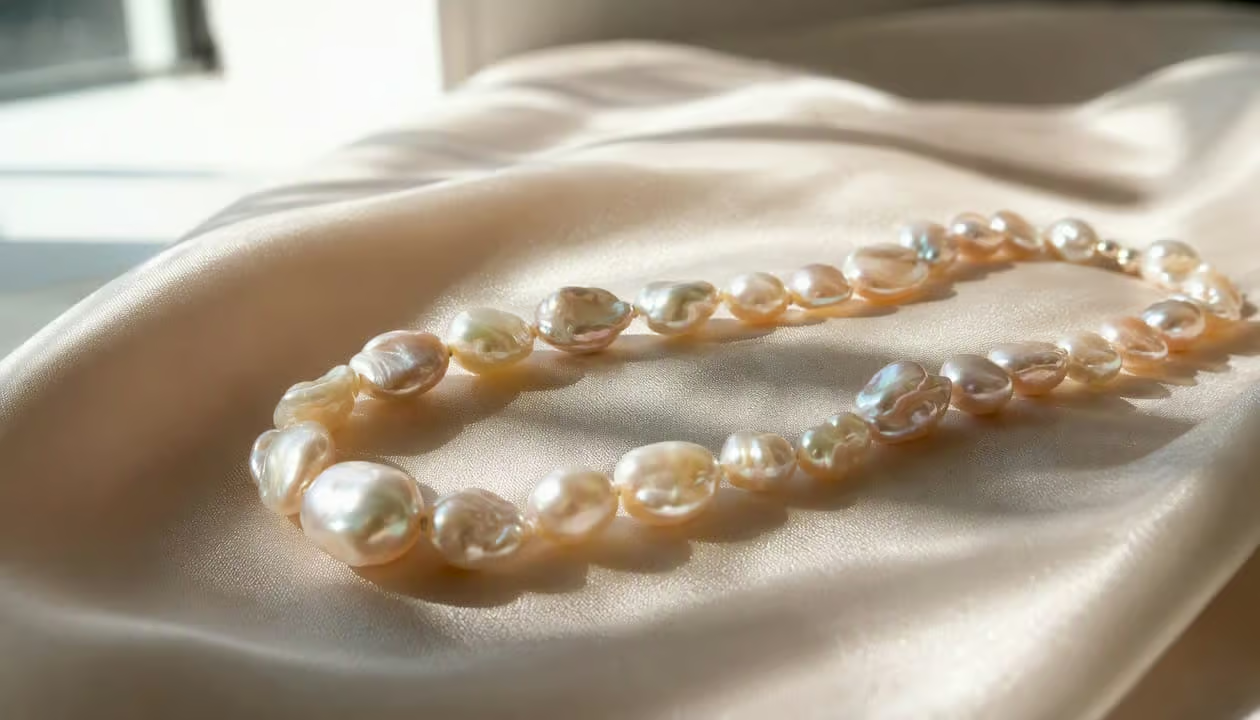
Baroque and irregularly shaped pearls, which are most common in freshwater varieties, have their own appeal.
Their organic, asymmetric forms make each piece genuinely one-of-a-kind, and they’re often more affordable than round pearls of the same type. For a handcrafted gift that feels personal rather than mass-produced, baroque freshwater pearls are hard to beat.
Why are pearls such a classic June gift?
Pearls’ symbolic weight runs deep. The Old Farmer’s Almanac connects pearls to purity, wisdom, and loyalty, associations that have made them a natural choice for weddings and milestone gifts across cultures for centuries.
Ancient Chinese texts described pearls as gifts from dragons. In European royal courts, pearls were so prized that sumptuary laws restricted who could wear them.
A few historical threads worth knowing:
- Pearls have been a bridal staple across cultures for centuries, symbolizing a pure and faithful union.
- They’re the traditional gift for the 30th wedding anniversary, making them meaningful for milestone celebrations beyond birthdays.
- In Hindu tradition, pearls are associated with the moon and are considered calming and protective.
- Ancient Romans valued pearls above almost every other gem, and Julius Caesar reportedly used their rarity as a measure of social status.
For gifting, pearls work across a wide range of occasions: a June birthday, a graduation, a bridal shower, a 30th anniversary, or simply a thoughtful “I was thinking of you” gift. They’re one of the few gems that read as both timeless and personal.
If you’re planning a celebration with pearl jewelry as a gift, pairing it with other personal touches makes the moment even more memorable. Intimate wedding ideas often center on exactly this kind of meaningful, heirloom-quality detail.
How do jewelers evaluate pearl quality?
Luster and nacre thickness are the two factors that matter most. Everything else is secondary. A pearl with brilliant luster and thick nacre will outlast and outshine a larger pearl with a dull surface and thin coating.
Here’s the full quality checklist jewelers use:
- Luster: The depth and brightness of light reflected from the surface. High-quality pearls show a sharp, almost mirror-like reflection. The American Gem Society emphasizes that luster is the primary quality factor, more important than size alone.
- Color and overtones: Body color is the base hue; overtones are the secondary colors that shimmer across the surface. Parade’s June birthstone guide notes that high-quality pearls show visible, reflective overtones that add depth and desirability.
Pro Tip: At an entry budget, prioritize luster over size. A smaller pearl with brilliant luster looks far more luxurious than a larger dull one. At a mid-range budget, add nacre thickness to your checklist. For an heirloom piece, all seven factors matter, and a gemological certificate from the GIA or AGS adds lasting confidence.
How to clean and care for pearl jewelry
Pearls are living gems in the sense that they respond to their environment more than any mineral stone does.
They sit at just 2.5–4.5 on the Mohs hardness scale, which means they scratch easily and lose nacre when exposed to harsh chemicals, heat, or abrasive surfaces. Think of caring for pearls the way you’d care for a fine piece of art: gently, consistently, and with the right materials.
Cleaning steps:
- Wipe pearls with a soft, damp cloth after each wear to remove body oils and residue.
- For a deeper clean, use a cloth barely moistened with lukewarm water and a tiny drop of mild, pH-neutral soap.
- Wipe each pearl individually, then rinse the cloth and wipe again with plain water.
- Lay the strand flat on a clean towel to air-dry completely before storing. Never hang a wet strand, as the silk thread will stretch.
What to avoid:
- Ultrasonic and steam cleaners. Both will damage nacre, per GIA’s care guidance
- Perfume, hairspray, and lotions applied while wearing pearls (always put pearls on last)
- Plastic storage bags, which can off-gas chemicals that degrade nacre over time
- Harsh chemicals, bleach, or ammonia-based jewelry cleaners
- Leaving pearls in direct sunlight or near heat sources for extended periods
Maintenance checklist:
- Inspect the silk thread on strung pearl pieces every 6–12 months for signs of stretching or fraying.
- Restring pearl strands every 1–2 years if worn regularly; a jeweler can restring with knotted silk, which keeps pearls from rubbing against each other.
- Store pearls separately from harder gemstones and metals in a soft cloth pouch or fabric-lined box.
- If a pearl noticeably loses its luster, consult a jeweler. Sometimes a professional cleaning restores the surface.
For everyday styling ideas that keep your pearls looking their best, how to style pearl jewelry offers practical guidance on pairing and wearing freshwater pieces.
Buying guide: how to choose the right pearl for a June birthday
Match the pearl type to the recipient’s style and your budget. That’s the core rule. A minimalist who wears simple, clean lines will love a classic Akoya or freshwater strand.
Someone with a bolder aesthetic might prefer a baroque freshwater piece or a Tahitian pendant. A teenager or young adult getting their first fine jewelry piece? A freshwater bracelet or small stud earrings are ideal entry points.
Questions to ask before you buy:
- What type of pearl is it, and where was it farmed?
- Can the seller describe the nacre thickness or growth period?
- Is the piece strung on knotted silk, and what’s the restringing policy?
- Does it come with any gemological documentation (GIA or AGS certificate)?
- What’s the return or exchange policy?
Price expectations by type:
Freshwater pearls offer the widest range, from affordable everyday pieces to well-crafted mid-range sets. Akoya pearls typically sit in the mid-range, with price rising sharply for larger, rounder specimens.
Tahitian and South Sea pearls occupy the higher tiers, where nacre quality and size drive significant price differences. For a June birthday gift, freshwater pearls give you the most flexibility: you can find a genuinely beautiful, gift-ready piece without stretching your budget.
Gift selection tips:
- Personalize by color: lavender and peach freshwater pearls feel more personal than plain white, and they suit a wider range of skin tones.
- Pair a pearl piece with a simple metal setting (sterling silver or gold-fill) to let the pearl’s natural luster take center stage.
- For bridal and graduation gifts, a classic strand or a delicate necklace reads as both celebratory and lasting.
- Presentation matters: a fabric-lined box and a short note about pearl care turn a beautiful piece into a genuinely thoughtful gift.
Key Takeaways
Pearl is June’s traditional birthstone, and the most versatile, gift-ready choice across budgets, but luster and nacre thickness are the two quality factors that determine whether a pearl piece stays beautiful for years or fades quickly.
| Point | Details |
|---|---|
| Pearl is June’s traditional stone | June also has alexandrite and moonstone; pearl suits the widest range of styles and budgets. |
| Prioritize luster and nacre thickness | These two factors predict long-term beauty better than size or shape alone. |
| Freshwater pearls offer the best value | They have naturally thick nacre, come in many colors, and suit everyday and artisan pieces. |
| Care is simple but specific | Wipe after wear, store in a soft cloth, avoid chemicals and ultrasonic cleaners, and restring every 1–2 years. |
| HerMJ for handcrafted freshwater gifts | HerMJ’s handcrafted freshwater pearl pieces are gift-ready and perfect for June birthdays. |
Why freshwater pearls are the gift I’d choose every time
There’s a tendency in the pearl world to treat Akoya and South Sea pearls as the “real” options and freshwater pearls as the budget fallback. I’d push back on that firmly.
Freshwater pearls grown over longer periods develop nacre that’s genuinely thick, often thicker than their saltwater counterparts, and their color range is something no other pearl type can match.
Lavender, peach, white, cream, pink: you can match a freshwater pearl to almost any skin tone or personal style without compromising on quality.
What I find most compelling about freshwater pearls for gifting is their organic character. Because they’re grown without a bead nucleus, no two are exactly alike.
A baroque freshwater strand isn’t a compromise; it’s a piece that couldn’t have been made any other way. That’s the kind of jewelry that actually means something to the person wearing it.
My advice: don’t chase round perfection at the expense of nacre quality. A slightly irregular pearl with brilliant luster and thick nacre will look more beautiful in five years than a flawlessly round pearl with thin coating looks today.
If you’d like to ask about custom options or have questions about a specific piece, send HerMJ’s customer service team a quick note. They’ll be happy to help you find exactly the right fit.
HerMJ’s handcrafted freshwater pearl pieces for June gifts
Handcrafted freshwater pearl jewelry from HerMJ gives you genuine artisan quality at a price that doesn’t require a special occasion to justify.
Every piece is made with real freshwater pearls, and the range covers the most common gifting needs for June birthdays, graduations, and anniversaries.
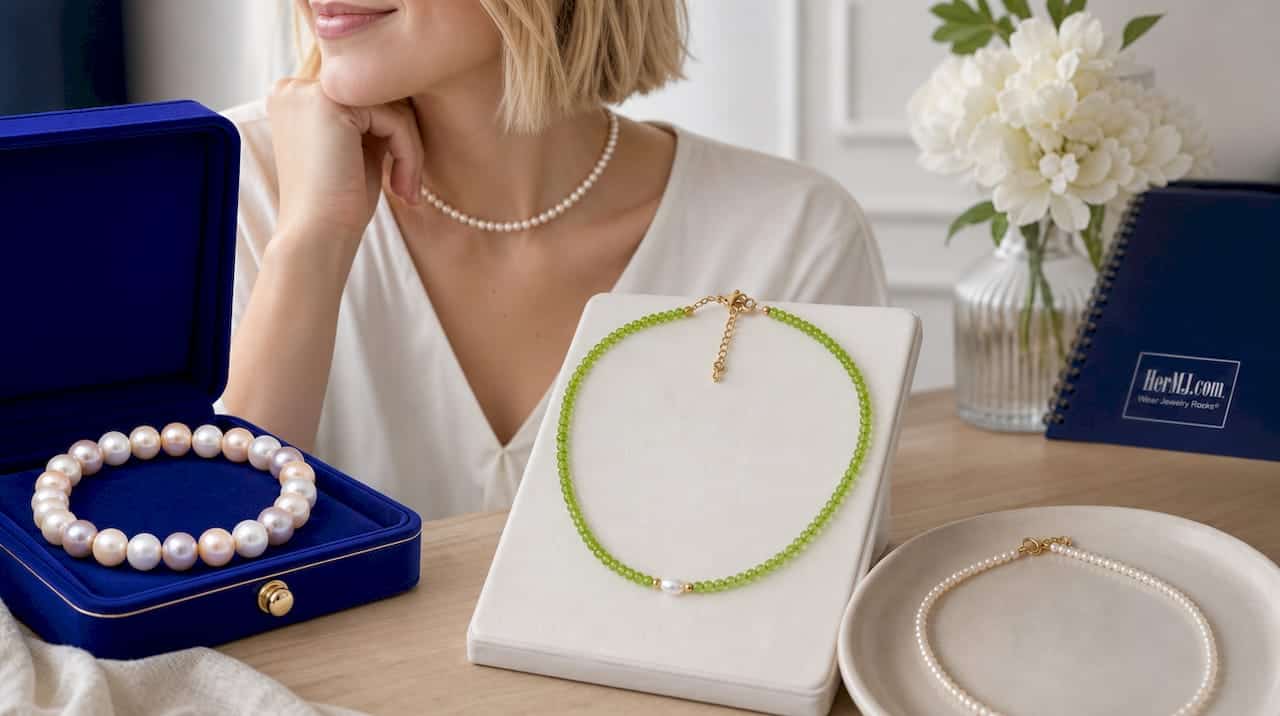
Three pieces worth knowing about: the Lustrous Freshwater Pearl Bracelet is a clean, elegant everyday piece that works as well with a casual outfit as it does dressed up.
The Peridot and Pearl Fusion Necklace pairs freshwater pearls with peridot for a birthstone-hybrid gift that feels personal and considered.
And the Elegant Freshwater Pearl Necklace is the classic choice: a handcrafted strand that suits a wide range of styles and occasions.
US orders ship free with no minimum. International orders ship free at $150+. Browse HerMJ’s full freshwater pearl jewelry collection to find the right piece, or reach out directly if you’d like a custom option for a June birthday gift.

Useful sources and further reading
- June Birthstones | Pearl, Alexandrite, Moonstone …
- June Birthstones: Pearl overview | American Gem Society
- Nacre thickness and how it affects pearl durability | GIA
- June Birthstone: Pearl – International Gem Society
- June birthstone color and meaning | The Old Farmer’s Almanac
- June birthstone guide | Parade
- What is June birthstone? | USA Today
- Explore June Birthstone Jewelry | Jared
Recommended
- Fashionable Pearl Necklaces For Brides And Grads ✺ HerMJ
- Alternative Birthstones | Handmade Gemstone Jewelry by Month
- How I Choose The Perfect Pearl Necklace: A Practical Guide
- Why Pearl Gifts Symbolize Love: Meaning and History