


Pearl Overtone Guide: Pick the Right Color for You
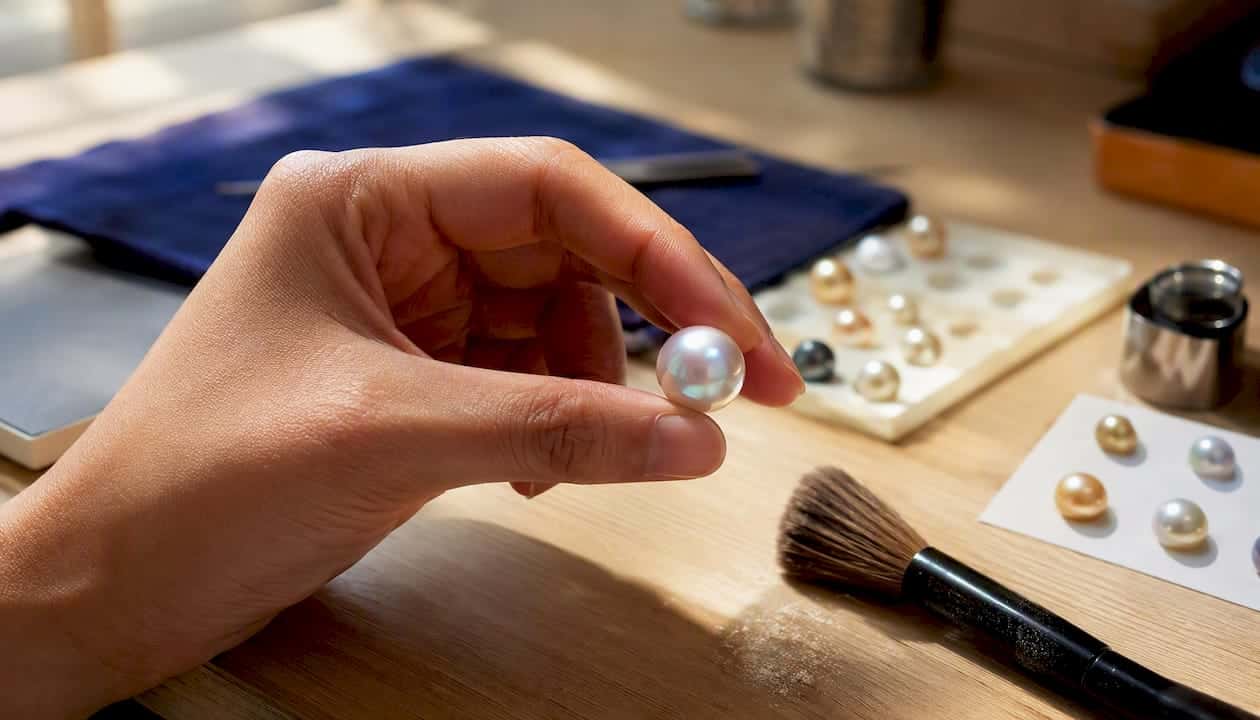
A pearl’s overtone is the translucent secondary color that sits over its bodycolor, and it’s the single element most buyers overlook when shopping.
Get it right, and a pearl looks alive against your skin. Miss it, and even a beautiful strand can fall flat. Before you buy anything, tilt the pearl in daylight-balanced light and watch for that soft color shift. That’s the overtone speaking.
Table of Contents
- What physically causes pearl overtones?
- What overtones can you expect from each pearl type?
- How do you identify a pearl’s overtone in person and online?
- When does overtone actually affect a pearl’s value?
- How do you pick an overtone that flatters your skin tone and style?
- How do multiple overtones and orient combine?
- Key Takeaways
- What I’ve learned from years of choosing pearl overtones
- See HerMJ’s freshwater pearl pieces in person
- Authoritative sources and further reading
What physically causes pearl overtones?
Overtones aren’t painted on, because they’re not a dye. They’re a natural optical phenomenon produced by the way light travels through a pearl’s nacre layers.
Nacre is built from microscopic aragonite platelets stacked in concentric layers around the pearl’s nucleus. When light hits the surface, it passes through those layers, reflects off multiple platelet surfaces, and recombines.
The interference between reflected light waves produces the translucent color cast you see as an overtone. Thicker, more uniform nacre tends to produce stronger, more consistent overtones. Thinner nacre, or nacre with irregular layering, often yields a weaker or patchy overtone.
The mollusk species also matters. Black-lipped oysters (Pinctada margaritifera) produce the dark bodycolors of Tahitian pearls, and the same nacre chemistry that creates those dark tones also generates the vivid green, pink, and purple overtones Tahitians are known for.
Akoya oysters (Pinctada fucata) produce thinner nacre layers that tend toward the cool rose and silver overtones associated with classic Japanese Akoya pearls.
- Nacre thickness: thicker nacre generally deepens and enriches overtone expression.
- Layer uniformity: consistent platelet alignment produces a cleaner, more predictable overtone.
- Mollusk species: different species produce different nacre chemistry, which shapes the overtone palette.
- Growing conditions: water temperature, salinity, and harvest timing all influence nacre deposition.
Because overtone is a light-interaction effect, it shifts with viewing angle and lighting environment. Under warm incandescent light, a rose overtone can look almost invisible. Under cool daylight or LED daylight-balanced light, it becomes vivid.
Pro Tip: Always view pearls against a neutral gray or white background in daylight-balanced light (5000–6500K color temperature). Warm yellow lighting suppresses cool overtones, and a colored background will tint your perception of the pearl’s color entirely.
As Prism News explains in their pearl color guide, overtones are natural optical phenomena. Not surface dyes or pigments. And the same pearl can look meaningfully different depending on its setting and the light source above it.
What overtones can you expect from each pearl type?
Each pearl type has a characteristic overtone palette shaped by its mollusk species and growing region. The table below gives you a reliable reference, but keep in mind that individual pearls vary, and rarer overtone combinations command a premium.

| Pearl Type | Typical Bodycolor | Common Overtones | Styling Note | Rarity Flag |
|---|---|---|---|---|
| Akoya | White, cream, light pink | Rose, silver, cream, aquamarine | Pairs beautifully with platinum, white gold, and bridal fabrics | Rose overtone on white body is the most prized combination |
| Tahitian | Dark gray, black, charcoal | Green, peacock (green + purple), pink, blue, silver | Striking with yellow gold and dark fabrics; strong statement pieces | Peacock overtone is the most sought-after and commands the highest premium |
| South Sea | White, silver, gold | Silver, cream, gold, pink | Luxurious with yellow gold (gold body) or platinum (white body) | Deep gold body with pink overtone is exceptionally rare |
| Freshwater | White, cream, peach, lavender, pink | Rose, cream, silver, lavender, peach | Versatile across metals and occasions; excellent everyday wear | Strong rose or lavender overtone on a clean white body is increasingly desirable |
For a deeper look at how these types compare visually, HerMJ’s complete visual guide to pearl types is a useful companion reference.
Tahitian pearls deserve a special note. Their dark bodycolors mean that overtone and orient carry most of the visual weight.
A Tahitian described simply as “peacock” carries an implicit expectation of green-dominant iridescence with purple secondary tones, but as Prism News notes, that trade term can be vague without an explicit bodycolor description alongside it. Always ask for both.
Freshwater pearls, on the other hand, offer the widest variety of overtones at accessible price points. A cream freshwater with a rose overtone can look strikingly similar to a high-end Akoya at a fraction of the cost, which is one reason they’ve become a favorite for everyday and bridal pieces alike.
How do you identify a pearl’s overtone in person and online?
Overtone is subtle enough that many buyers miss it entirely, especially in photographs. Here’s how to catch it reliably.
Evaluation Tips:
- Start in daylight-balanced light, not under store spotlights, which are often warm and directional.
- Hold the pearl against a neutral white or gray surface, never directly against your skin or a colored cloth.
- Tilt the pearl slowly through a 90-degree arc. The overtone will appear as a consistent translucent color cast that moves with the pearl.
- Compare two pearls side by side. Overtone differences that are invisible in isolation become obvious in direct comparison.
- Use a loupe or take a macro photo to examine nacre transparency. A pearl with thick, well-layered nacre will show depth; thin nacre looks chalky or opaque.
- Orient appears as rainbow flashes that shift rapidly as you tilt. Overtone is steadier and more uniform.
Pro Tip: Product photography almost always flattens overtone because it’s a translucent, angle-dependent effect. If a seller’s photos all look identical regardless of angle, that’s a sign the images were taken under directional studio lighting that eliminates the overtone entirely. Ask for a video or a photo taken outdoors in natural light.
When does overtone actually affect a pearl’s value?
Overtone matters most when the other quality factors are already strong. According to GIA’s pearl quality framework, the value hierarchy runs: size, shape, luster, surface quality, nacre quality, and then color (which includes bodycolor, overtone, and orient together).
A pearl with poor luster and heavy blemishes won’t be rescued by a beautiful overtone. But when two pearls are otherwise equal, overtone can be the deciding factor.
The clearest example is Tahitian peacock. Two Tahitian pearls of identical size, shape, and surface quality can differ significantly in price if one shows a vivid peacock overtone and the other shows only a flat gray-green. The rarer the overtone-and-bodycolor combination, the more it contributes to desirability.
Matching across a strand adds another layer. A necklace where every pearl shows the same rose overtone is more valuable than one where overtones vary from pearl to pearl, even if the individual pearls are similar in quality. Consistent overtone across a matched set signals careful selection and skilled curation. HerMJ’s pearl quality primer explains how luster and nacre quality interact with perceived color, and why a modest overtone on a high-luster pearl can be more visually striking than a vivid overtone on a dull one.
For buyers who want to understand how these factors translate to market pricing, the pearl value guide offers useful context on how rarity and color patterns affect what you’ll pay.
How do you pick an overtone that flatters your skin tone and style?
Think of overtone as an optical filter between the pearl and your skin. The right one makes both look better. The wrong one can make a beautiful pearl look washed out or your complexion look uneven.
- Warm skin undertones (golden, olive, peachy): cream, gold, and peach overtones harmonize naturally. A freshwater pearl with a cream or peach overtone against warm skin looks luminous. Rose overtone can work but sometimes reads slightly cool.
- Cool skin undertones (pink, rosy, bluish veins): rose and silver overtones are the classic pairing. A white Akoya with a rose overtone is the quintessential cool-tone choice. Aquamarine overtone on Akoya also works beautifully for cool complexions.
- Neutral skin undertones: you have the most flexibility. Both rose and cream overtones work, and you can lean into personal preference rather than skin-tone rules.
Metal pairings:
- Yellow gold: cream, gold, and peach overtones. The warmth echoes and amplifies.
- Rose gold: rose and peach overtones. A freshwater pearl with a rose overtone on a rose gold chain is one of the most flattering combinations in contemporary pearl jewelry.
- White gold or platinum: rose, silver, and aquamarine overtones. The cool metal and cool overtone create a clean, unified look.
- Mixed metals: neutral cream or subtle silver overtones, which don’t compete with the metal contrast.
Occasion guidance:
- Bridal: rose or silver overtone on a high-luster white pearl. The cool, clean palette photographs beautifully and reads as classic.
- Daily wear: a clean bodycolor with a subtle cream or rose overtone. Nothing too vivid, so it transitions from desk to dinner without effort.
- Statement pieces: strong orient combined with a vivid overtone (peacock Tahitian, or a lavender freshwater with strong orient) for occasions where you want the jewelry to lead.
For more on pairing pearls with specific outfits and fabrics, the pearl styling guide covers the full picture. And if you’re pairing pearls with colored gemstones, the gemstone pearl pairing guide is worth a look.
How do multiple overtones and orient combine?
A pearl can carry more than one overtone simultaneously, and orient adds a third layer of visual complexity on top. Understanding how these interact helps you read descriptions accurately and avoid being misled by trade shorthand.
Orient is fundamentally different from overtone. Overtone is a consistent translucent color cast that sits over the bodycolor. Orient is an iridescent, rainbow-like shimmer that appears to move across the surface as the pearl tilts. In photographs, orient shows up as flashes of multiple colors shifting rapidly, while overtone appears as a steady, uniform tint.
Multi-overtone combinations are most common in Tahitian pearls. A pearl described as “peacock” typically shows a dominant green overtone with a secondary purple or pink overtone, layered over a dark gray or charcoal bodycolor. The green and purple interact to create the rich, complex color that makes peacock Tahitians so distinctive. But as Prism News points out, “peacock” is trade shorthand, and sellers should always pair it with an explicit bodycolor description. A “peacock” pearl on a lighter gray body looks very different from one on a near-black body.
When reading photos for multi-overtone pearls:
- Look for color shifts across the pearl’s surface rather than a single uniform cast.
- Rainbow flashes that appear and disappear as the image angle changes indicate orient.
- A consistent secondary color visible across the whole pearl surface, even in a static photo, is overtone.
- Ask for a short video clip if you’re buying online. Multi-overtone and orient effects are nearly impossible to capture accurately in a single still image.
A pearl with both strong orient and a vivid overtone is genuinely rare, and that combination is part of what makes certain Tahitian and high-quality freshwater pearls so compelling to collectors and designers alike.
Key Takeaways
Overtone is the translucent secondary color layered over a pearl’s bodycolor, and identifying it correctly in daylight-balanced light is the single most practical skill you can develop as a pearl buyer.
| Point | Details |
|---|---|
| Three-component framework | Every pearl has bodycolor (dominant hue), overtone (translucent overlay), and orient (iridescent shimmer) — assess them in that order. |
| Best viewing practice | Tilt the pearl in daylight-balanced light against a neutral background to reveal the true overtone before buying. |
| Overtone by pearl type | Akoya shows rose or silver; Tahitian shows green or peacock; South Sea shows gold or silver; freshwater shows rose, cream, or lavender. |
| Value hierarchy | Size, luster, surface, and nacre quality outrank color — but consistent overtone across a matched strand adds meaningful value. |
| HerMJ freshwater pieces | HerMJ’s handcrafted freshwater pearl jewelry illustrates common overtones (rose, cream, lavender) at accessible prices with free US shipping. |
What I’ve learned from years of choosing pearl overtones
Most buyers focus on size and price, and they walk away with a pearl that’s technically fine but somehow doesn’t feel right against their skin. Nine times out of ten, the culprit is overtone mismatch, not quality.
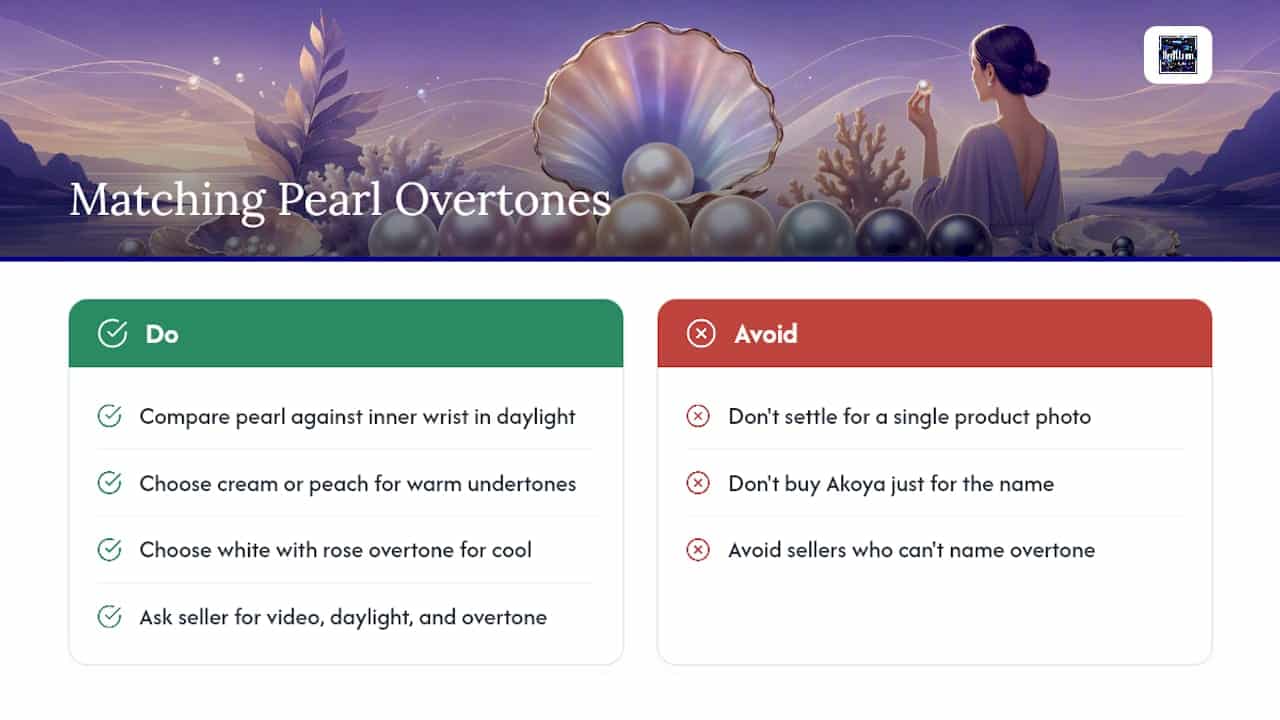
My personal rule when selecting freshwater pieces for bridal customers is this: always compare the pearl against the wearer’s inner wrist in daylight, not under store lighting.
The inner wrist shows the skin’s true undertone, and the overtone that looks best there is almost always the right choice. For warm-toned clients, I reach for cream or peach freshwater pearls every time. For cool-toned clients, a white freshwater with a rose overtone is rarely wrong.
I do, however, disagree with the assumption that Akoya is always the superior choice for bridal. A well-selected freshwater pearl with a strong rose overtone and high luster can be indistinguishable from an Akoya in photographs and in person.
The difference is the price, and for many brides, that difference is meaningful. I’d rather put a beautifully matched freshwater strand on someone than a mediocre Akoya just because the name carries more prestige.
When you’re shopping online, don’t settle for a single product photo. Ask for a video, ask for a daylight shot, and ask the seller to name the bodycolor and overtone explicitly. A seller who can’t answer those questions confidently is a seller who doesn’t know their pearls. Jewelers of America’s member directory is a good starting point for finding sellers who can.
Browse HerMJ’s freshwater pearl collection to see more
Freshwater pearls are where overtone variety really shines, and HerMJ’s handcrafted collection makes it easy to see those differences side by side.
The Elegant Freshwater Pearl Necklace shows the kind of clean white bodycolor with a soft rose overtone that flatters cool and neutral skin tones beautifully.
If you prefer something for the wrist, the Lustrous Freshwater Pearl Bracelet for Elegance is a daily-wear piece that demonstrates how a subtle cream overtone reads across different lighting conditions.
For pairing pearls with colored stones, the Pearl and Aquamarine Necklace shows how a cool-toned gemstone can amplify a silver or rose overtone, while the Faceted Garnet Gemstone Necklace and Strawberry Quartz Gemstone Bracelet offer warm-toned contrast options for cream or peach overtone pearls.
If you’re drawn to earthy, warm tones, the Tiger Eye Bracelet pairs naturally with gold-overtone South Sea or warm freshwater pieces.
Every HerMJ piece ships free within the US with no minimum order. Browse the full freshwater pearl jewelry collection to find the overtone that speaks to you.
Authoritative sources and further reading
These are the primary references used throughout this guide. Each one covers a different angle of pearl color and quality.
- Pearl Quality Factors
- How to read pearl color, bodycolor, overtone and orient | Prism News
- jewelers.org
- Different Types of Pearls: Your Complete Visual Guide
- Understanding Pearl Quality: The Beauty Of Real Pearls
Recommended
- How I Choose The Perfect Pearl Necklace: A Practical Guide
- Different Types of Pearls: Your Complete Visual Guide
- Jewelry Choices: What colors look best on cool skin tones