


Quartz Scratches Glass (Mohs 7 vs 5.5): 4 Tests Jewelry Buyers Need
Quartz is a crystalline mineral built from an ordered lattice (an arrangement) of silicon and oxygen atoms; ordinary glass is an amorphous silicon dioxide (SiO2) based material with no such order.
Visualize the makeup of a quartz crystal like perfectly ordered Legos, perfectly interlocking, with every piece in its right place. Glass, on the other hand, would be a random jumble of the same components, lacking the orderly structure of a quartz crystal.
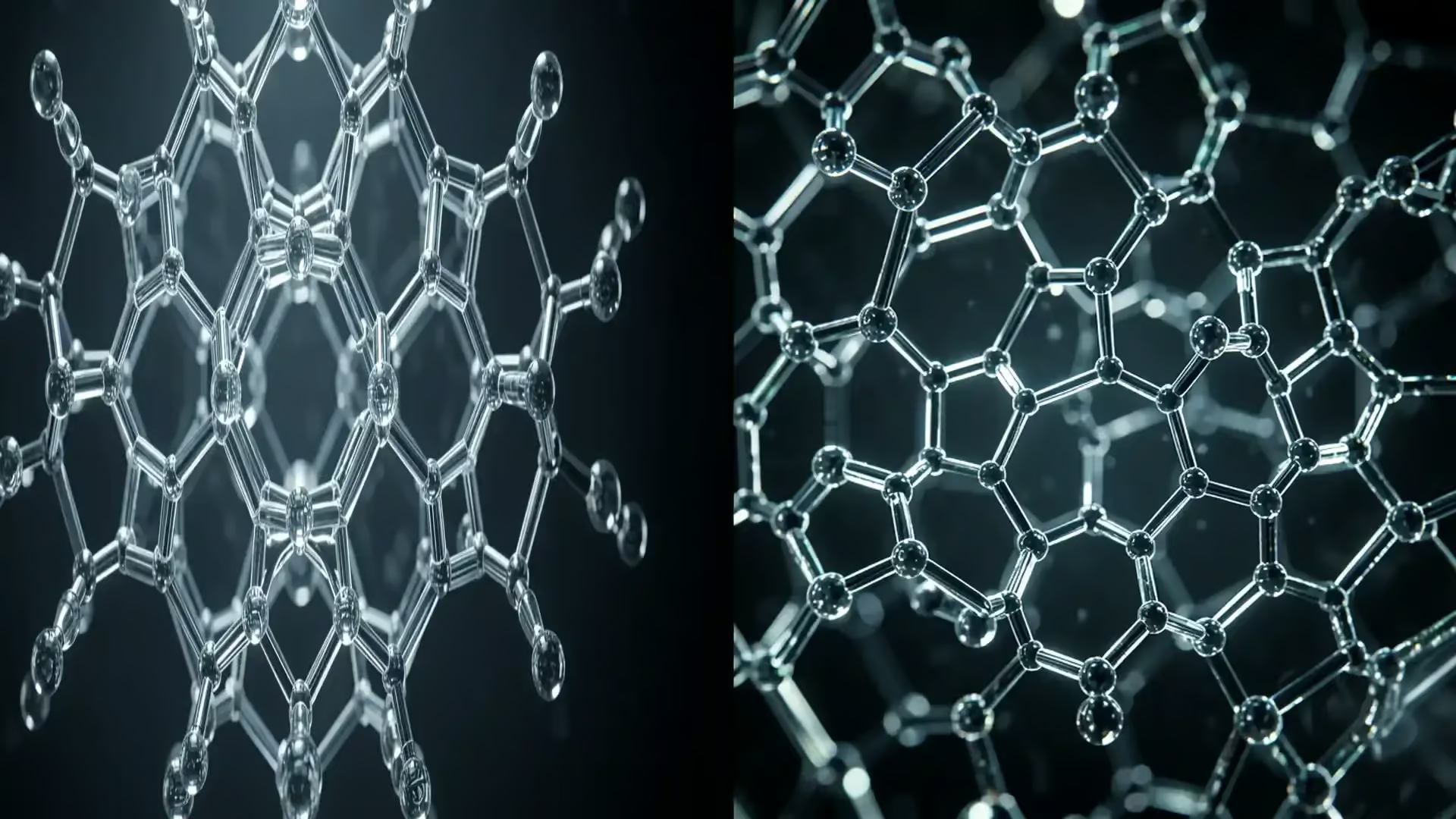
Fused silica sits conceptually between quartz and glass, since it’s nearly pure silicon dioxide SiO2 like quartz yet remains unstructured like glass.
That single structural fact explains almost everything else you’ll notice: why quartz scratches glass, why it feels colder in your hand, and why a loupe can often settle the argument of which is which in seconds.
The Edit
- Quartz’s crystalline structure makes it harder, more heat resistant, and capable of scratching glass, which normally cannot scratch quartz.
- Natural quartz is nearly pure silicon dioxide with minimal impurities, while soda-lime glass includes additives like soda ash and lime to lower melting points, making it cheaper.
- Fused silica is a high-purity, amorphous form of silicon dioxide that transmits deep UV light and withstands thermal shock better than standard glass but is more expensive.
- Simple at-home tests such as scratch, cold-feel, loupe inspection for bubbles, and UV fluorescence can reliably distinguish quartz from glass.
- Responsible sources caution that synthetic quartz can mimic natural quartz’s properties, so verification with seller disclosures and multiple tests is essential.
Crystalline Quartz vs Amorphous Glass: The Structural Divide
Every difference in properties between these two materials stems from how their atomic building blocks are arranged.
Quartz forms a repeating, ordered lattice, with silicon and oxygen locked into the same geometric pattern that repeats endlessly through the crystal.
Glass never gets that organization. Its silicon and oxygen atoms bond into a network, but a disordered one, frozen in place mid-chaos because its molten material cooled too fast to crystallize.
That’s also why fused quartz trips people up. It’s chemically almost identical to natural quartz, nearly pure SiO2, yet it’s manufactured by melting quartz sand or synthetic silica and cooling it in a way that prevents crystal formation.
The result is a glass in every structural sense, just an exceptionally pure one.
An ordered lattice (like quartz’s) resists deformation differently from a disordered network (like glass’s), which is part of why quartz retains an edge in a scratch test that glass loses.
Quartz also bends light and handles heat differently, since its more symmetrical construction interacts with light and thermal energy in a more orderly, directional way than glass’s jumbled network does.
What’s the Chemical Difference Between Quartz and Glass?
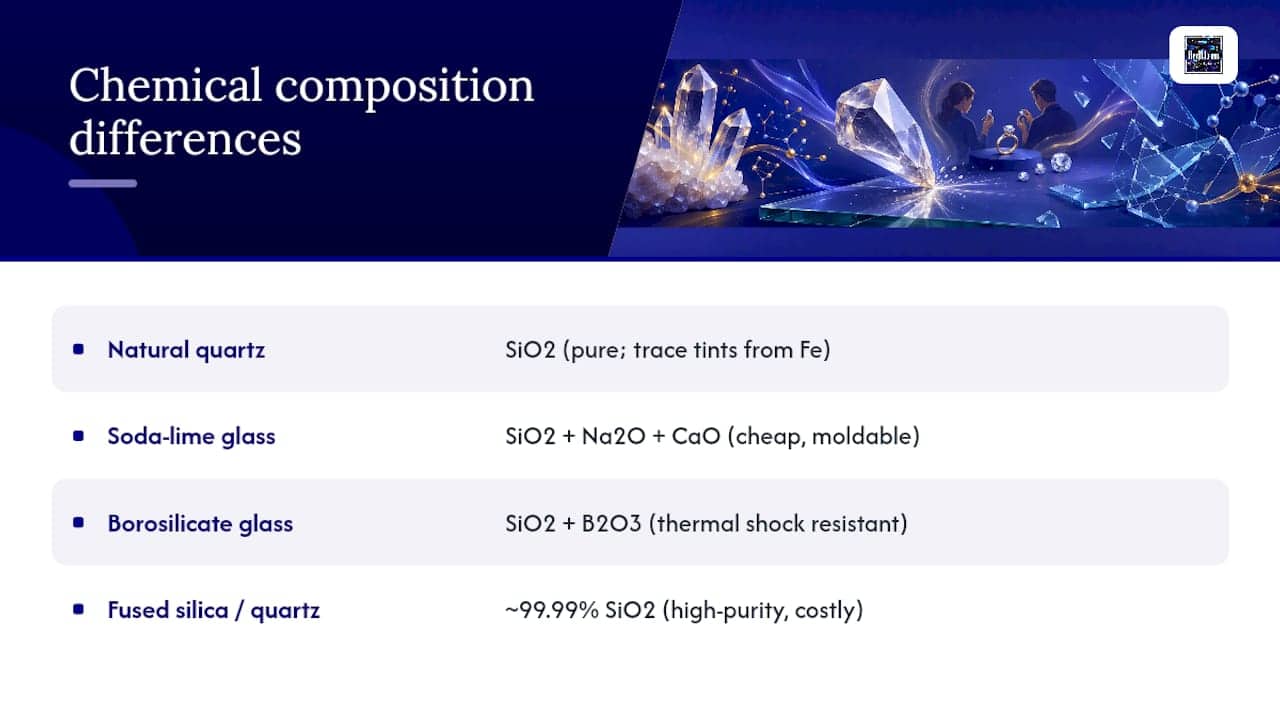
Natural quartz is essentially just SiO2, silicon dioxide, with very few impurities beyond trace elements that occasionally tint it (iron impurities produce citrine).
Ordinary glass rarely gets away with that kind of purity.
Standard soda-lime glass, which is used in most windows and drinking glasses, is made from silica, soda ash (Na2O), and lime (CaO). Those ingredients are added to lower the melting point, making large-scale manufacturing affordable.
Borosilicate glass, the kind in lab beakers and oven-safe cookware, swaps in boron trioxide (B2O3) to improve thermal shock resistance.
Fused silica and fused quartz occupy the high-purity end of the glass family. Running 99.99% SiO2 or higher.
Grades like JGS1, JGS2, and JGS3 are used for deep-UV optics, visible-light UV work, or infrared transmission.
That purity isn’t free.
Stripping out the additives that make soda-lime glass cheap and moldable pushes fused silica’s cost and processing difficulty beyond ordinary glass.
The primary reason you find it in scientific instruments and semiconductor equipment, not window panes.
How Do Quartz and Glass Compare in Hardness and Heat?
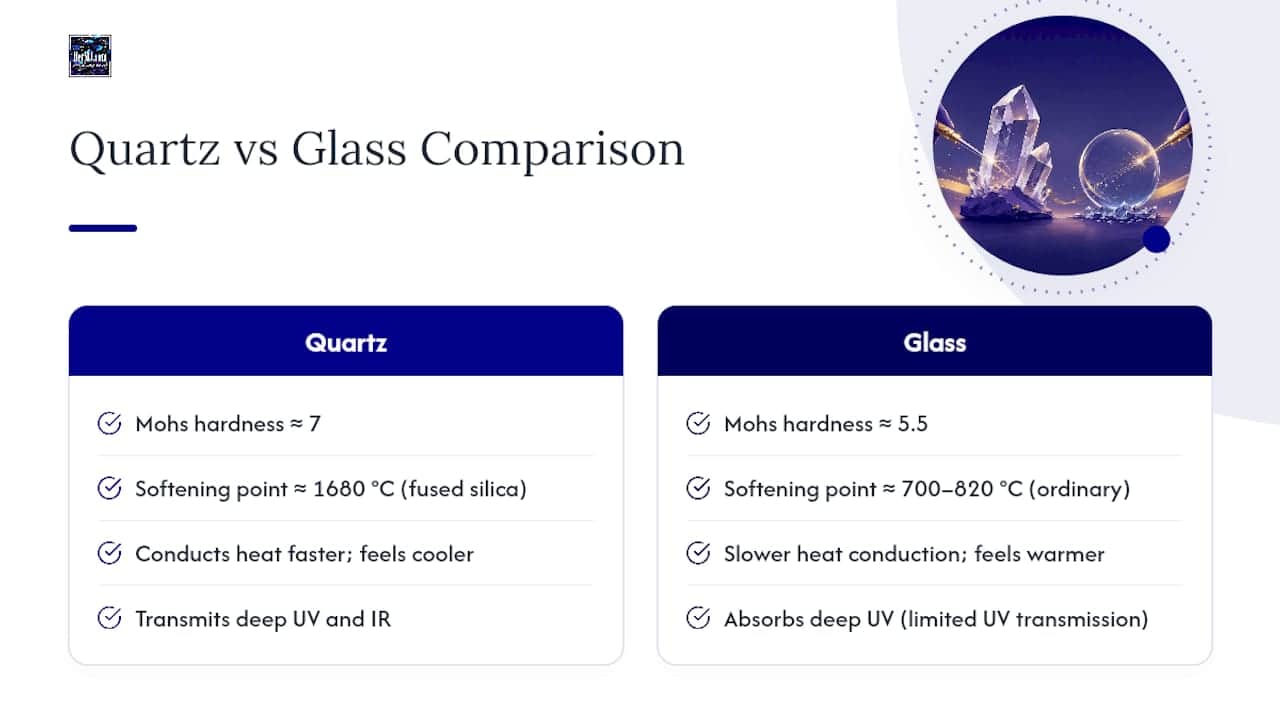
Grab a loose piece of glass and a quartz crystal, and physics settles most disputes before you even reach for a lab test. Quartz sits at roughly 7 on the Mohs scale; common soda-lime glass lands around 5.5.
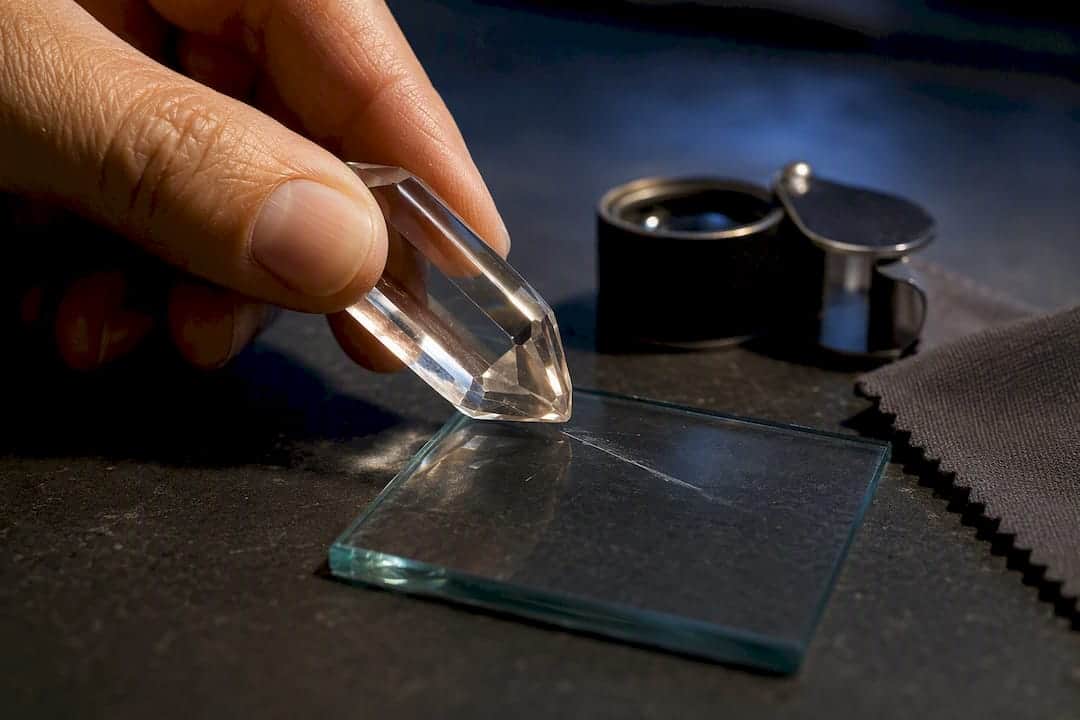
That gap means quartz will scratch glass, but glass generally isn’t hard enough to scratch quartz. This ends up being one of the most reliable means to tell the two apart you’ll find.
Thermal behavior splits along the same crystalline-versus-amorphous line. Quartz conducts heat away from your skin faster than glass.
This is why quartz feels cooler to the touch.
Fused silica takes things even further: its thermal expansion coefficient is so low that it withstands thermal shock that would shatter other types of glass. And with a softening point around 1680°C, compared with roughly 700-820°C for ordinary glass types.
Optically, both materials transmit visible light well, but their UV performance is quite different.
High-purity fused silica transmits deep into the ultraviolet and all the way into the infrared, which is why it shows up in spectroscopy equipment and semiconductor lithography.
Standard glass would simply absorb the wavelengths engineers need. Refractive index ranges overlap enough that eyeballing clarity alone rarely tells you anything definitive.
One property of quartz is piezoelectricity.
Crystalline quartz generates a small electrical charge under mechanical stress, a direct result of its crystalline lattice, which is exactly why quartz crystals are used in watches and oscillators.
Glass has no equivalent ability, although both materials are excellent electrical insulators on their own.
How Can You Tell Quartz From Glass at Home?
You don’t need a lab to get a confident answer. Combine two or three of these tests, since no single check is foolproof on its own, especially against high-quality synthetic quartz.
- Scratch test. Find an inconspicuous edge and try scratching glass with a suspected quartz point. Quartz should leave a mark; glass won’t scratch quartz back (do this on scrap glass, never on a finished piece you care about).
- Cold-feel test. Hold the piece for a few seconds, then press it to your inner wrist or upper lip. For a more detailed read, chill it for about 30 seconds first. Quartz stays noticeably colder for longer because it conducts heat away from your skin faster than glass.
- Loupe inspection. Look for tiny round bubbles under 10x magnification. Spherical bubbles strongly suggest glass; natural growth lines, veils, or mineral inclusions suggest quartz.
- UV lamp check. Some natural quartz varieties fluoresce faintly under UV light in ways manufactured glass typically doesn’t replicate.
Pro Tip: Run all four tests before you draw a conclusion. Lab-grown synthetic quartz can pass hardness and thermal tests just as convincingly as natural quartz, so the loupe often ends up being your tiebreaker.
When Should You Choose Quartz Over Glass?
Fused silica earns its price tag in deep-UV optics, semiconductor manufacturing, and high-temperature labware, anywhere extreme heat resistance or UV clarity actually justifies the cost.
Soda-lime and borosilicate glass cover nearly everything else. Windows, everyday drinkware, and oven dishes because they’re cheaper to produce and durable enough for those uses.
In jewelry and home decor, the calculation shifts again. Natural quartz brings genuine mineral inclusions, subtle color variation, and a story glass imitations can’t fake, though glass alternatives run lighter on the wallet.
If you’re weighing larger quartz pieces for a room, the same purity and inclusion cues from the loupe test apply at a bigger scale.
What I’ve Learned Sourcing Quartz for Jewelry
People assume “real quartz” settles the authenticity question, but it doesn’t, not entirely. Lab-grown quartz is chemically identical to natural quartz.
Same crystal structure, same hardness, same cold-to-the-touch feel.
The real question shoppers should ask isn’t whether it’s natural or fake. It’s natural versus synthetic versus glass imitation, because only the latter is a genuine downgrade in durability and character.
I’d rather see a shopper buy a well-disclosed synthetic quartz piece than an undisclosed glass one sold at quartz prices.
Ask any seller directly whether a piece is natural or lab-grown, and ask for a loupe photo if you can’t inspect it in person. A seller who hesitates on either question is telling you something.
Reputable return policies exist for exactly this reason, and you should use them without hesitation if a piece doesn’t match its description once it arrives.
— Veronique
Shop Genuine Quartz: The HerMJ Quartz Crystal Necklace
Once you know what separates real quartz from a glass stand-in, the smarter move is to buy from someone who takes that distinction seriously.
This jewelry brand builds every piece around genuine gemstones and crystals. The Quartz Crystal Necklace is a direct example: natural quartz and a handcrafted setting.
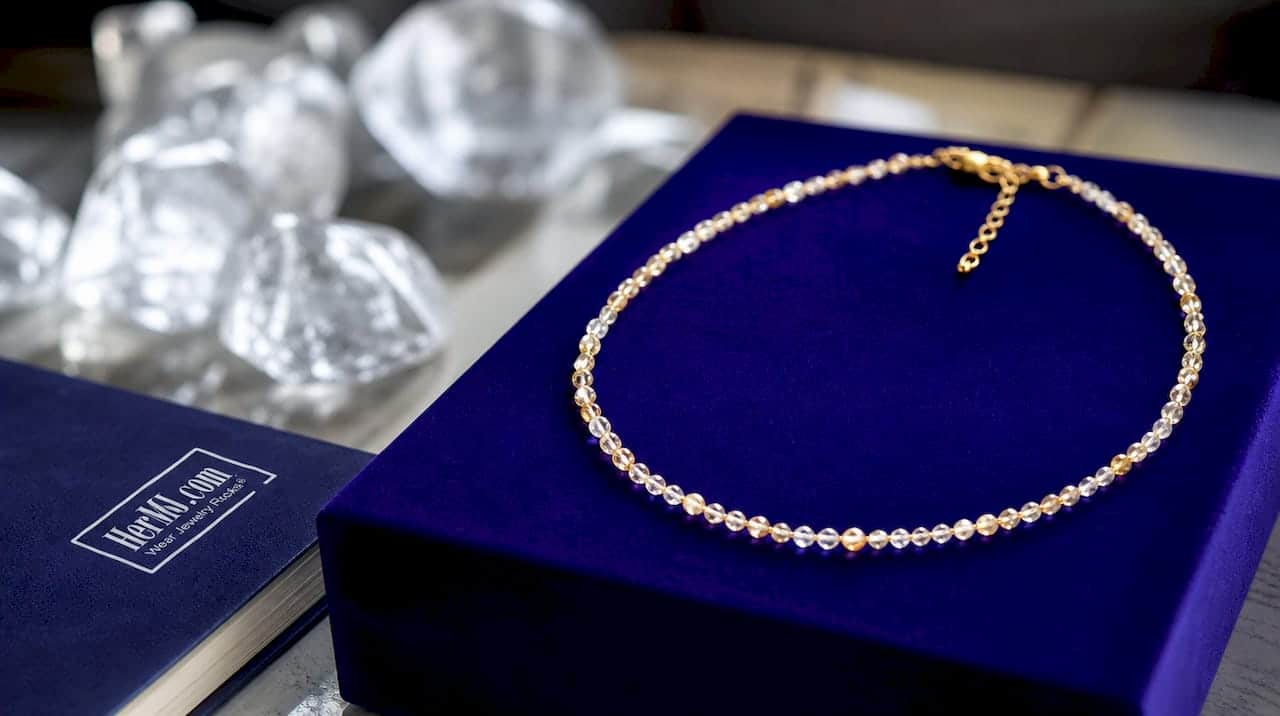
If you’re drawn to how quartz pairs with other stones, browse the full necklace collection or check out the European Crystal Jewelry line for more color contrast.
Quartz jewelry holds up well day-to-day, but skip ultrasonic cleaners and stick to a soft cloth with mild soap, since repeated heat and vibration can stress natural inclusions over time.
US orders ship free with no minimum, and international orders ship free when the order total is $150 or more.
Pick your piece, check the sizing notes on the product page, and add it to your cart. That’s really all there is to it.
Sources
- What Is Quartz Glass? Properties, Grades, Uses & Technical Guide
- How to Tell Glass From Quartz — Sciencing
- Quartz vs Glass – How To Tell Them Apart (With Photos)
- Fused quartz — Wikipedia
FAQ
How Can You Tell if Something Is Quartz or Glass?
Combine a scratch test, a cold-feel test, and a loupe check to distinguish bubbles from natural inclusions. Quartz scratches glass, stays cold longer, and rarely shows the perfectly round bubbles common in manufactured glass.
Is Quartz Better Than Glass?
Neither wins across the board. Quartz beats glass on hardness, thermal shock resistance, and UV transmission, but ordinary glass is cheaper, easier to manufacture, and perfectly adequate for everyday uses like windows and drinkware.
Is Quartz Basically Glass?
No, not structurally. Quartz is crystalline with an ordered atomic lattice, while glass is amorphous with a disordered atomic network; fused silica is the exception, chemically close to quartz but still amorphous like glass.
Will a Quartz Crystal Scratch Glass?
Yes. Quartz measures roughly 7 on the Mohs scale, compared to common glass at about 5.5, so quartz will scratch glass, though glass won’t scratch quartz.
Does HerMJ Sell Natural or Synthetic Quartz Jewelry?
Current sourcing details and pricing for specific pieces, including the Quartz Crystal Necklace, are listed on the HerMJ site, where you can also review return policy details before you buy.
Recommended
- Mohs Gemstone Hardness: Is Your Diamond A Jewelry Killer?
- How to Evaluate Gemstone Setting Handmade Quality