


Types of Gemstone Cuts: A Plain-English Guide
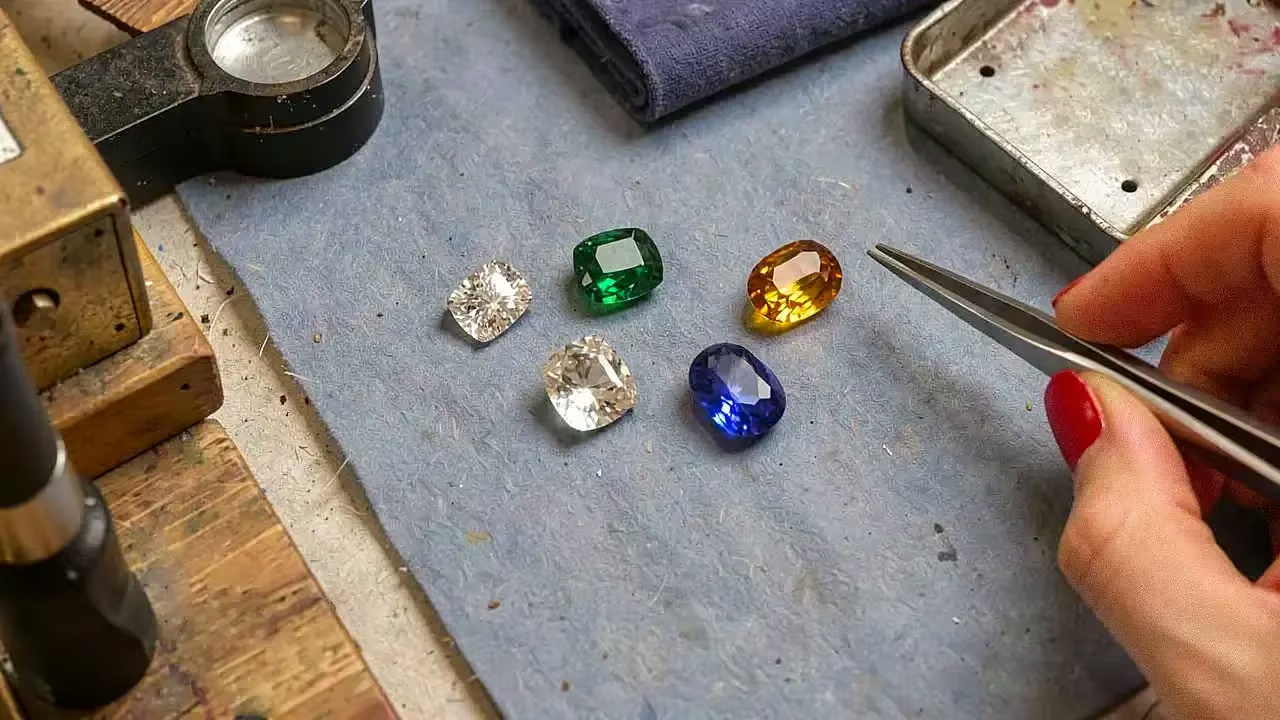
Gemstone cuts fall into a few families: brilliant cuts, step cuts, mixed cuts, cabochons, and a growing group of fancy or custom cuts.
Each family shapes light differently, so your choice of cut determines whether a stone flashes, glows, or shimmers softly.
Below, I’ll walk you through the names you’ll see in jewelry listings, what they do, and how to match a cut to the stone and the way you’ll wear it.
TL;DR:
- A cut is two things: an outline (oval, pear, cushion) and a facet style (brilliant, step, mixed, or a smooth cabochon).
- Brilliant cuts maximize sparkle, step cuts show off color and clarity, and mixed cuts balance the two.
- Cabochons suit opaque and softer stones, and they’re the sturdier pick for daily wear.
- Cushion cuts look soft and full, ovals look longer and lighter, and the stone’s color often decides between them.
- Look at the stone in person or in video: a well-cut gem has an even glow, with no dead, washed-out spots.
Cut, shape and style: three words that get mixed up
Most shoppers use “cut” to mean a stone’s outline. Jewelers use it for something broader: the way a stone’s facets are arranged.
A round brilliant, for example, is a shape paired with a particular facet arrangement, not simply a circle. That’s why two oval stones can look completely different on the same earlobe or collarbone.
It helps to separate three ideas:
- Shape is the outline you see from above: round, oval, pear, marquise, square, rectangle.
- Style is the facet pattern: brilliant, step, mixed, or a smooth dome.
- Cut quality is how well the proportions and angles were executed, which decides how the stone handles light.
Once you can read those three, a listing like “oval, mixed cut, faceted” stops being industry jargon and starts telling you what the stone will look like.
The three faceting styles
Faceting means cutting a stone into flat, polished surfaces. The International Gem Society describes it as the art and science of arranging those surfaces to maximize light performance.
Gem cutting styles fall into three basic types: brilliant, step, and mixed.
Brilliant cuts
Brilliant cuts use many triangular and kite-shaped facets arranged to send light back to your eye. The result is brilliance (the return of white light) and fire (flashes of spectral color).
Round brilliants are the best known, but ovals, pears, marquises, hearts and cushions are often cut in brilliant style too.
They’re a lovely choice for lively, clear stones such as white topaz, amethyst, citrine and quartz. The many small facets also help hide tiny blemishes, which makes brilliants forgiving for everyday pieces.
Step cuts
Step cuts use long, parallel facets that run down the stone like a staircase. They don’t scatter light into confetti. Instead, they create broad, clean flashes and a glassy, almost architectural look.
They showcase color and clarity, which is why they favor stones with rich saturation.
The emerald cut is the classic example. As the name suggests, it’s the most common cut for emeralds, partly because the shape suits the crystal and partly because the trimmed corners protect a brittle stone.
The Asscher and baguette are other step-cut outlines.
Mixed cuts
Mixed cuts combine the two: often brilliant-style facets on the crown and step facets on the pavilion, or the reverse. Cutters use them to balance sparkle with color depth.
You’ll most often see them in colored gemstones such as sapphire, garnet, tourmaline, and peridot, where the goal is a glowing hue with some life.
| Style | Look | Best for | Watch for |
|---|---|---|---|
| Brilliant | Sparkly, lively, high flash | Clear or light stones, daily statement pieces | Can look busy in very dark stones |
| Step | Calm, glassy, mirror-like | Saturated, clean stones | Shows flaws more readily |
| Mixed | Balanced glow and sparkle | Most colored gemstones | Quality varies by cutter |
| Cabochon | Smooth, deep, silky | Opaque or phenomenal stones | Little sparkle by design |
Brilliant cut vs. step cut: how to choose
This is the question I hear most often, and the answer depends on what you want your eye to do. A brilliant cut draws attention to movement. A step cut makes you notice color.
If you love shimmer that catches the light in a room, choose brilliant. If you’re drawn to a deep green, a rich blue, or a smoky tone you can almost look into, choose step. And if you can’t decide, a mixed cut gives you a bit of both.
One practical difference: step cuts have large, open facets, so inclusions and chips are easier to see. Brilliants scatter attention across many facets. Neither is better. They’re two different moods.
Cabochons: when the surface is the star
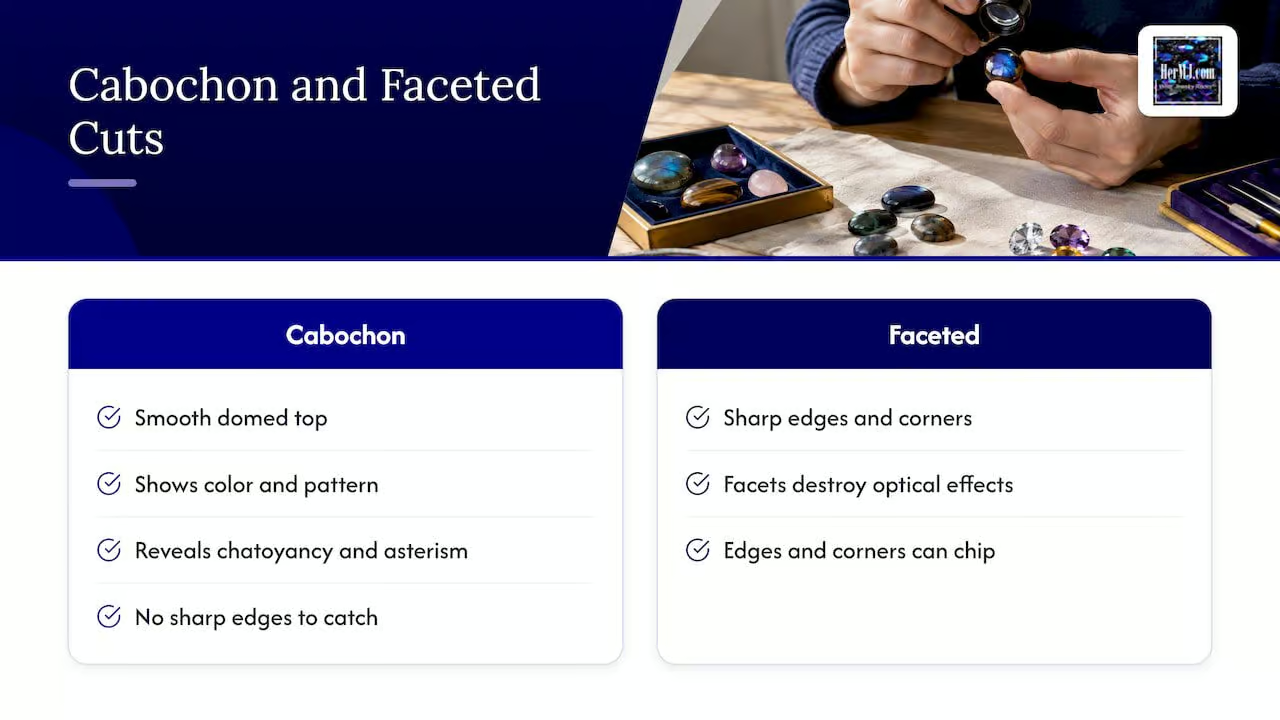
A cabochon has a smooth, domed top and usually a flat or gently curved base. It’s the oldest way to finish a gem, and it’s still the right choice for many stones.
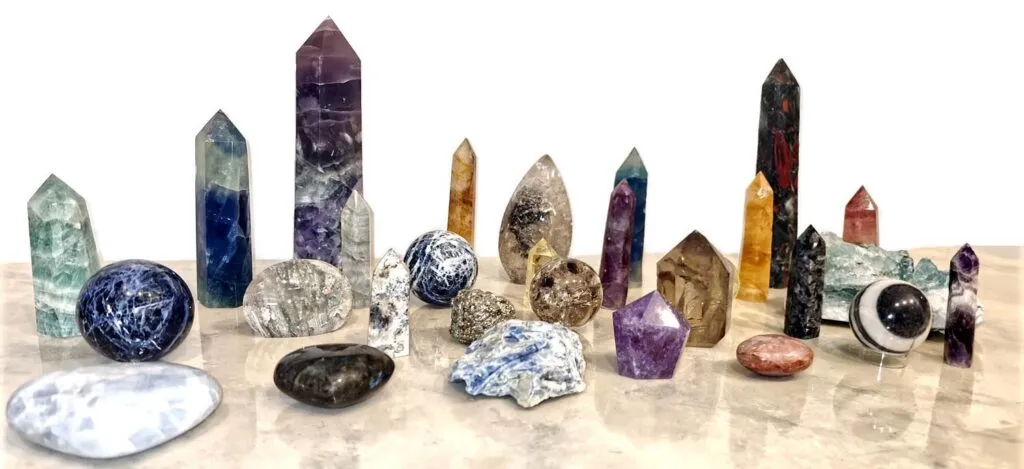
For opaque or translucent materials such as turquoise, opal, moonstone, and tiger eye, a polished dome shows color and pattern without asking light to pass through the stone.
Domed cuts also reveal optical effects like chatoyancy (the cat’s-eye band) and asterism (a star), which facets would destroy. HerMJ’s Tiger Eye Bracelet is a good example: the silky band of light is the whole point, and a cabochon lets it glide as you move your wrist.
Cabochons are also tougher in daily life. Faceted stones have sharp edges and corners that can chip, while a rounded dome has nothing to catch.
If you’re weighing the two, I’ve written a more detailed guide to choosing between cabochon and faceted gemstones, and a shorter four-question approach to cabochon or faceted.
Fancy shapes and the names you’ll see in listings
Beyond the style, you’ll see outline names. Here are the ones that come up most.
- Round: the traditional, symmetrical choice. Cut as a brilliant, it’s the benchmark for sparkle.
- Oval: an elongated round. It flatters most necklines and makes a stone look larger across the skin.
- Cushion: a squarish or rectangular stone with rounded corners, like a pillow. It looks soft and vintage.
- Pear and teardrop: one rounded end, one point. Lovely in drop earrings and pendants.
- Marquise: a long, pointed oval that creates a lengthening line.
- Emerald and Asscher: step-cut rectangles and squares with trimmed corners.
- Baguette: a slim rectangle, often used as an accent beside a larger stone.
- Rose cut: a flat base with a faceted dome of triangles meeting at a point. It glows quietly rather than sparkles.
- Briolette: a teardrop or oval covered in facets, usually drilled through the top and hung from a wire or chain.
Briolettes and beads are a favorite in handmade work because they move and catch light from every angle. They suit earrings and delicate necklaces beautifully.
Cushion cut vs. oval: which suits you
Both are soft, rounded outlines, so they’re easy to confuse in a photo. They behave differently when worn.
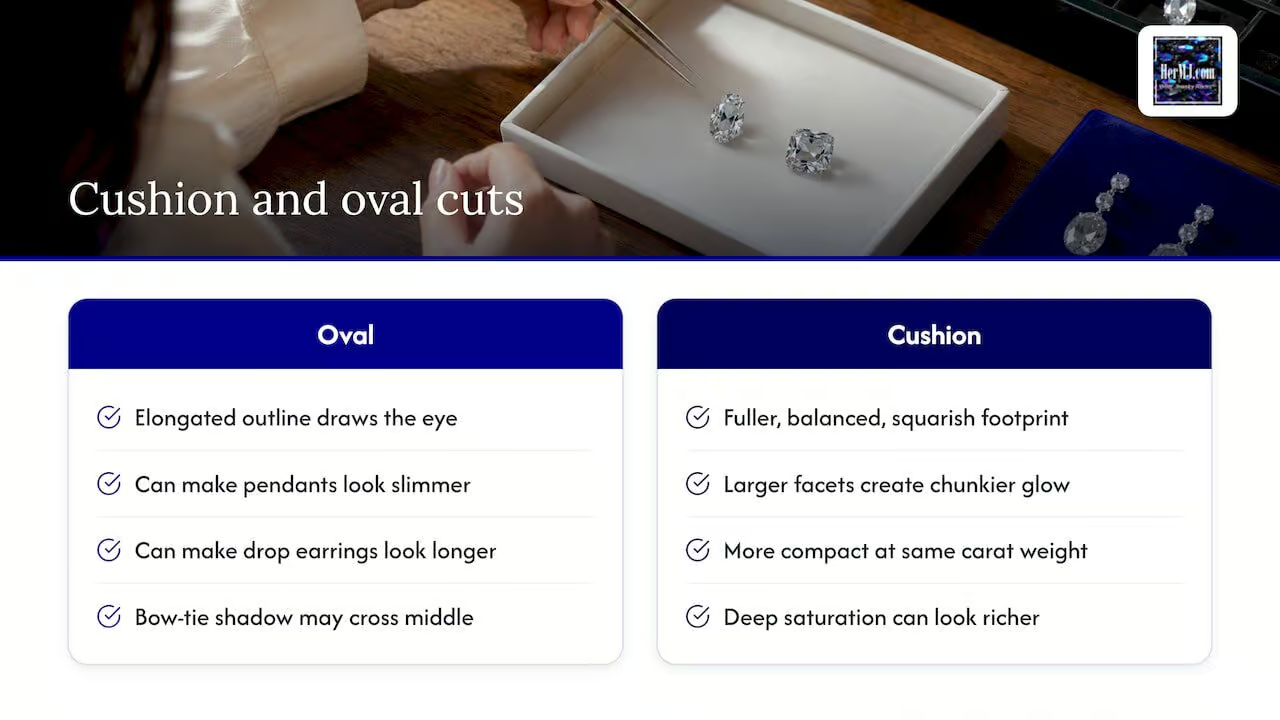
An oval is elongated. It draws the eye along a line, which can make a pendant look slimmer and a drop earring look longer.
Its color often looks even, though some stones can show a bow-tie shadow across the middle. Look for that darker band in photos; it’s one reason I encourage people to watch a video.
A cushion is fuller and more balanced, with a squarish footprint. It reads as warm and classic, and the larger facets in many cushion cuts give a chunkier, glowing look.
At the same carat weight, a cushion usually looks more compact, while an oval spreads further across the skin.
A simple rule of thumb: choose an oval if you want length and a modern line, and a cushion if you want a plush, antique feel.
Color matters too. A deeply saturated stone often looks richer in a cushion, while a pale one can look livelier in an oval.
Why cutters make the choices they do
A cut is an engineering decision. The cutter weighs the rough stone’s color, hardness, inclusions, and crystal shape, then decides how much weight to sacrifice.
Topaz is a good illustration. Its crystals are usually elongated, so cutters often cut them as long ovals or pears to save weight, and they frequently give strongly colored rough an emerald cut because that style maximizes color.
In emeralds, the cutter must consider depth of color, durability, and inclusions, and may cut deeper to darken a pale stone or shallower to lighten a dark one.
That’s why an “ideal” cut in colored stones isn’t always about perfect mathematics. Color usually drives value, so a good cutter will give up a little brilliance or weight to bring out the most beautiful hue.
How to spot a well-cut stone
You don’t need a loupe. You need patience and good light.
- Look for an even glow. Tilt the stone. It should stay lively across most of its surface.
- Check for windows. Poor proportions can leave flat, washed-out areas where light passes straight through, so the stone looks see-through or lifeless in the center.
- Check for extinction. Dark patches near the edges that don’t brighten when you move are a sign that light is leaking away.
- Match facets to size. The number of facets should relate to the finished size of the gem, so a tiny stone doesn’t need dozens, and a large one shouldn’t look sparse.
- Look at symmetry. The outline should be even, and the facets should meet cleanly at the edges.
- Ask to see it moving. A short video tells you more than a single still photo.
Setting quality matters too. A beautiful cut can still be undone by a loose or clumsy mount, and my guide to evaluating handmade gemstone setting quality covers what to check.
Custom and fantasy cuts
Designers are moving beyond traditional layouts. Fantasy and sculpted cuts use curved surfaces and unusual geometry to create optical effects standard facets can’t.
GIA research on nontraditional cutting describes cuts that combine curved surfaces with plane facets to use light in new ways.
They can be stunning, but they come with a trade-off. These cuts generally leave less room to hide inclusions, so they work best with clean material, and that tends to raise the cost.
If you’re drawn to one, it’s worth understanding how a custom piece comes together, and my guide to what a custom gemstone piece is explains the process.
For a broader look at how cuts influence design, see how gemstone cutting shapes light and jewelry design.
Faceted crystals, glass and glittering alternatives
Not every faceted piece in a jewelry box is a natural gemstone. Crystal glass and rhinestones are also faceted to sparkle, and they’re common in eveningwear and costume pieces.
If you’re comparing them for a special occasion, this overview of rhinestones versus crystals for bridal and stagewear explains how they differ in wear.
With natural stones, the cut works with real material that has its own color, hardness, and quirks, and that’s part of their charm.
My perspective on choosing a cut
I design with the stone first, then the cut. A gem tells me what it wants: a dark, saturated garnet often looks richest with larger, simpler facets, while a clear quartz can carry a brilliant pattern with ease. A moonstone or tiger eye belongs in a dome.
You should also think about the life of the piece. A bracelet knocks against desks and door frames, so a smooth cabochon or a well-protected faceted bead is often the smarter choice.
Earrings are gentler on stones, so that’s where we love a pear or briolette that swings and catches light.
HerMJ aims for craftsmanship that feels special without the luxury price, and a thoughtful cut is a big part of that.
My golden rule: pick the cut you’ll still love when the novelty fades. Sparkle is wonderful, but you’ll reach for the stone that feels like you every morning.
— Veronique
Shop cuts you can see and wear
If you’d like to see these cuts in real pieces, browse our necklaces for pendants and beads in faceted and smooth finishes, or our bracelets for cabochons built for daily wear.
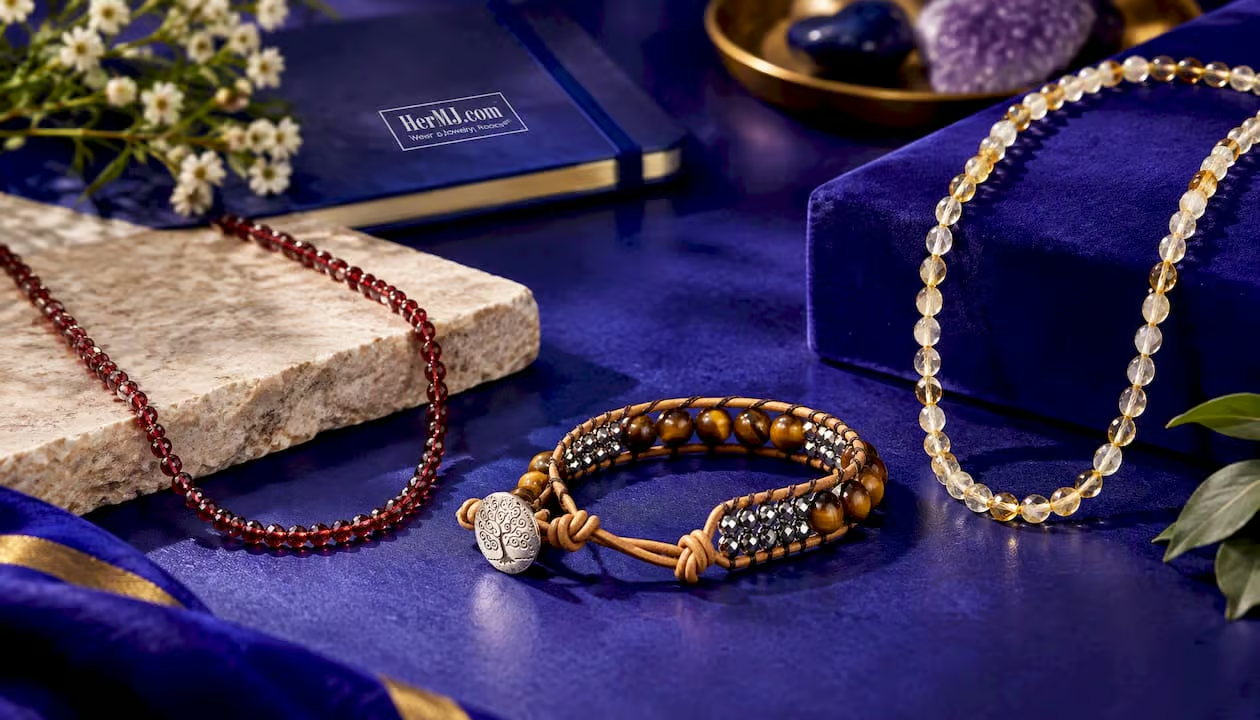
The Faceted Garnet Gemstone Necklace shows how faceting can deepen a stone’s color, and our modern drop earrings are a good place to see pears and briolettes in motion. US orders ship free with no minimum.
FAQ
What are the main types of gemstone cuts?
The three basic faceting styles are brilliant, step, and mixed. Cabochons, which are smooth and domed, form a separate group, and fancy or custom cuts cover everything else. Within each, you’ll see outline names like round, oval, cushion, pear, and emerald.
What’s the difference between a cabochon and a faceted gemstone?
A faceted stone has polished flat surfaces arranged to reflect light, so it sparkles. A cabochon has a smooth dome that shows color, pattern, or effects like a cat’s-eye. Cabochons are generally sturdier for daily wear because they lack sharp edges.
Is a cushion cut or an oval cut better?
Neither wins outright. Cushions look fuller and softer, while ovals look longer and can make a stone seem larger across the skin. Choose based on the look you want and how the stone’s color shows in each shape.
Does the cut change a gemstone’s price?
Yes. Cut quality affects how much light and color a stone shows, and cutters often trade weight for color, so two stones of the same size can be priced differently. Fancy and sculpted cuts can cost more because they need cleaner, larger rough.
Sources
- A Guide to Gem Cutting Styles, International Gem Society
- What Is Faceting? International Gem Society
- Emerald Quality Factors, GIA
- Topaz Quality Factors, GIA
- Colored Stone Cut Quality: What to Look For, GIA
- Curves and Optics in Nontraditional Gemstone Cutting, GIA
Recommended
- How Gemstone Cutting Shapes Light and Jewelry Design
- Choosing Between Cabochon vs. Faceted Gemstones
- Choosing Between Cabochon vs. Faceted Gemstones
- GIA Optics: 4 Questions to Choose Cabochon or Faceted