


GIA Optics: 4 Questions to Choose Cabochon or Faceted
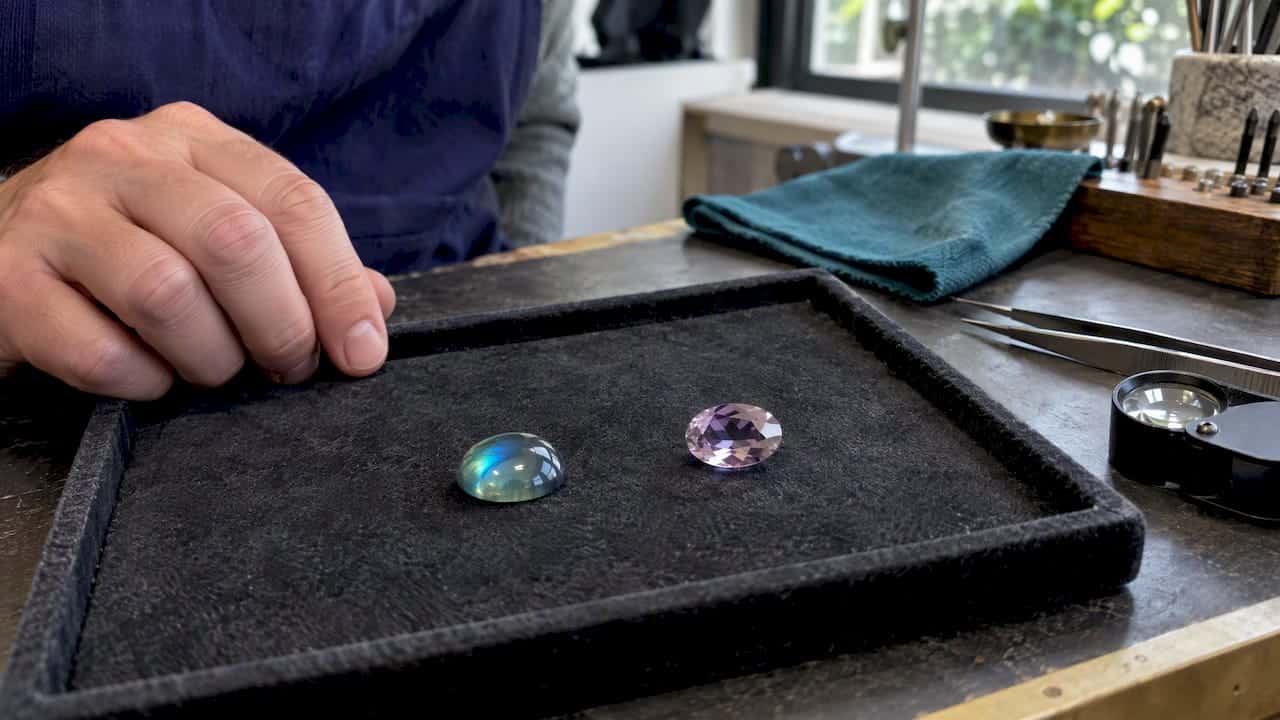
Choose a cabochon when you want to showcase color or optical phenomena like a cat’s-eye or star, and choose a faceted cut when you want sparkle and light return.
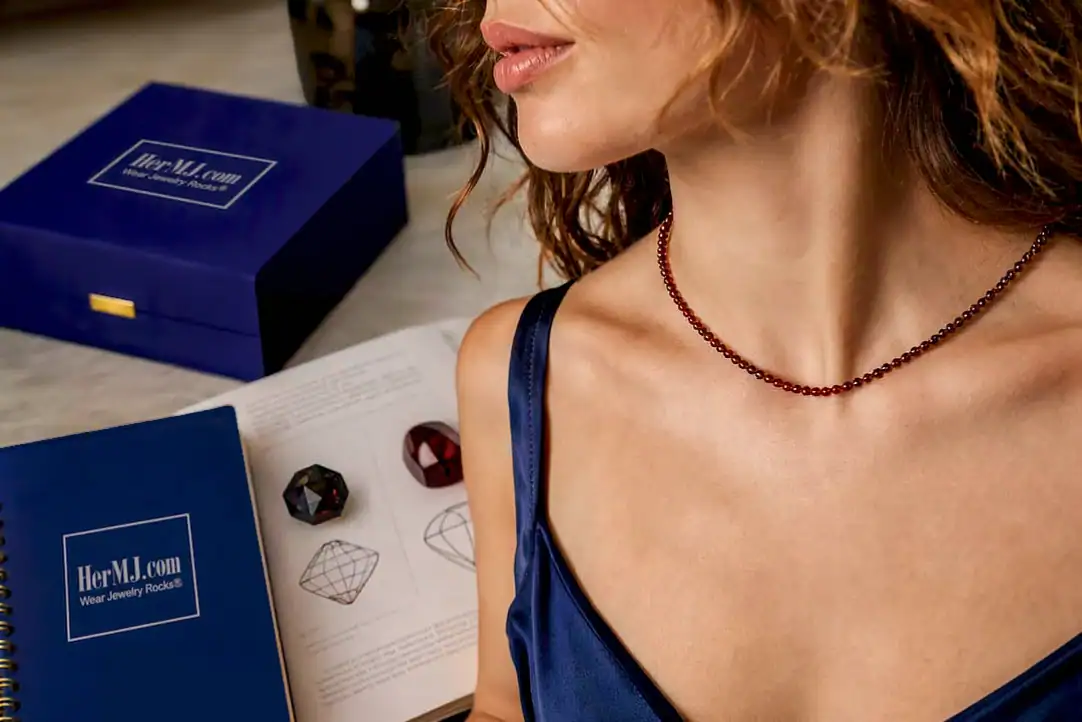
Choose a gem cut and a shape that match how often you plan to wear a piece, since softer or phenomenal stones are almost always cut as cabochons. HerMJ’s Faceted Garnet Gemstone Necklace is a good example of what a transparent, faceted stone can do for an everyday piece.
The Edit
- Cabochons preserve more rough material weight and display optical effects like star or glow, making them ideal for phenomena-dependent stones like star sapphire.
- Faceted cuts maximize brilliance and sparkle through multiple flat surfaces, best suited for transparent, high-clarity gemstones such as diamonds and fine sapphires.
- Rarity, clarity, and optical effects influence whether a stone is cut as a cabochon or faceted, with certain phenomena only possible in cabochons.
- Durability and setting type are crucial; bezel settings protect cabochons’ domes, while tougher, high-hardness stones are better in prong settings for sparkle.
- Price differences are generally driven by rarity and cutting effort, with cabochons often cheaper due to lower labor and clarity requirements, unless they feature rare phenomena.
What is a cabochon, and why do cutters choose it?
A cabochon is a gem cut and polished into a smooth dome, usually with a flat or gently convex back.
You’ll see them in ovals, rounds, and freeform shapes, and ellipses tend to look more balanced to the eye than perfect circles, according to background on cabochon cutting.
Cutters reach for this shape for a few practical reasons.
It preserves more of the rough material’s weight than faceting does, it shows off color and internal patterns instead of breaking them up, and it’s the only way to reveal certain optical effects at all.
A cabochon’s dome acts like a lens, focusing light scattered by parallel needle-like inclusions into a visible line or star, and even small changes in dome height can sharpen or blur that effect, as explained in GIA’s research on phenomenal gemstones.
Gems commonly cut this way include:
- Star sapphire and star ruby, for asterism
- Tiger’s eye and cat’s-eye chrysoberyl, for chatoyancy
- Moonstone, for its glowing adularescence
- Opal and turquoise, for color and pattern
What is a faceted cut, and how does it create brilliance?
Faceting covers a gem with flat, polished surfaces arranged to control how light enters and exits.
The main parts are the table on top, the crown around it, the girdle at the widest point, and the pavilion below.
A standard round brilliant diamond has dozens of facets, each placed according to proportion and symmetry standards that GIA’s cut grading relies on to judge visual performance.
Facet geometry is what produces brightness, fire, and scintillation (the flashes you see as a stone moves). Cutters plan contrast patterns, alternating light and dark zones, so the stone stays brilliant from multiple angles rather than looking flat or showing a dull “nail head” in the center.
Faceting works best on transparent, high-clarity material where light can travel cleanly through the stone.
That’s why it’s the standard choice for:
- Diamond
- Clean sapphire and ruby
- Emerald with good transparency
- Garnet, citrine, and amethyst of decent clarity
Optical differences: how each cut handles light, color, and special effects
Faceted stones and cabochons solve the same problem, making a gem look its best, but with opposite strategies.
Faceting breaks the surface into many small mirrors that bounce light back toward your eye, building brightness and sparkle.
Cabochons keep one continuous curved surface that behaves more like a lens, gathering and focusing light rather than scattering it into flashes.
A few things determine which approach wins for a given stone:
- Transparency decides whether faceting can even work; opaque and translucent material won’t show fire no matter how it’s cut.
- Inclusions that would ruin clarity in a faceted stone are often the exact feature a cabochon is cut to display, like the fibers behind a cat’s-eye.
- Color saturation matters too: GIA’s work on optimizing face-up appearance notes that maximizing brightness can wash out saturation in some colored stones, so cutters sometimes trade a bit of sparkle to keep the color rich.
- Dome shape controls how sharp a star or eye looks, with cutters adjusting curvature to reduce blur.
Pro Tip: If you’re comparing two similar stones in a shop, tilt each one under a single light source: a faceted gem will flash distinct points of light, while a cabochon will show a soft glow, a moving band, or a star that seems to glide across the dome.
Common gemstones and typical cut choices
Most gem species have a default cut buyers expect, although clarity can override the rule. Garnet is a good example: fine, clean material gets faceted, while lower-clarity rough is often cut as a cabochon to hide inclusions while keeping the color.
Typical pairings look like this:
- Cabochon by default: opal, moonstone, star sapphire, chrysoberyl, turquoise
- Faceted by default: diamond, clean sapphire, fine emerald, top-grade garnet
- Either, depending on clarity: ruby, amethyst, citrine, lower-grade corundum
For a handful of stones there’s no real choice. Star sapphire, star ruby, and cat’s-eye chrysoberyl have to be cut as cabochons, since faceting would cut straight through the fibrous inclusions that create the phenomenon in the first place.
Durability, settings, and care for each cut
Choosing a cut is only half the decision. How you set and wear the stone determines whether it survives daily life.
Durability isn’t one number: it’s a combination of hardness, toughness, and stability, and the Mohs scale alone misses impact resistance entirely.
A stone can be hard enough to resist scratches and still chip or crack under a sharp knock, which matters more for jewelry you’ll wear often.
Setting choice follows from that.
A bezel wraps metal fully around the stone’s edge, protecting a cabochon’s dome and shielding a faceted stone’s vulnerable girdle and exposed facet edges.
Prong settings leave more of a faceted gem’s surface open to light, boosting sparkle but also exposing it to knocks, so they suit harder, tougher stones better than fragile ones.
A few practical habits help either way:
- Clean gemstone jewelry with mild soap and a soft cloth, not ultrasonic cleaners, for porous or treated stones.
- Save fragile or cleavage-prone gems like opal for pendants and earrings instead of pieces that take daily knocks.
- Check my guide on Mohs hardness and scratch risk before pairing softer stones with harder ones in the same piece.
How to choose between cabochon and faceted for your next piece
Start by naming what you actually want the stone to do. Phenomena like asterism or chatoyancy only exist in cabochons, so if that’s the appeal, you’ve already made your cut choice.
If you’re after sparkle and fire, faceted is the only direction that gets you there.
A short checklist helps once you know your priority:
- Decide if you want color and phenomena, or brightness and sparkle.
- Factor in how often you’ll wear the piece, since daily wear favors tougher stones and protective settings.
- Set a budget range, since rough yield and cutting labor both affect price.
- Ask about rarity: a strong star or eye effect in a cabochon can be harder to source than a clean faceted stone of the same species.
Styling follows the same logic, as seen in curated gemstone jewelry trends and styling inspiration. Cabochons tend to read as warm and organic, which suits pendants and statement earrings, while faceted stones bring structure and shine that work well in necklaces and drop earrings. For room pieces or display stones, larger cabochons often show off color and pattern better than small faceted gems ever could. Our piece on how cutting shapes design goes further into matching cut to setting style.
Pro Tip: When buying a cabochon, ask about dome height and curvature; when buying a faceted stone, ask about facet symmetry and clarity grade. Both questions tell you more about quality than the carat weight does.
How we choose cuts for our artisan pieces
HerMJ works with genuine pearls, gemstones, and crystals, and the cut decision shapes nearly every piece we offer.
A faceted garnet earns its place in a necklace because the stone’s clarity supports real sparkle, while an opal or moonstone accent calls for a cabochon so its glow stays front and center instead of getting cut away.
— Veronique
Find your cut: faceted sparkle or cabochon glow
If the garnet’s faceted brilliance caught your eye earlier, our Faceted Garnet Gemstone Necklace is cut to show exactly that kind of light return in an everyday piece.
Browse the full Necklaces category for more faceted and cabochon options, or explore our Pearl and Gemstone Jewelry collection if you’re still deciding.
- Shipping details and costs vary; U.S. orders ship free nationwide, and international orders of $150 or more ship free.
- Check Bracelets, Modern Drop Earrings, and Room Jewelry for more ways to wear either cut.
FAQ
Why are cabochons so inexpensive?
Cabochon stones can be lower in clarity, so they cost less to source than clean material faceting requires. Cutting a cabochon also takes less precision time than faceting, which keeps labor costs down for standard shapes and sizes.
Are cabochons more expensive than faceted stones?
Not usually, though a cabochon showing a strong, sharp star or cat’s-eye can cost more than an average faceted stone of the same species, since that phenomenon is rare and hard to source well. Price mostly tracks rarity and cutting skill rather than the cut style itself.
What are the different types of cabochons?
Cabochons are generally grouped by shape (oval, round, freeform) and by back style (flat-backed or double-sided, called a “double cabochon”). Within those shapes, dome height varies from low and shallow to high and steep, which changes how visible a color or phenomenon appears, per GIA’s gemstone optics research.
What does it mean if a stone is faceted?
A faceted stone has been cut with multiple flat, polished surfaces, typically arranged into a table, crown, and pavilion, to maximize brightness and sparkle. This cutting style suits transparent, high-clarity gems like diamond, sapphire, and fine garnet, as GIA’s cut guidance explains.
Sources
- Gems & Gemology — Phenomenal gemstones (GIA Summer 2025)
- Diamond cut | Understanding the cut scale | GIA 4Cs
Recommended
- How Gemstone Cutting Shapes Light and Jewelry Design
- How to Choose Gemstone Jewelry for Holiday Gifting