


How Gemstone Cutting Shapes Light and Jewelry Design
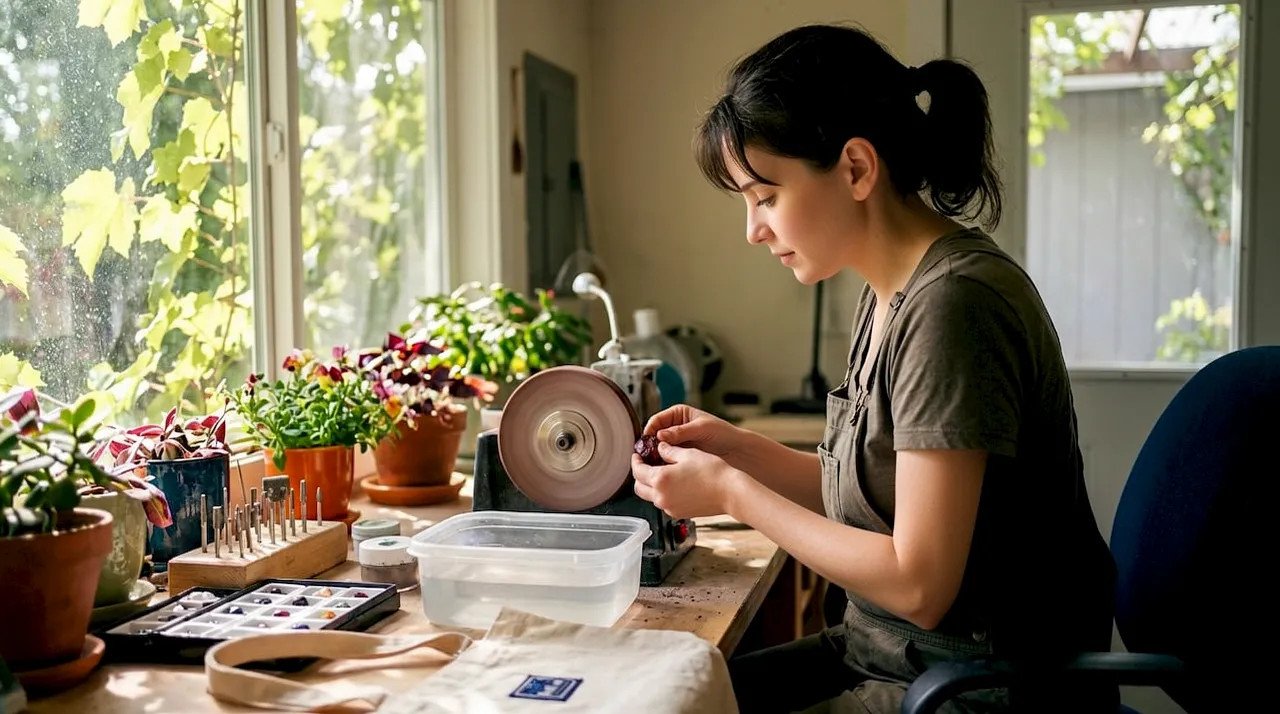
Gemstone cutting is the human craft that determines how a gem interacts with light and, by extension, how designers use it in jewelry.
Before a stone ever reaches a setting, a cutter’s decisions about facet angles, proportions, and orientation have already fixed its brilliance, fire, scintillation, perceived color, and usable face-up size.
The Gemological Institute of America (GIA) and the International Gem Society (IGS) both treat cut as the single most design-consequential variable in gem finishing. At HerMJ, that principle guides every piece we select and craft.
The immediate design impacts of cutting include:
- Color emphasis vs. sparkle: A shallower crown angle pushes brightness; a steeper one intensifies spectral fire and color saturation.
- Setting choice: Deep pavilions call for closed-back or bezel settings; high-brilliance cuts open naturally to prong or halo mounts.
- Apparent size: A well-proportioned table maximizes face-up area, making a stone look larger than its carat weight suggests.
- Market value: A well-cut gem commands a substantially higher price than an identical stone with poorer cutting, often more so than small differences in clarity.
What does gemstone cutting actually mean, and what are the Five Ps?
People often use “cut” and “shape” interchangeably, but they describe two different things.
Shape is the outline you see from above: round, oval, pear, cushion, emerald.
Cut is the internal architecture: the arrangement of facets, their precise angles, their proportions, and the quality of their finish. You can have two oval stones with identical outlines where one blazes with light and the other looks glassy and flat. That difference is entirely the cut.
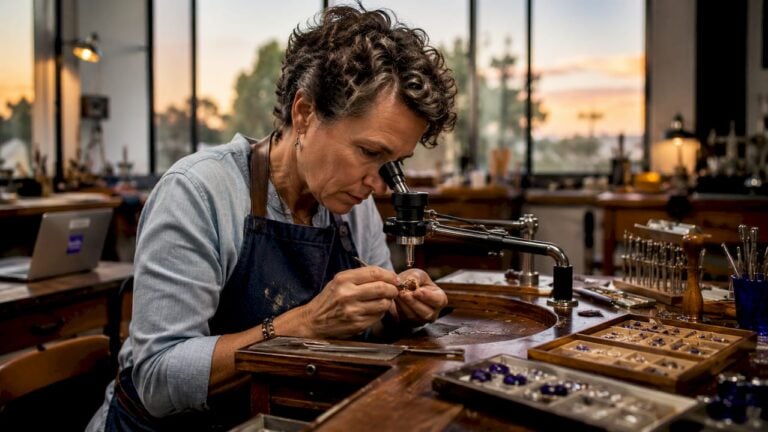
The craft responsible for this is lapidary, specifically faceting. As the IGS notes, faceting is the only one of the traditional Four Cs (cut, color, clarity, carat) that reflects pure human skill.
Nature determines the other three; the cutter controls this one entirely. That’s a meaningful distinction when you’re evaluating a finished piece.
The IGS describes the Five Ps as the practical framework cutters use to balance optical outcomes:
- Proportion: The overall relationship between crown height, pavilion depth, and girdle thickness relative to the stone’s diameter.
- Ratios: Length-to-width ratios that determine if an oval reads as graceful or stubby, or a cushion looks square or rectangular.
- Shape: The chosen outline and how well the cutter has executed its geometry.
- Positioning: How the rough is oriented before cutting to favor a preferred hue, hide inclusions, or manage color zoning.
- Polishing: The final surface quality that determines how cleanly light enters and exits each facet.
Consider two garnets of identical color and clarity. Orient one with its color axis perpendicular to the table and polish it to a high grade; orient the other carelessly and leave micro-scratches on the pavilion facets.
The first stone will appear richer and more saturated face-up.
The second will look washed out. Same rough, same chemistry, entirely different result.
How does cut control light performance in a gemstone?
Every faceted gem is, in optical terms, a miniature light-management system. Light enters through the crown (the upper portion above the girdle), reflects off pavilion facets (the lower cone), and returns to your eye through the crown.
The table is the large flat facet on top; the girdle is the narrow band at the widest point; the culet is the tiny point or facet at the very bottom.
Brilliance, fire, and scintillation defined
- Brilliance is the white light returned to the eye from internal and external reflections. It’s what makes a stone look bright.
- Fire is the dispersion of white light into spectral colors, those flashes of red, orange, and violet you see when a gem moves.
- Scintillation is the pattern of light and dark that shifts as the stone, the observer, or the light source moves.
These three qualities depend on facet geometry. Crown and pavilion facets must meet at precise angular relationships to maximize light return.
For a brilliant-style cut, ideal angles run approximately crown ~35° and pavilion ~41°, though the exact values shift with each material’s refractive index (RI).
Why refractive index matters
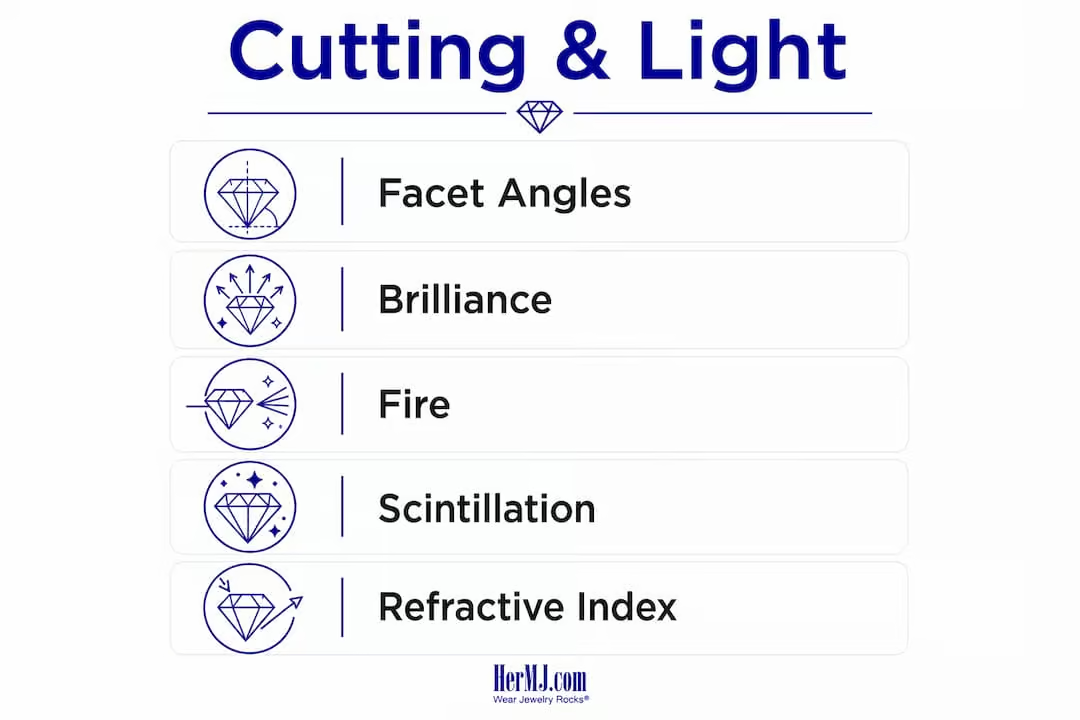
Every gem material has a characteristic RI that determines its critical angle: the minimum angle at which light striking a pavilion facet will reflect back up rather than escape through the bottom.
A cutter who ignores the critical angle risks windowing, a visible zone of transparency in the center of the stone where light leaks straight through the pavilion instead of returning to the eye. The opposite failure, cutting the pavilion too steeply, creates extinction: large dark areas where no light returns at all.
| Optical Outcome | Cause | Visible Effect |
|---|---|---|
| Brilliance | Correct pavilion angle, full internal reflection | Bright, white-light return across the crown |
| Fire | Steeper crown angle, high dispersion material | Spectral color flashes when stone moves |
| Scintillation | Precise meetpoints, varied facet sizes | Dynamic light-and-dark pattern in motion |
| Windowing | Pavilion angle too shallow for the stone’s RI | Transparent “window” visible through the table |
| Extinction | Pavilion angle too steep | Large dark patches, dull face-up appearance |
The key insight from GIA research: For colored gemstones, optimizing face-up appearance often means prioritizing color saturation over maximum brightness. Computer modeling and contrast maps (tools like ASET and Angular Spectrum Evaluation Tool) help cutters choose facet combinations that preserve a stone’s hue while still improving scintillation.
For colored stones, a too-bright cut can actually wash out the very hue collectors prize most. That trade-off is one of the most nuanced decisions in gemstone craftsmanship.
Which cuts do designers choose, and why?
Cut selection is rarely arbitrary. Designers choose facet patterns based on what they want the stone to do in a specific piece, if the end result is blazing with white light, glowing with saturated color, or offering a quiet, architectural elegance.
Common cuts and their visual personalities
- Round brilliant: Maximizes brilliance and fire through 57–58 precisely arranged facets. The default choice when sparkle is the priority, especially for diamonds and colorless stones.
- Step cuts (emerald, Asscher, baguette): Long, parallel facets create a hall-of-mirrors effect. They emphasize clarity and color depth over sparkle, making them ideal for stones with exceptional transparency or saturated hues.
- Mixed cuts (cushion, radiant, oval brilliant): Combine brilliant-style pavilions with modified crowns to balance color saturation and light return. Designers reach for these when a colored stone needs both presence and sparkle.
- Cabochon: A domed, unfaceted surface that showcases phenomena like asterism (star stones), chatoyancy (cat’s eye), and adularescence (moonstone). No facets means no fire, but the organic glow is irreplaceable.
- Custom facet patterns: Freeform or designer cuts that a cutter creates specifically for a stone’s shape, inclusions, or the designer’s visual concept.
Diamonds vs. colored stones: different priorities
Diamonds are typically cut to maximize brilliance and fire because colorlessness is their chief virtue. Colored gemstones follow a different logic.
A deeply saturated Burmese ruby or a vivid Paraíba tourmaline may benefit from a slightly shallower pavilion to keep the color from appearing too dark face-up. The gemstone grading criteria for colored stones weigh hue, tone, and saturation heavily, so the cutter’s job is to present the best possible color, not the most light return.
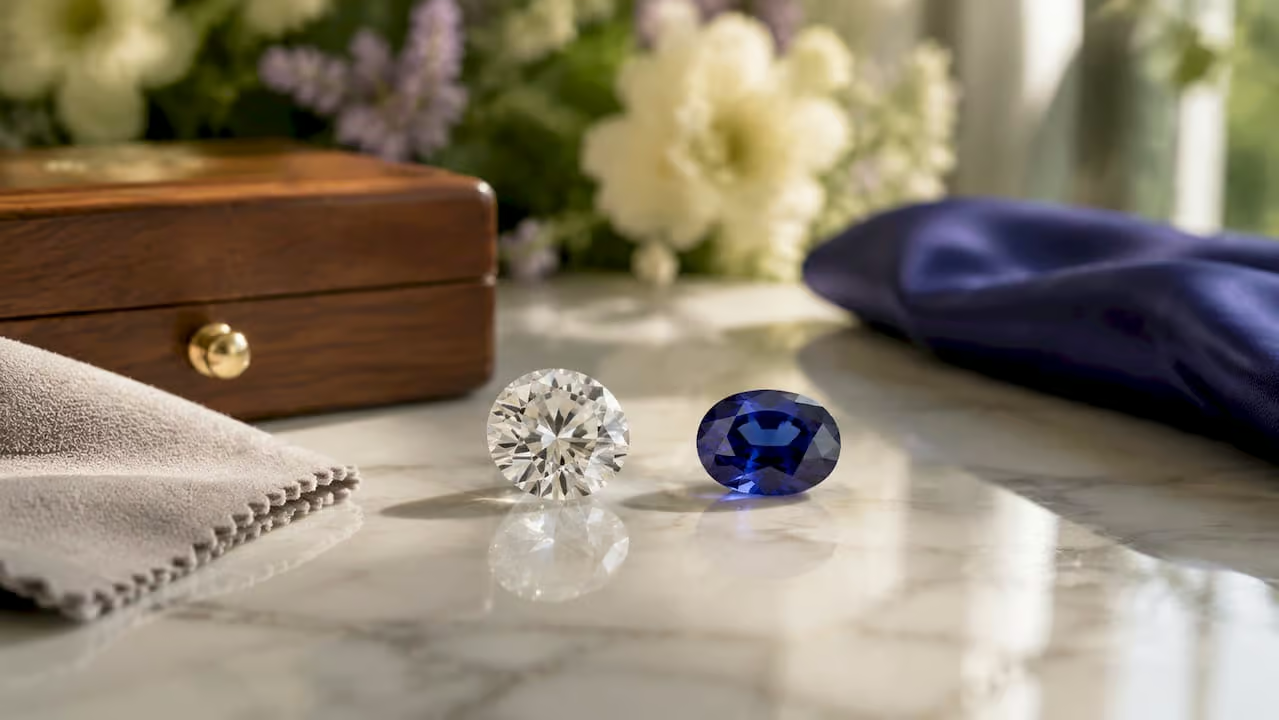
| Cut Type | Best For | Typical Design Use |
|---|---|---|
| Round brilliant | Maximum sparkle, colorless or near-colorless stones | Pendants, earring studs, halo necklaces |
| Emerald/step | Clarity showcase, deep color saturation | Statement pendants, earrings, brooches |
| Oval/cushion brilliant | Balance of color and sparkle | Drop earrings, pendant centerpieces |
| Cabochon | Optical phenomena, opaque or translucent gems | Organic-style pendants, decor accents |
| Custom / freeform | Unique rough shapes, designer-specific concepts | One-of-a-kind statement pieces |
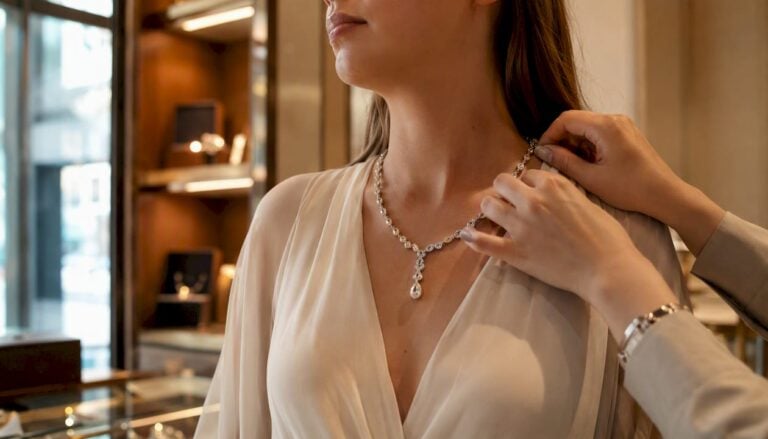
For necklace and pendant designs, step cuts and oval brilliants tend to photograph beautifully because their larger table facets catch directional light.
Earrings benefit from cuts with strong scintillation since they move with the wearer. Home decor accents, like faceted crystal centerpieces, often use custom or freeform cuts that scatter light across a room rather than concentrate it.
How do material properties constrain a cutter’s decisions?
A cutter never works in a vacuum. The rough stone itself sets the boundaries, and understanding those constraints is what separates artisan cutting from mechanical production.
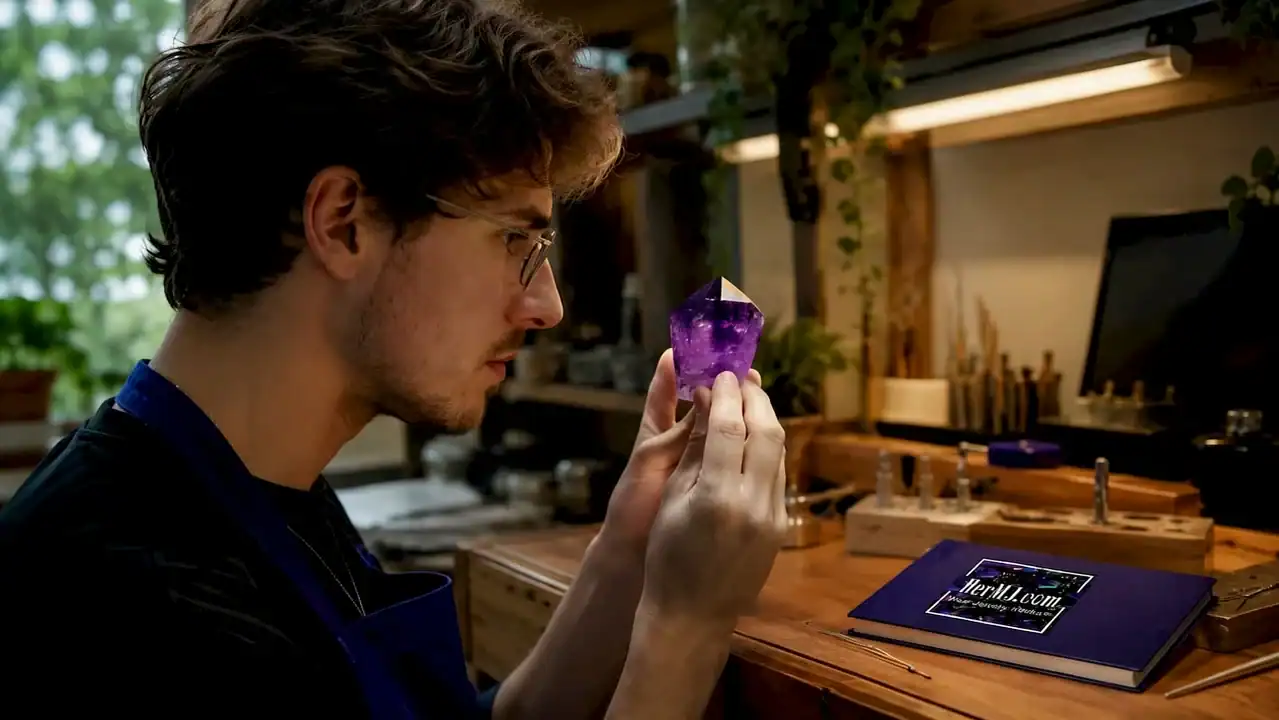
Cleavage planes are directions of atomic weakness where a stone will split cleanly if struck. Topaz, for example, has perfect basal cleavage, meaning a cutter must orient facets to avoid creating stress along that plane in the finished piece. A poorly oriented topaz can chip at the girdle during setting or even in daily wear.
Inclusions are internal features: crystals, fractures, needles, or clouds. Cutters frequently sacrifice geometric symmetry to retain carat weight or to position inclusions where the setting’s prongs or bezel will conceal them. That’s an intentional design decision, not a flaw in workmanship.
Color zoning occurs when a rough crystal concentrates its color unevenly. Amethyst, for instance, often carries its deepest purple near the base of the crystal. A skilled cutter orients the rough so that the concentrated color zone sits at the pavilion tip, where it reflects back through the entire face-up area and makes the whole stone appear evenly saturated.
Pleochroism adds another layer. Tanzanite shows three distinct colors depending on the viewing angle: blue-violet, burgundy, and bronze. Cutters orient pleochroic stones so the preferred hue, usually the blue-violet in tanzanite, dominates face-up. That orientation choice directly changes the finished silhouette because the cutter may need to accept a slightly different outline shape to achieve the right color axis.
Hardness affects wearability in design. A stone with a Mohs hardness below 7 (like fluorite or opal) is more susceptible to surface scratching in everyday wear. Cutters working with softer materials often choose thicker girdles and avoid sharp points, like the tips of a marquise, that could chip in a pendant or earring setting.
How has gemstone cutting evolved, and what do modern tools make possible?
The history of lapidary is essentially the history of humans learning to see inside a stone. Ancient craftspeople polished gems into cabochons, relying on surface luster alone.
By the 14th century, European lapidaries had developed point cuts and table cuts, flat-topped stones that were the first true faceted gems. The rose cut, with its domed crown of triangular facets and flat base, became fashionable in the Baroque era and has seen a strong revival in contemporary design.
The round brilliant as we know it emerged in the early 20th century, when Marcel Tolkowsky published his mathematical analysis of ideal diamond proportions in 1919. That work established the angular relationships (crown ~35°, pavilion ~41°) that remain the benchmark for brilliant-style cutting today.
Modern tools have transformed what’s possible:
- CAD and 3D modeling let cutters simulate a stone’s face-up appearance before a single facet is ground, reducing waste and allowing designers to preview a finished gem in a specific setting.
- Laser sawing cuts through rough with minimal kerf loss, preserving more carat weight than traditional saw blades.
- Computer-aided facet planning with contrast maps (ASET, Angular Spectrum Evaluation Tool) shows exactly which facets return light and which create extinction, guiding angle adjustments before polishing.
- Precision polishing machines hold facets to tolerances that manual lapping can’t consistently achieve, producing the sharp meetpoints that mark skilled workmanship.
These tools also change how cutters and designers collaborate. A designer can now receive a CAD simulation of a proposed cut, review the face-up appearance in the intended lighting environment, and request adjustments before the stone is committed.
That kind of iterative dialogue was simply not possible before digital modeling.
How should a gem’s cut drive your design choices?
The cut isn’t just a feature of the stone; it’s a set of instructions for the designer. Once you understand what a cut is doing optically, the right setting, metal, and silhouette become much clearer.
Matching settings to optical goals
A deep-pavilion colored stone with strong saturation benefits from a bezel or closed-back setting that reflects light back up through the pavilion, intensifying color.
An open prong setting on the same stone lets light escape from the sides and can make the color look thinner. Conversely, a high-brilliance round brilliant needs an open prong or halo setting that exposes the pavilion to ambient light from below, maximizing the white-light return that makes the stone blaze.
Metal color and perceived gem color
Warm metals (yellow gold, rose gold) amplify warm-toned stones: garnets, citrines, warm sapphires. They add a golden cast that deepens the stone’s apparent warmth. White metals (platinum, white gold, sterling silver) work best for cooler stones like aquamarine, blue topaz, and amethyst, and they maximize perceived brightness in any stone by not competing with the gem’s color.
For seasonal styling, these pairings shift with trend cycles, but the optical logic stays constant.
Silhouette and scale
A large table facet maximizes face-up area, making a stone read as bold and statement-worthy in a pendant. A smaller table with a higher crown creates more fire and depth, which reads better at earring scale where the stone is seen from a distance and in motion.
For home decor accents, like faceted crystal centerpieces, a larger table and a shallower crown scatter light broadly across the surface, which is exactly what you want for anambient effect.
Pro Tip: When working with pleochroic stones in multi-stone designs, orient every stone with the same color axis facing up. A necklace with five tanzanites where three show blue-violet and two show bronze looks unintentional rather than artful.
What should you ask before commissioning or buying a cut stone?
If you’re working with a cutter directly or selecting a finished stone, a few focused questions will quickly tell you if the workmanship is worth the price.
Before cutting begins (commissioned work):
- How will you orient the rough to favor the preferred hue?
- Will you prioritize color saturation or maximum carat yield?
- Can you show me a CAD simulation or contrast map before final polish?
- How do you handle inclusions near the girdle or table?
When evaluating a finished stone:
- Are the meetpoints sharp and precise, or do facets miss each other slightly?
- Is there windowing visible when you hold the stone over a light source?
- Does the face-up color look even, or are there darker and lighter zones?
- What’s the polish grade, and was it done by hand or machine?
As Blue Nile’s buyer guidance notes, asking if the cutter can show ASET or contrast maps before final polish is one of the clearest signals of a serious artisan operation versus a production house.
Typical timeline and cost drivers
Custom cutting for a single stone generally runs two to six weeks depending on complexity. Simple round brilliants in common materials are faster; freeform or custom facet patterns in rare or fragile rough take longer.
Cost drivers include stone rarity, the cutter’s skill level (artisan hand-cutting versus automated production), and the complexity of the facet pattern.
Ethical and environmental considerations are increasingly part of this conversation. Ask about rough traceability: where was the stone mined, under what conditions, and has it been treated or enhanced after cutting?
Treatment disclosure, if a stone has been heated, irradiated, or fracture-filled, is a standard expectation in reputable trade. For buyers interested in lab-grown versus natural options, cutting quality matters equally in both categories; a poorly cut lab stone is just as optically disappointing as a poorly cut natural one.
Key Takeaways
The role of gemstone cutting in design is decisive: cut controls light, and light controls everything a viewer sees, from sparkle and color to apparent size and perceived value.
| Point | Details |
|---|---|
| Cut controls light performance | Facet angles determine brilliance, fire, scintillation, and whether a stone windows or extincts. |
| The Five Ps guide evaluation | Proportion, ratios, shape, positioning, and polishing together define workmanship quality. |
| Design choices follow the cut | Setting type, metal color, and silhouette should respond to the cut’s optical intentions, not just gem color or size. |
| Colored stones prioritize saturation | For colored gems, a cut that maximizes color evenness often outperforms one that maximizes brightness. |
| HerMJ applies these principles | HerMJ selects and crafts pieces where cut orientation and setting choice work together to present each gem at its best. |
Why the cutter-designer conversation matters more than most buyers realize
Most jewelry buyers focus on the stone’s color or the setting’s style. What they rarely see is the conversation that happened before either of those decisions was finalized: the exchange between a cutter and a designer about orientation, trade-offs, and what the stone will look like once it’s set.
I’ve seen this play out in ways that genuinely change a finished piece. A cutter working on a deep green tourmaline might propose a slightly asymmetric outline to keep the color axis perfectly centered face-up.
Not a flaw; it’s a deliberate choice that makes the stone look richer in the finished necklace than a geometrically perfect but poorly oriented version would.
A designer who understands that trade-off will embrace the asymmetry. The one who doesn’t will reject it and end up with a prettier outline and a duller stone.
The conventional wisdom is that you buy the stone and then design around it. My experience suggests the opposite works better: start with the design intent, then commission or select a cut that serves it.
A pendant meant to be worn under warm gallery lighting needs different facet geometry than one worn outdoors in diffuse daylight. Those are solvable problems, but only if the cutter and designer are talking before the polishing wheel starts.
HerMJ brings thoughtful gem selection to every piece
At HerMJ, cut selection isn’t an afterthought. Every necklace and pair of earrings in our collection is chosen with the stone’s optical behavior in mind: how it’ll catch light at the neckline, how it reads against the skin, and if the setting opens or closes the pavilion in a way that serves the gem’s best qualities.
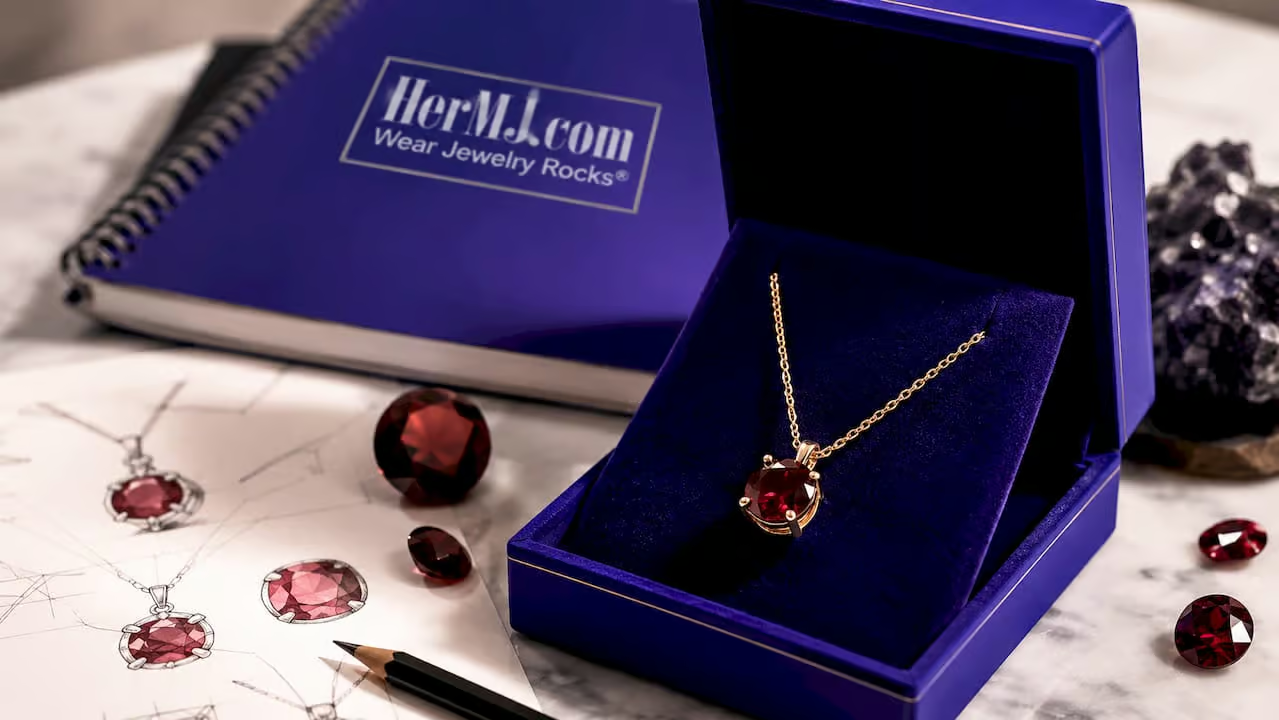
A strong example is our Faceted Garnet Gemstone Necklace, where the faceting is selected to bring out garnet’s characteristic warm, deep red rather than chasing maximum brilliance at the expense of color saturation. The result is a piece that glows rather than flashes, which is exactly what a well-cut garnet should do.
If you’re curious about how cut choices read across different styles, our gemstone necklace guide walks through several examples worth exploring.
US orders ship free with no minimum. International orders ship free at $150+; orders below $150 ship via USPS with customer-paid shipping. Browse the full collection at HerMJ and reach out if you’d like to discuss a custom orientation or stone selection for a specific piece.
Useful sources and further reading
These are the primary references behind this guide, each contributing something specific to the discussion of gemstone cutting and design.
“The quality of the cut is primarily responsible for making a stone appear brilliant and colorful, or dull and lifeless.” — The Optical Design of Gemstones, American Gem Society / White Flash research paper, describing the foundational role of cut in gem optics.
- GIA: Optimizing Face-Up Appearance in Colored Gemstone Faceting (gia.edu). The core scientific source for understanding how contrast maps and ASET tools help cutters balance color saturation with scintillation in colored gems.
- International Gem Society: Evaluating Gemstone Cutting — The Five Ps (gemsociety.org). The practical workmanship framework that buyers and designers can use to assess any faceted stone.
- International Gem Society: The Role of Faceting in Gemology (gemsociety.org). Covers meetpoint precision, ideal angle ranges (crown ~35°, pavilion ~41°), and why cut is the only human-controlled variable among the Four Cs.
- Blue Nile: Gemstone Cut — What to Look For (bluenile.com). Accessible buyer-focused explanation of cut versus shape, with practical questions to ask before purchasing.
- SOSNA Gems: The Art of the Gemstone Cut (sosnagems.com) — Practitioner perspective on pleochroism management, color zoning, and the artisan decisions that separate hand-cut gems from production stones.
Recommended
- Gemstone Jewelry Outfit Pairing: Style It Right
- Gemstone Jewelry for Every Season: Style Guide
- Unique Crystal Centerpiece Ideas with Gemstone Accents