


Keshi Pearls: 5 Questions About Origin and Luster Before You Buy
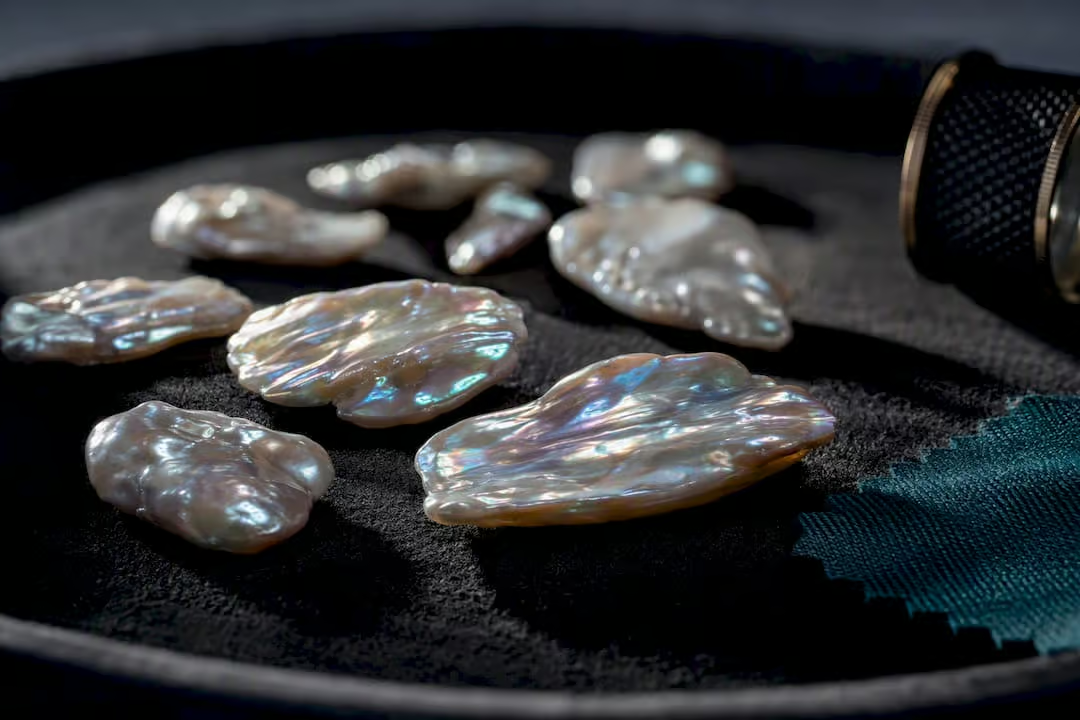
Keshi pearls are non-nucleated pearls made entirely of nacre, formed as an accidental or deliberate by-product of pearl cultivation.
Their solid nacre structure is exactly why their value hinges on luster and orient, not on how round or symmetrical they look. If you remember one thing while shopping, remember this: ask about provenance before you ask about shape.
TL;DR:
- Saltwater keshi pearls are increasingly rare due to improved farm technology that reduces accidental bead rejection, making genuine bead-rejection saltwater keshi a limited market.
- Freshwater keshi are often intentionally cultivated and offer similar all-nacre luster at a much lower price, serving as practical entry points for buyers.
- High-luster South Sea keshi command premium prices because collectors prioritize orient and luster over perfect shape or symmetry.
- Genuine saltwater bead-rejection keshi typically originate from specific farms and regions, so vague sourcing claims are a red flag for authenticity.
- The irregular shapes and vibrant orient of keshi pearls make them more valuable when chosen for their natural luster and organic form rather than perfect symmetry.
What Is a Keshi Pearl, Exactly?
The word “keshi” comes from the Japanese term for poppy seed, a nod to the tiny, irregular pearls that once turned up unexpectedly in Akoya oyster harvests.
Today the term covers a wider range of shapes and sizes, but the defining trait hasn’t changed: a keshi pearl has no bead nucleus at its core. It’s composed entirely of nacre, which is the same iridescent material that coats every cultured pearl, just without the shell bead most cultured pearls are built around.
That all-nacre body changes how light behaves inside the pearl. Instead of light hitting a bead and bouncing back uniformly, it moves through layer after layer of nacre, creating the deep, almost liquid glow collectors chase.
Where things get murky is the freshwater market. Trade purists argue “keshi” should only describe saltwater by-products of bead rejection, while much of the freshwater trade uses the same word for pearls that form through a different, often deliberate, process. Worth knowing before you buy:
- Saltwater keshi are historically accidental, born from bead rejection in Akoya, South Sea, or Tahitian oysters.
- Freshwater “keshi” is often produced intentionally and sold under the same name, muddying price comparisons.
- Origin, not the label alone, tells you what you’re actually paying for.
How Do Keshi Pearls Actually Form?
Keshi formation isn’t a single event. It’s a handful of different pathways, and knowing which one produced your pearl tells you a lot about its rarity.
- Bead rejection in nucleated mollusks. A farmer implants a bead and a tissue graft to start a cultured pearl. Sometimes the oyster rejects or expels the bead, but the mantle tissue continues producing nacre around the remaining graft, forming a solid keshi pearl instead of the intended round pearl.
- Tissue-only sacs. In some cases, only the tissue graft takes, with no bead involved at all. The pearl sac still forms and still secretes nacre, again with no core to speak of.
- Deliberate non-nucleated cultivation. Freshwater farms, largely in China, routinely insert tissue alone rather than a bead, producing keshi-style pearls by design during what’s often called a second harvest.
- Farm technology tightening supply. Machine harvesting and routine X-ray screening now catch bead rejection earlier, which means fewer accidental saltwater keshi make it to market than a generation ago.
That last point matters more than it sounds. Fine, high-luster saltwater keshi are getting scarcer precisely because farms have gotten better at preventing the “mistake” that used to create them.
Pro Tip: If a seller markets a strand as “rare saltwater keshi,” ask which harvest and which farm. Genuine bead-rejection keshi from Tahitian or South Sea farms are a real minority of the total harvest, so vague sourcing answers are a red flag.
How Can You Tell Keshi From Other Pearl Types?
Look at the surface first, then the shape, then the light. Keshi pearls tend toward baroque, wing-like, or petal-shaped forms, occasionally cornflake-flat, occasionally almost round by accident rather than design.
Compare that to natural pearls, which form with no human intervention at all, or standard cultured pearls, which almost always carry a visible or X-rayable bead center. Soufflé pearls, another bead-free type, are distinguished by a hollow or resin-filled cavity rather than the fully solid nacre of true keshi.
What separates a great keshi from a mediocre one isn’t roundness. It’s the interplay of light across the surface, what gemologists call orient, combined with depth of luster.
A slightly lopsided keshi with mirror-like reflection and rainbow flash will outsell a symmetrical one with a flat, chalky surface every time.
- Check for a sharp, near-metallic reflection rather than a soft glow.
- Tilt the pearl under a single light source and look for shifting color, the orient effect.
- Compare surface texture across the whole strand; consistency matters more than any single pearl’s shape.
- Ask whether the GIA-style assessment covered luster, surface, size, shape, and color, since luster tends to carry the most weight in keshi pricing specifically.
High-luster South Sea keshi can command premium prices, sometimes rivaling comparable round South Sea strands despite the irregular shapes, because collectors weight orientation and luster over uniformity.
Freshwater keshi sits at the opposite end of the market: abundant, affordable, and a smart entry point if you want that same nacre-driven glow without a South Sea budget. Origin remains the single biggest price lever across the category, more than size and often more than shape.
Cleaning and Storing Keshi Pearl Jewelry
Pearls are organic, formed by a living creature, and they need care that treats them more like delicate botanical specimens than mineral gemstones.
Keshi pearls, with their exposed all-nacre surface and often irregular drilling, can be a bit more prone to surface wear than a smooth round pearl, so a little extra attentiveness goes a long way.
- Wipe your keshi pieces with a soft, slightly damp cloth after each wear to remove skin oils and perfume residue.
- For a deeper clean, use mild soapy water and a soft cloth, then dry fully before storing.
- Never use ultrasonic cleaners, steam, or harsh chemicals on any pearl, keshi included; the nacre is far softer than most gemstones and scratches easily.
- Store keshi jewelry flat or gently coiled in a soft pouch, away from harder gems that can nick the surface in a crowded jewelry box.
Watch for flaking, dulling, or a chalky white residue near the drill holes; these are signs that the nacre is thinning or has been chemically damaged. If you notice peeling layers or the pearl feels gritty rather than smooth, that’s a job for a jeweler, not a home fix.
Pro Tip: Treat pearls the way you’d treat a fine watercolor. Both are beautiful precisely because they’re delicate, and both reward gentle, consistent care over occasional deep cleaning.
What Should You Ask Before Buying Keshi Pearls?
Buying keshi pearls well comes down to asking the right questions before you hand over your card, not inspecting the piece after it arrives.
- Where did this pearl form, in saltwater or freshwater, and from which species of mollusk?
- Has it been treated, dyed, or bleached, and is that disclosed in writing?
- Can the seller provide X-ray documentation confirming the absence of a bead nucleus for higher-value pieces?
- How is the pearl drilled, and does the drilling orientation suit the setting you want?
Budget shapes which keshi you should even consider. Freshwater keshi, often sourced from Chinese farms and typically undisclosed unless you ask, deliver that same solid-nacre glow at a fraction of South Sea prices, making them the practical choice for everyday jewelry.
South Sea and Tahitian keshi, rarer and pricier, suit collectors chasing a specific rainbow-orient effect or investment-grade pieces. If you’re pairing keshi for earrings, expect a longer wait and a bit of a premium; matching irregular shapes takes real sorting effort compared with grabbing two rounds off a tray.
| Keshi Type | Typical Budget | Best Styling Use |
|---|---|---|
| Freshwater keshi | Accessible, everyday price range | Layered strands, stacking bracelets |
| Akoya keshi (saltwater) | Mid-range | Delicate pendants, small clusters |
| South Sea / Tahitian keshi | Higher, collector-tier | Statement pendants, single-pearl focal pieces |
Styling depends on shape as much as budget. Petal and wing shapes make striking cluster earrings or pendants where the irregularity becomes the design feature rather than a flaw.
Rounder keshi work beautifully strung into a single strand, where slight variation from pearl to pearl reads as organic rather than mismatched. Mixed-metal settings, gold paired with a hint of silver, tend to flatter the warm-to-cool color shifts you get from orient, and a well-chosen pearl size can make a small keshi cluster look far more substantial on the neckline than the same weight in one large round pearl.
Why I Think the Keshi Market Rewards Patience Over Perfection
Most buyers walk in expecting symmetry to matter, and that’s the biggest misread in the whole category.
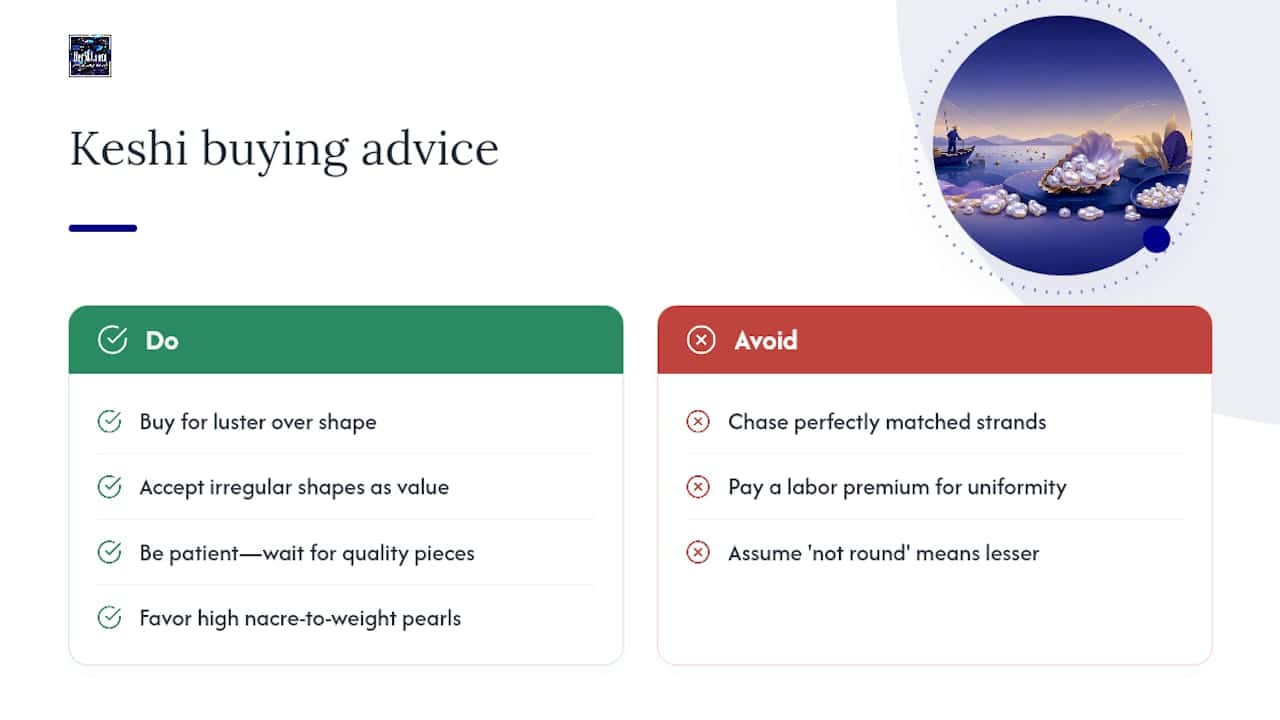
Keshi pearls flip the usual pearl hierarchy on its head: the very irregularity that would tank a round pearl’s value is often what makes a keshi worth owning.
I’d argue the freshwater keshi market gets undervalued for exactly the wrong reason: people assume “not fully round” means “lesser,” when the nacre-to-weight ratio in a solid keshi often beats a bead-nucleated pearl of similar size.
Where I’d push back on conventional buying advice is the obsession with matching. A perfectly matched keshi strand is lovely, but it’s also unnatural, and chasing that uniformity usually means paying a labor premium for something that fights the pearl’s whole appeal.
The smarter play, especially for a first keshi purchase, is buying for luster and letting the shapes stay a little wild. That’s where the real value sits, and it’s the one piece of guidance I’d want every reader to walk away with.
— Veronique
Which HerMJ Pieces Capture the Keshi Look?
If you love the deep, all-nacre glow that makes keshi pearls so collectible, you don’t need a South Sea budget to get it. HerMJ builds its freshwater pearl pieces around the same principle that drives keshi value: luster first, symmetry second.
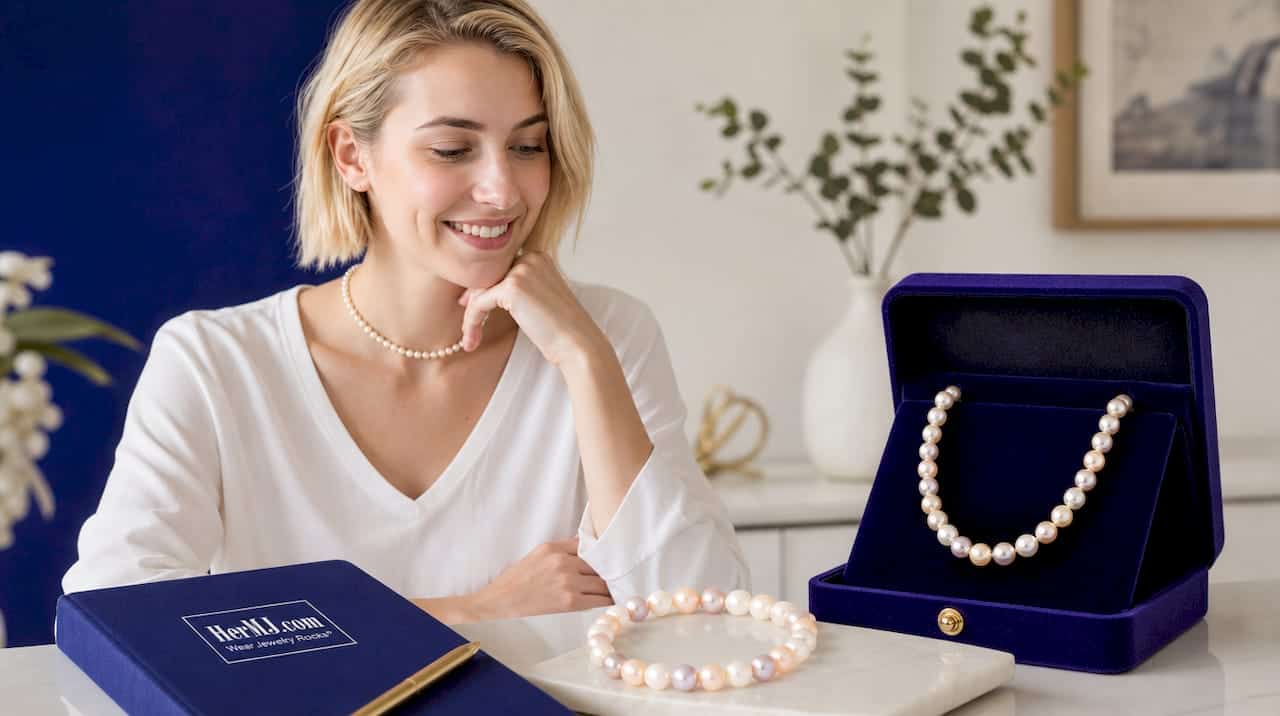
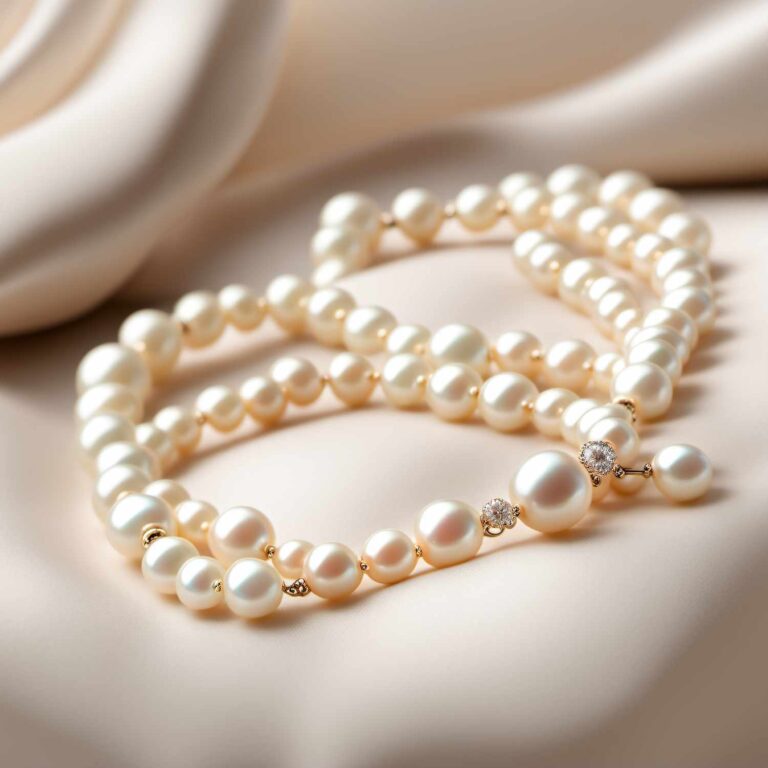
The Elegant Freshwater Pearl Necklace showcases that organic, high-luster nacre in a design meant for everyday wear or a special occasion without the price tag of rarer saltwater varieties.
Pair it with the Lustrous Freshwater Pearl Bracelet for Elegance, which leans into the same soft glow and slightly organic pearl shapes we’ve talked about throughout this guide, rather than forcing perfect rounds where nature didn’t intend them.
HerMJ pieces are handmade, with US orders shipping free with no minimum, and international orders shipping free on orders of $150 or more. Browse the necklace or bracelet today and see the luster for yourself.
Sources
- Keshi pearls and soufflé pearls – International Gem Society
- Defining Keshi – Rapaport
- What Is Keshi? – JCK
- Keshi pearl – Modern Jeweler
Recommended
- What Makes Pearls Valuable: Exploring The Origin of Elegance
- South Sea Pearls: What Collectors Need to Know
- Pearl Grading: What Every Buyer Needs to Know
- Real vs Fake Pearls: 6 Quick At Home Tests Buyers Use