


Gemstone Inclusions Guide: What Those Marks Inside Your Stone Mean
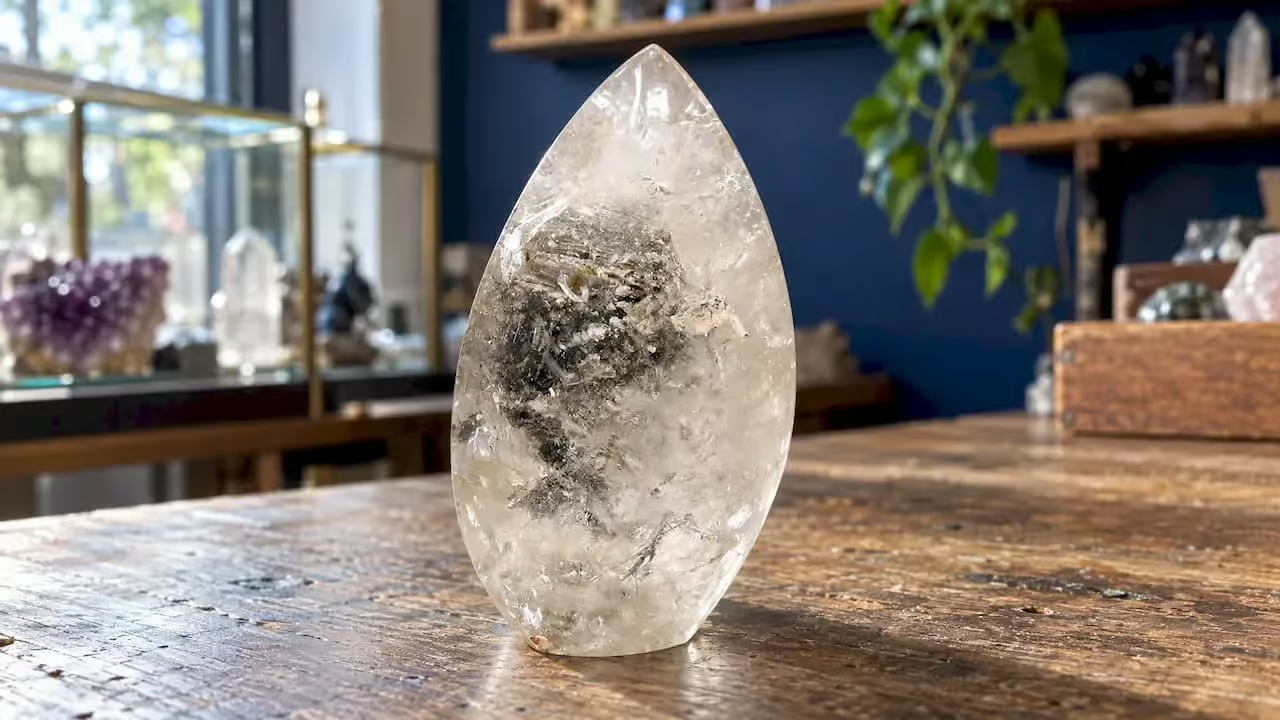
Inclusions are tiny crystals, fluid-filled cavities, fine needles, and healed cracks trapped inside a gemstone as it grew, and in natural stones, they’re a sign of a real gem with a real history. Once you know how to read them, a wispy feather or a cluster of needles stops looking like a flaw and starts looking like a fingerprint.
This guide explains what inclusions are, the main types, what they tell you about a stone, and when they matter for everyday wear.
TL;DR
- An inclusion is any feature inside a gem, from a trapped crystal to a fluid-filled cavity or a healed fracture, and almost all gem materials have them.
- Different inclusions point to different stones: needles, fluids, and crystals typically appear in natural gems, while particular patterns show up in lab-grown ones.
- How much an inclusion matters depends on the stone: emerald is expected to show them, while some gems are prized when they’re clean to the eye.
- Position and size count for more than quantity. A surface-reaching fracture is a durability question, while a tiny interior crystal is simply character.
- Choose stones you love at arm’s length, then wear and clean them according to their type.
What gemstone inclusions actually are
Gemologists use “inclusion” for any feature you can see inside a gem. GIA describes gem inclusions as mineral crystals or cavities filled with fluid, gas, or both, sitting inside a host stone. They can be larger than a millimeter or so small that only specialized equipment reveals them.
The word has a wider meaning in the lab than you might expect. According to a university gemology chapter on inclusions, the term covers foreign bodies of liquid, gas, or solid, as well as cleavage cracks, fractures, color zoning, growth lines, and crystals of the same composition as the host. The same source points out that almost every gem material, natural or man-made, contains some, and that a few can even raise a stone’s value.
It also makes a useful distinction. In the diamond trade, you’ll hear words like “flaw” and “imperfection.” In colored stones, “inclusion” is the neutral term, and I’d encourage you to think of it that way, too.
How inclusions form
A gemstone grows slowly, usually in hot, mineral-rich surroundings deep in the earth. Anything that’s present while the crystal builds can get trapped inside it. GIA’s research explains the main routes:
- Trapped fluids and gases. Crystals that grow in geological fluids can hold single-phase or multi-phase fluid pockets.
- Healed fractures. When a crack forms and later seals, it can trap tiny amounts of fluid in angular shapes called negative crystals.
- Exsolution. As a stone cools, impurity elements can separate out as fine inclusions, which is how rutile needles develop in a gem.
So every inclusion is a small record of the conditions where the stone formed. No two stones have the same record, which is exactly why handmade jewelry built around natural gems feels individual.
The main types you’ll run into
You don’t need a gemology degree to recognize the common families. Here’s the plain-English version.
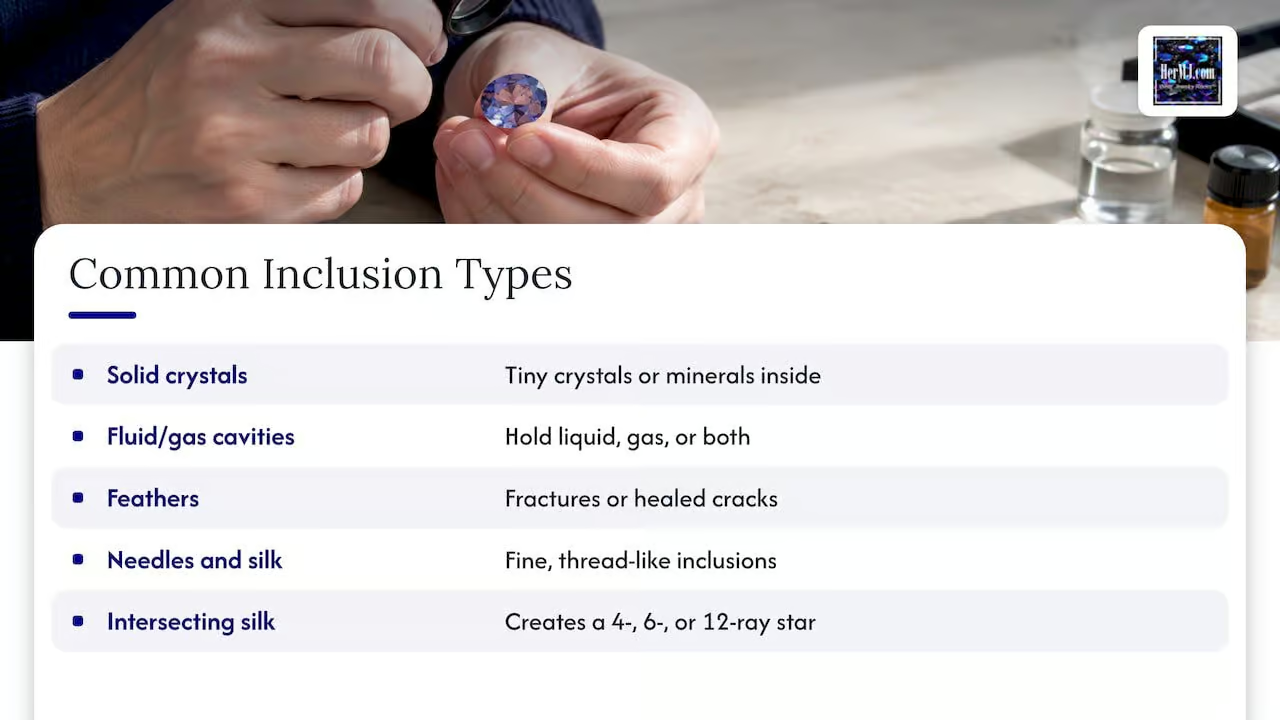
Solid inclusions are tiny crystals or minerals locked inside the host. They can look like specks, rods, or tiny faceted shapes.
Fluid and gas inclusions are small cavities holding liquid, gas, or a mix. When a cavity holds a liquid and a movable bubble, gemologists call it two-phase. Three-phase inclusions add a solid crystal to the liquid and gas, and they’re a classic sight in emerald.
Feathers are fractures or healed cracks that look like, well, feathers or wisps when you tilt the stone under light.
Needles and silk are fine, thread-like inclusions, often rutile. The International Gem Society’s guide to identifying inclusions notes that corundum silk forms a hexagonal pattern of fine threads meeting at 60- or 120-degree angles, while garnet threads meet at 70 or 110-degree angles. It also explains that beryl and tourmaline can develop straight, even-sided hollow growth tubes.
When needles cross correctly, and the stone is cut as a smooth dome, you can get a star. Intersecting silk creates a 4, 6 or 12 ray star, called asterism, in cabochon-cut sapphires, according to GIA’s sapphire buyer’s guide. If you love that rounded look, my guide to cabochon versus faceted gemstones shows how each cut treats light, and our plain-English page on types of gemstone cuts covers the rest.
What inclusions tell you about a stone
This is where inclusions get fascinating. They help gemologists answer three questions: what is this stone, where did it come from, and has it been treated?
Natural or lab-grown
GIA’s Insights From Inclusions explains that needles, clouds, fluids, and crystals are typically found in natural gemstones. Hematite needles, for example, appear only in natural amethyst.
Lab-grown stones show inclusions specific to how they were made, such as granular flux in flux-grown crystals. That difference is one reason inclusions are so valuable to identification. For a broader look at spotting the real thing, see my guide to fake gemstones versus real ones.
Where the stone came from
The Australian Museum notes that inclusions seen through a microscope or a 10x loupe can reveal the environment where a mineral formed, identify a gem, and even point to its source. Its example is lovely: hairs trapped in a Baltic amber bead blew into sticky resin from an oak flower 20 to 40 million years ago.
GIA’s work gives gemstone examples. Parisite inclusions in an emerald are a diagnostic indicator of Colombian origin, and rubies from Mogok, Myanmar, often hold calcite inclusions because they formed in pure calcite marble.
Whether it’s been treated
Microscopy is arguably the most important way to identify treatments. In sapphire, a blue halo around old rutile silk indicates high-temperature heat treatment. The same examination can reveal dyes and fracture filling. If you’d like to understand common treatments, my page on gemstone enhancements goes through them.
Do inclusions lower value? It depends on the stone
The honest short answer, from a jeweler’s bench, is that it changes with the gem. Some stones are expected to be clean to the eye. Others are almost never clean, and buyers don’t penalize that.
Emerald is the clearest example. CIBJO’s retailers’ guide calls inclusions in emerald customary and expected, and says eye-clean emeralds are extraordinarily rare. The “jardin,” French for garden, is the web of tiny liquid-filled inclusions and fine fissures that gives emerald its soft, hazy depth. Included crystals such as pyrite even offer positive proof of natural origin.
GIA’s archived emerald quality factors page adds the other side: when inclusions start to dull transparency and clarity, value drops dramatically, and eye-clean emeralds are especially prized because they’re so rare.
Peridot sits at the other end of the spectrum. GIA’s peridot guide says the best peridot has no eye-visible inclusions, perhaps just a few tiny black spots under magnification, and reflective, disk-shaped “lily pads” are another common sight.
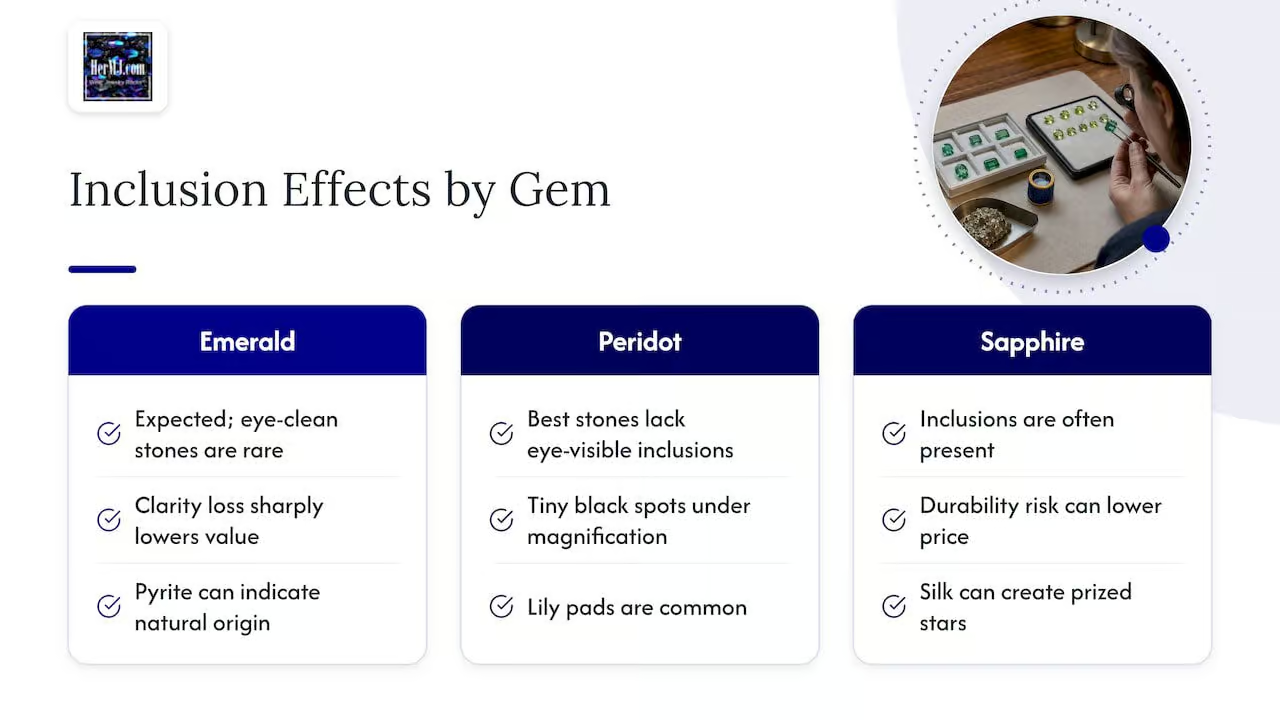
Sapphire is in between. It often has inclusions, and GIA’s sapphire guide notes that prices can drop if inclusions threaten durability. Silk, on the other hand, can create the star effect that collectors love.
Three factors that matter more than count
- Visibility. Can you see it from a normal distance? If it takes a loupe, it’s rarely a wearing issue.
- Position. A mark near the edge of a stone is easy to live with. The same mark right under the center draws the eye.
- Reach. Interior crystals are stable. A fracture that reaches the surface is the one to think about for durability.
How to look at inclusions yourself
Gemologists examine stones with a microscope and a range of lighting setups, including brightfield, darkfield, and fiber-optic lighting at different angles, as GIA describes.
You can capture that spirit at home with simple habits.
Hold the stone in front of a bright, steady light and look from a few angles. Then look at it the way somebody else will. At arm’s length or across a table. Ask yourself whether you’d notice anything without hunting for it. If a 10x loupe is handy, use it to enjoy the interior landscape. It’s similar to looking into a tiny terrarium.
Don’t try to grade the stone or name its origin from what you see. That’s lab work, and it’s why GIA’s sapphire guide recommends an independent report from a reputable gemological laboratory when you need to confirm natural or synthetic origin, treatments, or a geographic opinion on a major purchase. For everyday jewelry, the practical test is simpler: do you love how it looks, and does it feel true?
Matching inclusions to everyday wear
Inclusions and durability connect in a few specific ways.
Emeralds. GIA’s archived guide notes that almost all emeralds have fissures and are more brittle than corundum, so careless daily wear can damage them. That’s why the emerald cut, with its faceted corners, gives prongs a comparatively safe place to sit. CIBJO also suggests avoiding stones with larger fissures at the corners where prongs would grip.
Sapphires. They rate 9 on the Mohs scale of hardness and have excellent toughness, which makes them ideal for daily wear. Because of that, a few interior needles aren’t a concern.
Peridot. It’s durable enough for jewelry but best worn with a little care to avoid scratching.
For earrings and necklaces, which sit away from the knocks that hands take, a gem with a visible feather or a cloud of needles is a comfortable choice. Bracelets get more contact with desks and doorframes, so I’d look for stones whose inclusions sit inside the body rather than breaking the surface.
A note on cleaning included stones
The fractures inside a stone change how you should clean it. According to GIA’s sapphire guide, ultrasonic and steam cleaners can be safe for untreated, heat-treated, and lattice-diffusion-treated sapphires. They’re risky for stones with fractures and some black star sapphires, so warm, soapy water is the better route. Clean fracture-filled, cavity-filled, or dyed sapphires only with a damp cloth.
When you’re comparing cleaning products, look for ones that spell out which stones and settings they suit, such as these diamond jewelry cleaners. For pearls, which are organic and need gentler handling than any mineral, my page on pearl care covers cleaning, maintenance, and storage.
Choosing inclusions you’ll love
Here’s how I’d shop, whether you’re buying for yourself or for a gift.
- Decide what look you want. A clean, glassy stone and a richly included one are different moods. Neither is wrong.
- Match the expectation to the stone. Expect visible character in emerald, and hope for cleaner faces in peridot.
- Check position and reach. Interior is fine. Surface-breaking cracks near a prong or an edge deserve a second look.
- Think about wear. Choose protected styles like earrings and pendants for more delicate included stones.
- Keep your expectations realistic about price. Rarity and eye-clean clarity cost more, and a lovely included stone can be a smart, affordable choice. Our roundup of affordable gemstone jewelry types that look expensive shows how to get the look for less.
My perspective
I’ve always thought a gemstone without a story is just a colored pebble. Inclusions are the story. They’re the minerals that happened to be nearby, the fluid that was moving through the rock, the slow pressure of the earth.
That’s why my with at HerMJ includes genuine freshwater pearls, natural gemstones and crystals. Each piece we hand-finish has its own character, and we believe that’s what makes wearing it feel personal. A tiny feather or a soft cloud isn’t something to hide. It’s proof that the stone grew rather than was manufactured.
We also believe beautiful, real-stone jewelry shouldn’t require a luxury budget. Our aim is superior craftsmanship at accessible pricing, so you can enjoy natural materials every day, not just on special occasions. And with free shipping on every US order and no minimum, getting a piece to your door is simple.
Veronique
See natural character in HerMJ pieces
If you’d like to see how natural stones look when they’re made into jewelry, start with our necklaces and bracelets, or browse everything at https://www.HerMJ.com.
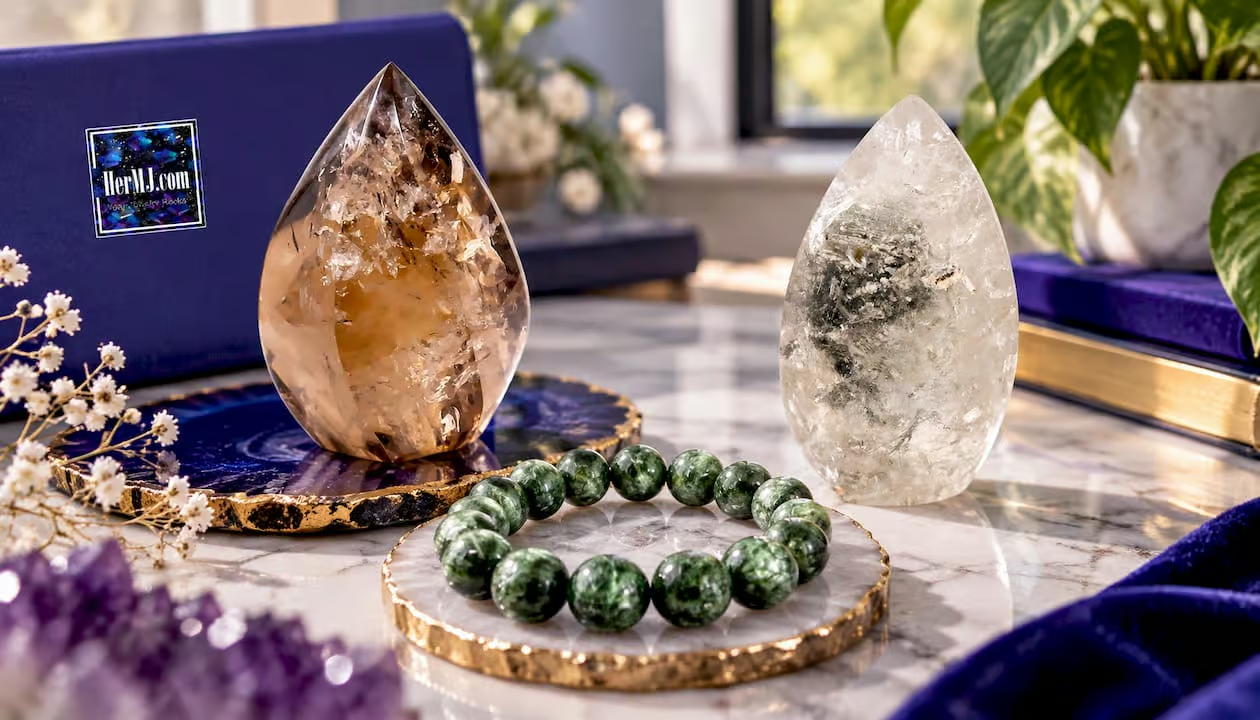
For the home, our Room Jewelry collection brings gemstone and crystal pieces to shelves and desks, including the Garden Quartz Point. US orders ship free with no minimum, and international orders ship free on orders of $150 or more.
FAQ
Are inclusions a sign that a gemstone is fake?
Usually it’s the opposite. Natural gems typically contain needles, fluids, and crystals, and certain inclusions, like hematite needles in amethyst, appear only in natural stones. Lab-grown stones have their own telltale patterns, such as granular flux, which is why gemologists read inclusions to tell them apart.
Do inclusions make a gemstone less durable?
Only if they reach the surface or sit where the stone takes stress. Small interior crystals and fluid pockets rarely affect wear. Fractures that break the surface, especially in brittle stones like emerald, are the ones to treat gently.
Which gemstones almost always have inclusions?
Emerald is the best-known example, since eye-clean stones are extraordinarily rare and buyers expect to see a jardin. Sapphire often shows silk or needles, and almost all gem materials, natural or man-made, contain some kind of inclusion.
How can I see inclusions without a microscope?
Hold the stone under a bright light and tilt it slowly. Feathers, cloudy zones, and larger crystals often show up that way. A 10x loupe reveals much more, including needles and tiny fluid pockets.
Sources
- Inclusions in Gemstones, GIA
- 12.1: Inclusions, LibreTexts Gemology
- Identifying Inclusions of Specific Gems, International Gem Society
- Sapphire Buyer’s Guide, GIA
- Insights From Inclusions, GIA
- Geological origin of gemstones, The Australian Museum
- Retailers’ Reference Guide: Gemstones, CIBJO
- Emerald Quality Factors, GIA (archived)
- Peridot Buyer’s Guide, GIA