


Pearl Necklace Cost: What Your Budget Actually Buys
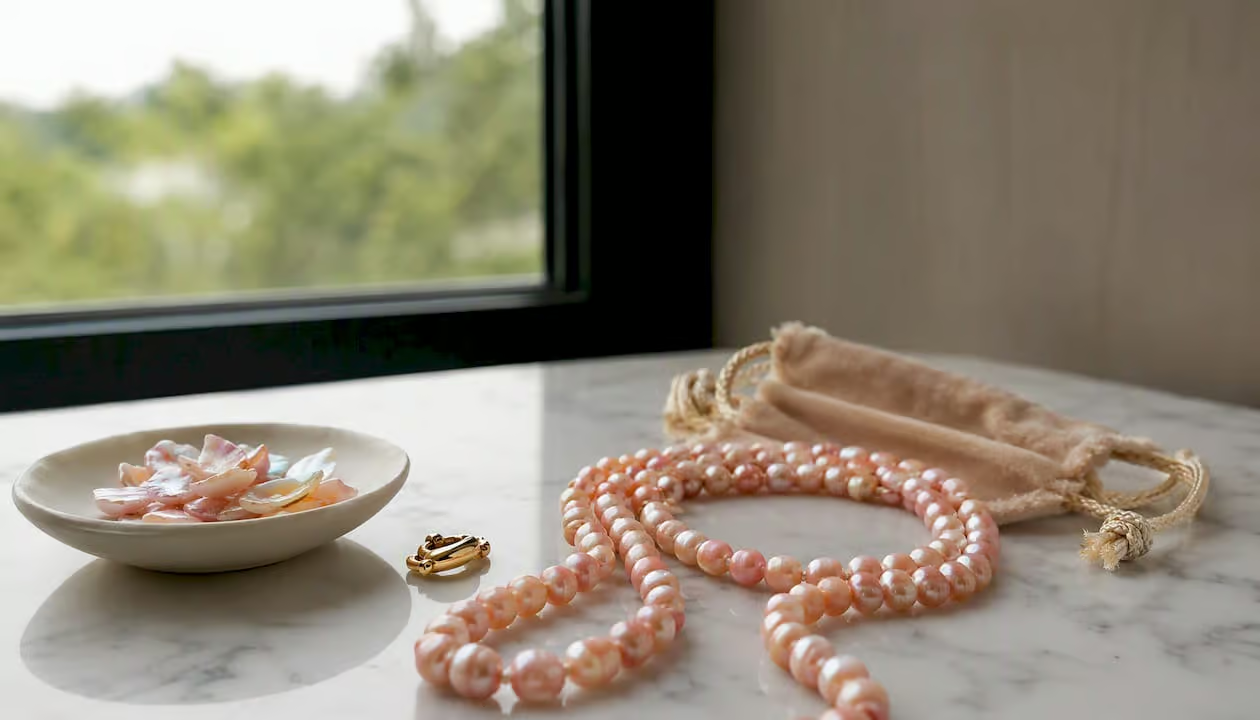
A real pearl necklace in the U.S. typically costs between $100 and $10,000 at retail, with freshwater cultured pearls anchoring the affordable end and South Sea or natural pearls reaching well beyond that range. Industry price guides confirm that pearl necklace prices span roughly $50 to over $100,000 depending on type and quality, though most buyers shopping for a genuine, wearable strand will land somewhere between $150 and $3,000.
For most buyers, a budget of $200 to $600 gets you a well-matched, lustrous freshwater or entry-level Akoya necklace that looks beautiful and holds up for years. Here’s a quick orientation before we go deeper:
- Under $200: Freshwater cultured pearls, often baroque or near-round, in shorter lengths
- $200–$800: Better-matched freshwater strands or entry Akoya necklaces with stronger luster
- $800–$3,000: Mid-grade Akoya or Tahitian strands with tighter matching and thicker nacre
- $3,000–$20,000+: Fine South Sea, high-grade Tahitian, or collector-quality Akoya strands
- $20,000+: Natural pearls, rare provenance pieces, or designer-signed strands at auction
Pro Tip: If you’re buying your first real pearl necklace, start with a freshwater strand in the range between about $150 and $400. You’ll get genuine nacre, real luster, and room to learn what you love before committing to a saltwater investment.
Key Takeaways
Most buyers get the best value in the $200–$600 freshwater or entry Akoya range, where luster, matching, and nacre quality are strong enough to last decades with proper care.
| Point | Details |
|---|---|
| Price range by type | Freshwater: several tens to a couple thousand; Akoya: several hundred to several thousand; Tahitian: several hundred to thousands; South Sea: $1,000 and up. |
| Top value drivers | Luster, nacre thickness, matching, and size move price more than any other factors. |
| Maintenance budget | Plan for restringing at $70 to $150 or more every two to three years for regularly worn strands. |
| Buying checklist | Always confirm pearl type, size in mm, nacre thickness, treatments, and return policy before purchasing. |
| HerMJ freshwater option | HerMJ’s handcrafted freshwater pearl necklaces sit between about $150 and $600, with free U.S. shipping and genuine nacre. |
How Much Does a Pearl Necklace Cost by Pearl Type?
Pearl type is the single biggest driver of price, and understanding the four main cultured types, plus natural pearls, gives you an immediate framework for any listing you encounter. Brilliant Earth’s pearl price guide confirms that saltwater types, particularly South Sea and Tahitian, consistently command the highest prices because of their rarity, size, and nacre quality.
Freshwater pearls are grown in mussels in freshwater lakes, primarily in China. Because a single mussel can produce multiple pearls at once, freshwater pearls are more abundant and therefore more affordable. Per-type price guides show freshwater strands starting under $100 for basic baroque shapes and reaching $2,000 for tightly matched, high-luster rounds in larger sizes. They’re the most accessible entry into genuine pearl jewelry.
Akoya pearls are Japan’s classic contribution to pearl culture. Grown in saltwater oysters, they produce smaller, exceptionally round pearls with a mirror-bright luster that’s hard to match.
A 16-inch strand of 7–7.5mm Akoya pearls in good quality typically retails between $300 and $1,200 in the U.S. market. Fine Akoya strands with 8–9mm pearls and tight matching can push several thousand dollars.
Tahitian pearls grow in the black-lipped oyster native to French Polynesia. Their natural dark body colors, ranging from charcoal to peacock green, make them genuinely distinctive. A standard 16–18 inch strand of 9–11mm Tahitians in good quality runs $500–$3,000, while exceptional overtone and tight matching push prices considerably higher.
South Sea pearls are the largest cultured pearls produced commercially, grown in Australia, Indonesia, and the Philippines.
Their size alone, often 12–16mm, drives cost up sharply. A single strand of 12–14mm South Sea pearls in good quality starts around $3,000 and can reach tens of thousands for exceptional luster and matching.
Natural pearls form without human intervention and are extraordinarily rare. Auction and estate evidence shows natural strands selling for as little as $5,000 for modest examples and well over $100,000 for historically significant or exceptionally matched pieces. For most buyers, natural pearls are a collector’s category, not a practical purchase.
What Actually Determines the Value of a Pearl Necklace?
Two strands of the same pearl type can differ in price by a factor of five or more. The difference comes down to six primary grading factors, plus two necklace-specific considerations that multiply cost when quality is tight.
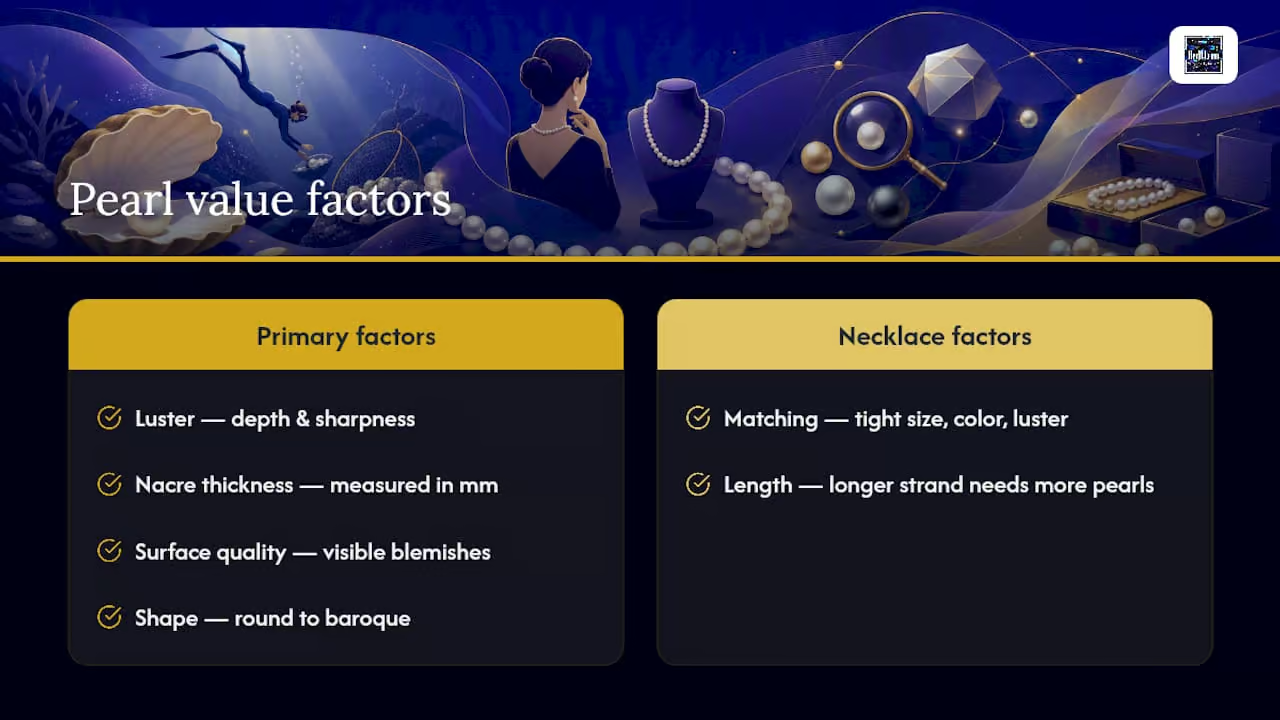
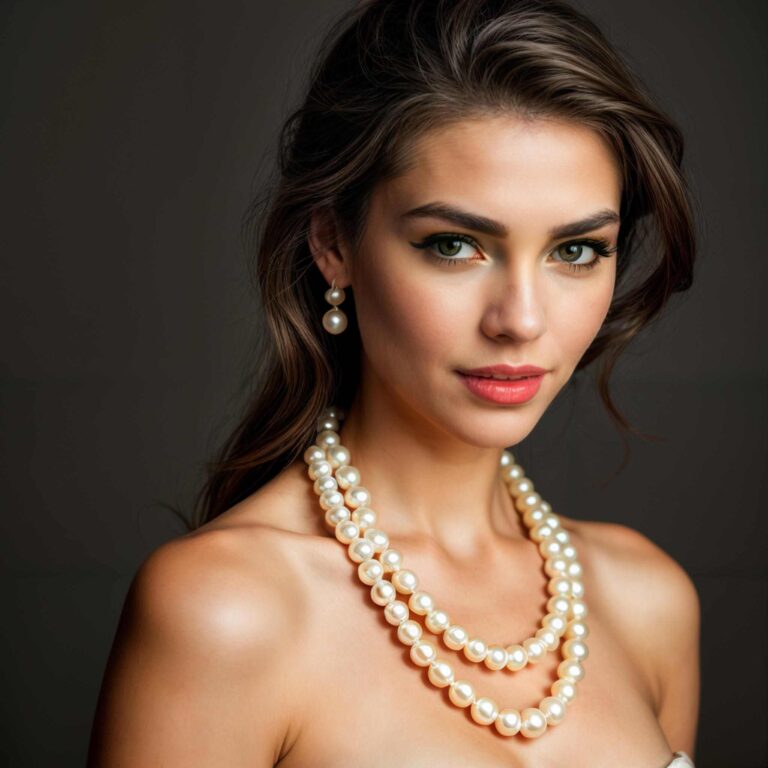
Luster is the most immediately visible quality factor. It’s the depth and sharpness of light reflected from the pearl’s surface. A high-luster pearl shows a bright, almost mirror-like reflection; a low-luster pearl looks chalky or dull. Luster is the first thing buyers notice and the first thing that separates a $200 strand from a $1,000 one.
Nacre thickness is what luster depends on. Nacre is the crystalline aragonite that mollusks deposit in concentric layers to form a pearl. Thicker nacre means deeper luster, better durability, and a longer-lived surface.
Thin-nacre pearls can chip or peel over time, exposing the bead nucleus beneath. When comparing listings, ask for nacre thickness in millimeters; anything under 0.35mm is considered thin for Akoya pearls.
Surface quality refers to the number, size, and visibility of blemishes: spots, bumps, wrinkles, or abrasions on the pearl’s surface.
Gem-grade pearls have very few visible blemishes; commercial-grade pearls may show several. A small cluster of blemishes near the drill hole matters less than one centered on the face of the pearl.
Shape ranges from perfectly round to off-round, oval, drop, button, and baroque. Round pearls command the highest premium because they’re the rarest shape.
Baroque pearls, which are organically irregular, are genuinely beautiful and often more affordable, making them a smart choice for buyers who value character over conformity.
Size is measured in millimeters and has an outsized effect on price for saltwater types. Each additional millimeter in diameter represents a longer growth period and a lower yield, so the price curve isn’t linear. A 9mm Akoya pearl can cost two to three times more than a 7mm pearl of the same quality.
Color and overtone affect desirability. Akoya pearls are typically white or cream with rose, silver, or ivory overtones. South Sea pearls range from white to golden.
Tahitians display peacock, aubergine, and silver-green overtones. Natural body color is more valuable than dyed or treated color, and buyers should always ask whether color has been enhanced.
Matching is the necklace-specific factor that most buyers underestimate. Assembling a strand of 35–40 pearls that graduate smoothly in size, match closely in color and overtone, and share consistent luster requires sorting through far more inventory than the strand itself contains.
Tight matching is one of the biggest drivers of list price for a finished necklace, because the labor and inventory cost of achieving it is substantial.
Treatments include bleaching, dyeing, polishing, and irradiation. Most cultured pearls undergo some processing, and mild bleaching is standard industry practice.
What matters is disclosure: a reputable seller will tell you what treatments were applied. Heavily treated pearls, particularly dyed ones, should be priced accordingly lower.
Clasp and stringing quality affect both wearability and resale value. A 14-karat gold clasp adds $50–$200 to the cost of a strand. Silk stringing with individual knots between each pearl is the standard for quality necklaces; it prevents pearls from rubbing against each other and limits loss if the strand breaks. A knotted silk strand on a gold clasp is a sign the maker cared about the finished piece.
Buyer’s Grading Checklist
When comparing listings, ask or look for: pearl type and origin, size in mm, nacre thickness, surface grade, shape description, treatment disclosure, matching grade, clasp material, and stringing method. Any seller who can’t answer these questions clearly deserves more scrutiny. For guidance on hidden quality signals buyers often miss, it’s worth reading up before you shop.
How Strand Length and Pearl Size Change the Total Price
Strand length and pearl diameter work together to determine how many pearls are on a necklace and how large each one is. Both variables push price up, and their combined effect can be dramatic.
Common strand lengths in the U.S. market follow these conventions:
| Strand Name | Typical Length | Approximate Pearl Count (7mm) | Price Impact vs. Choker |
|---|---|---|---|
| Choker | 14–16 in. | 35–40 pearls | Baseline |
| Princess | 16–18 in. | about 45 pearls | +15% |
| Matinee | 20 in. | about 57 pearls | +30–50% |
| Opera | 28 in. | about 70 pearls | +75% |
| Rope | 37 in. | about 90 pearls | +100%+ |
A princess-length Akoya strand at 18 inches contains roughly 45 pearls. Move to a matinee at 22 inches, and you’re adding 12–15 more pearls of the same quality, which translates directly into a higher price.
For South Sea pearls, where each pearl may cost $50–$300 individually, the difference between a 16-inch and a 20-inch strand can easily be $1,000 or more.
Pearl diameter compounds this effect. Each millimeter step up in size represents a longer cultivation period and a smaller percentage of the harvest that reaches gem quality.
For South Sea pearls, the jump from 12mm to 14mm on a full strand can double the price. Freshwater pearls show less dramatic per-millimeter sensitivity because their supply is larger, but the principle still holds.
A practical example: a 16-inch freshwater strand of 7–8mm near-round pearls might retail for $200–$400. Stretch that to a 20-inch matinee in 9–10mm pearls with tighter matching, and the same quality tier runs $600–$1,200. The pearls are similar in type and grade; length and size do most of the price work.
What Different Budgets Actually Buy You
Translating price bands into real purchase outcomes is where most guides fall short. Here’s what you can realistically expect at common U.S. price points, based on industry price guidance and retail market data.
Around $100–$200: A freshwater cultured pearl necklace in baroque or near-round shapes, typically 16–18 inches, with pearls around 6 to 8 mm in size. Luster will be moderate, matching will be approximate rather than tight, and the clasp is likely silver-plated or base metal.
These are genuine pearls with real nacre, and they make excellent everyday pieces or gifts. Don’t expect mirror luster at this price, but do expect a wearable, attractive necklace.
Around $300–$600: Better-matched freshwater strands with stronger luster, or an entry-level Akoya necklace in 6.5–7mm. At this range, you’ll see silk knotted stringing, a sterling silver or gold-filled clasp, and noticeably improved surface quality.
A cultured pearl necklace commonly ranges from about $100 to several thousand dollars, and this middle band is where the quality-to-value ratio tends to be strongest for most buyers.
Around $800–$1,500: A quality Akoya strand in 7–7.5mm with high luster and tight matching, or a Tahitian strand in 9–10mm with good overtone.
At this level, you should expect a 14-karat gold clasp, knotted silk stringing, and documentation of pearl type and treatment. This is the range where a necklace starts to feel like a genuine investment rather than a fashion purchase.
Around several thousand dollars: Fine Akoya in 8–8.5mm, a well-matched Tahitian strand in 10–12mm, or an entry South Sea strand.
Matching at this level is tight, nacre is thick, and the piece should come with a certificate or detailed provenance. Budget an additional $70–$150 for restringing within the first year or two of regular wear, and consider jewelry insurance for pieces in this range.
$10,000 and up: Collector-grade South Sea strands, exceptional Tahitian necklaces with rare overtone, or natural pearl pieces at estate or auction.
Retail and auction evidence shows strands at this level can reach well over tens of thousands for historically significant pieces. At this price, a third-party appraisal and lab report are not optional.
A note on purchase add-ons: sales tax in most U.S. Restringing a single strand costs $70 to $150 or more depending on length and clasp complexity, and most jewelers recommend restringing every two to three years for regularly worn pieces.
Where You Buy Changes What You Pay
The channel you choose affects price as much as the pearl type does. Each buying channel carries different markup structures, risk profiles, and verification requirements.
The trade-off is a tangible experience: you can see the pearls in person, compare luster under different lighting, and ask questions directly. For buyers new to pearls, this hands-on education is genuinely valuable.
Buying from a Jewelers of America member jeweler adds a layer of accountability, since member jewelers commit to ethical sourcing, verified disclosures, and warranty standards.
Online retailers range from large jewelry platforms to small artisan makers. Prices are typically significantly lower because online retailers have lower overhead than comparable brick-and-mortar stores.
The risk is that photos can flatter pearls, and luster in particular is hard to judge from a screen. Look for retailers who publish detailed grading information, offer 30-day returns, and respond clearly to questions about nacre thickness and treatments.
Estate and vintage channels can offer the best value for comparable quality, but they require the most buyer effort. Estate and auction channels can yield lower prices for comparable quality, but they require careful verification: photos of drill holes, surface condition, and provenance documentation. A strand that looks beautiful in a listing photo may have thin nacre, worn surfaces, or a compromised clasp. Always request detailed photos and, for pieces over $500, ask about the restringing history.
Auction houses handle the highest-value pieces and can be a legitimate source for fine strands, but buyer’s premiums of a buyer’s premium is often added to the hammer price, and returns are rarely accepted. Auctions suit experienced buyers who know exactly what they’re evaluating.
Custom and artisan makers offer a different value proposition: you’re paying for design skill and handcraft rather than brand markup. Prices are often competitive with mid-range retail, and you can specify length, clasp, and pearl selection. This channel suits buyers who want something personal rather than a catalog piece.
Pro Tip: When shopping online, always ask the seller for a photo of the drill holes. Thin nacre shows as a narrow white ring around the drill hole; thick nacre shows a deep, layered appearance. It’s one of the fastest quality checks you can do without holding the piece.
How to Tell If a Pearl Necklace Price Is Fair
A listed price only makes sense when you can verify what you’re actually getting. Here’s a practical verification process you can apply to any listing or seller conversation.
- Confirm the pearl type in writing. “Pearl necklace” is not enough. Ask for the specific type: freshwater cultured, Akoya cultured, Tahitian cultured, South Sea cultured, or natural. Each has a very different price floor.
- Request measurements in millimeters. A reputable seller can tell you the pearl diameter and strand length precisely. Vague descriptions like “medium” or “large” are a red flag.
- Ask about treatments. Bleaching, dyeing, and irradiation all affect value. Ask directly: “Have these pearls been treated, and if so, how?” A seller who can’t answer is either uninformed or evasive.
- Ask about matching criteria. How were the pearls selected for the strand? Were they matched by size, color, luster, and overtone? Tight matching takes time and inventory; if the price seems low for a “perfectly matched” strand, ask how the matching was done.
- Check the return policy. A 30-day return window is standard for reputable online sellers. No returns or “all sales final” on a new piece is a warning sign.
- Ask about certification or lab reports. For strands over $1,000, a GIA (Gemological Institute of America) report or equivalent adds independent verification of pearl type, treatments, and quality.
When a price seems too low for the claimed quality, it usually is. A strand advertised as “genuine South Sea pearls” for $150 is almost certainly freshwater, imitation, or mother-of-pearl shell.
Understanding the nacre vs pearl distinction matters here: mother-of-pearl is the nacre lining of the shell itself, not a whole pearl. It’s beautiful and legitimate in its own right, but it’s not the same as a cultured or natural pearl, and it shouldn’t be priced as one.
For strands over $2,000, a third-party appraisal from a certified gemologist (look for GIA Graduate Gemologist credentials) is worth the $50–$150 fee. An appraisal gives you an independent valuation for insurance purposes and confirms the seller’s claims before you commit.
Pro Tip: Ask the seller: “Can you provide a written description of the pearl type, size, treatments, and nacre thickness?” A seller who answers this in detail, without hesitation, is almost always selling a legitimate piece. One who deflects or gives vague answers deserves more scrutiny before you buy.
Caring for Pearls to Protect Their Beauty and Value
Pearls are organic gems, and they respond to how you treat them in ways that diamonds and sapphires simply don’t. A well-cared-for strand can look as beautiful at 30 years as it did on day one. A neglected one can lose its luster within a few years.
The most important daily habit is putting your pearls on last and taking them off first. Perfume, hairspray, and cosmetics contain acids and alcohols that erode nacre over time.
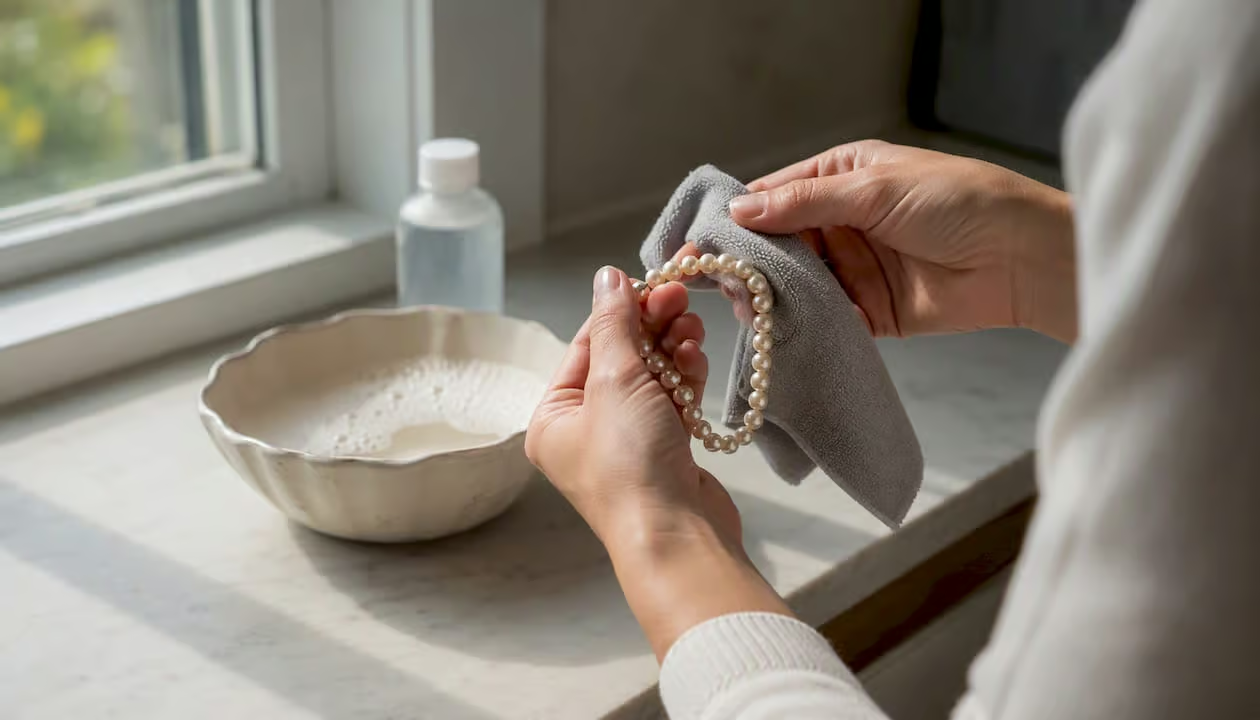
After wearing, wipe the pearls gently with a soft, damp cloth to remove skin oils and any product residue. Never use ultrasonic cleaners, steam, or harsh chemicals on pearls.
Storage matters as much as cleaning. Pearls need a little humidity to stay healthy; storing them in an airtight container or a very dry environment can cause nacre to crack over time.
A soft pouch or a lined jewelry box, away from harder stones that can scratch the surface, is the right environment. Keep them flat rather than hanging, which puts stress on the silk thread over time.
Pro Tip: My golden rule for pearl storage: keep them in a soft cloth pouch, separate from other jewelry, and lay the strand flat. Hanging a pearl necklace on a hook stretches the silk thread and stresses the knots. A few seconds of care when you put them away adds years to the life of the strand.
Restringing is the maintenance step most buyers overlook until a strand breaks. Silk thread absorbs moisture and body oils, weakening over time. For a necklace worn regularly, restringing every two to three years is a reasonable guideline.
The cost for a single strand typically runs $70 to $150 or more depending on length and clasp work. Budget this into your first-year cost of ownership, especially for strands in the $500+ range.
For strands valued at $1,000 or more, jewelry insurance is worth considering. Most homeowner’s and renter’s insurance policies cover jewelry up to a sublimit, but a scheduled rider or a standalone jewelry policy provides better coverage for loss, theft, and accidental damage.
Where HerMJ Freshwater Pearl Necklaces Fit in the Price Spectrum
HerMJ’s artisan freshwater pearl necklaces sit squarely in the $150 to $600 range that the guide identifies as the strongest value band for most buyers. Every piece is handmade using genuine freshwater pearls, which means you’re getting real nacre, real luster, and real craftsmanship at a price that doesn’t require a significant financial commitment.
Three pieces worth knowing about:
The Elegant Freshwater Pearl Necklace is a classic single-strand design built for everyday wear and special occasions alike. It sits in the entry-to-mid freshwater price band, making it a strong first pearl necklace or a thoughtful gift. U.S. orders ship free with no minimum order.
The Peridot And Pearl Fusion Necklace pairs freshwater pearls with natural peridot gemstones for a piece that reads as distinctly personal rather than catalog-standard. Gemstone accents like peridot add design value without pushing the price into saltwater territory.
The Pearl And Aquamarine Necklace combines freshwater pearls with aquamarine, a combination that works beautifully for both everyday wear and gifting. It’s the kind of piece that looks more expensive than it is, which is a genuine advantage in the freshwater price band.
HerMJ’s handcrafted approach means each piece is made individually rather than mass-produced, which shows in the attention to matching and finish.
For buyers who want something that feels personal without the custom-order price tag, this is a meaningful distinction. For international shoppers, orders over $150 ship free.
The freshwater category HerMJ works in is exactly where per-type price guides show the best accessibility for buyers entering the pearl market.
You’re not compromising on the pearl itself; you’re simply choosing a type that’s more abundant and therefore more fairly priced. For a broader look at freshwater pearl jewelry options, HerMJ’s full collection shows the range of styles available at this price point.

My Approach to Buying a Pearl Necklace
If I were buying a pearl necklace for myself or as a gift right now, I’d start by locking in the budget before I looked at a single listing.
Budget drift is the most common mistake I see: a buyer starts at $300, falls in love with a $900 strand, and ends up spending more than they planned. Decide the number first, then shop within it.
My personal priorities, in order: luster, matching, nacre thickness, then shape. I’d rather have a slightly baroque pearl with exceptional luster than a perfectly round one that looks chalky. Luster is what makes a pearl feel alive on the skin, and it’s the quality that holds up over decades of wear.
For a gift, I’d choose freshwater in the $200–$500 range and spend the extra $30–$50 on a quality clasp upgrade if the seller offers one. A gold-filled or sterling silver clasp makes a freshwater strand feel considered and complete.
For a personal investment piece, I’d save toward a quality Akoya strand in 7.5–8mm with documented nacre thickness, bought from a seller who offers a written return policy and clear treatment disclosure.
Patience is a legitimate buying strategy here. And if you’re comparing two strands at similar prices, always ask for the drill hole photo. That single image tells you more about nacre quality than any marketing description.
HerMJ Handcrafted Pearl Necklaces for Real Buyers
Genuine pearl jewelry doesn’t have to start at $500. HerMJ’s handmade freshwater pearl necklaces are built for buyers who want real nacre, real craftsmanship, and a piece that reflects personal style, without paying a retail markup for a brand name.
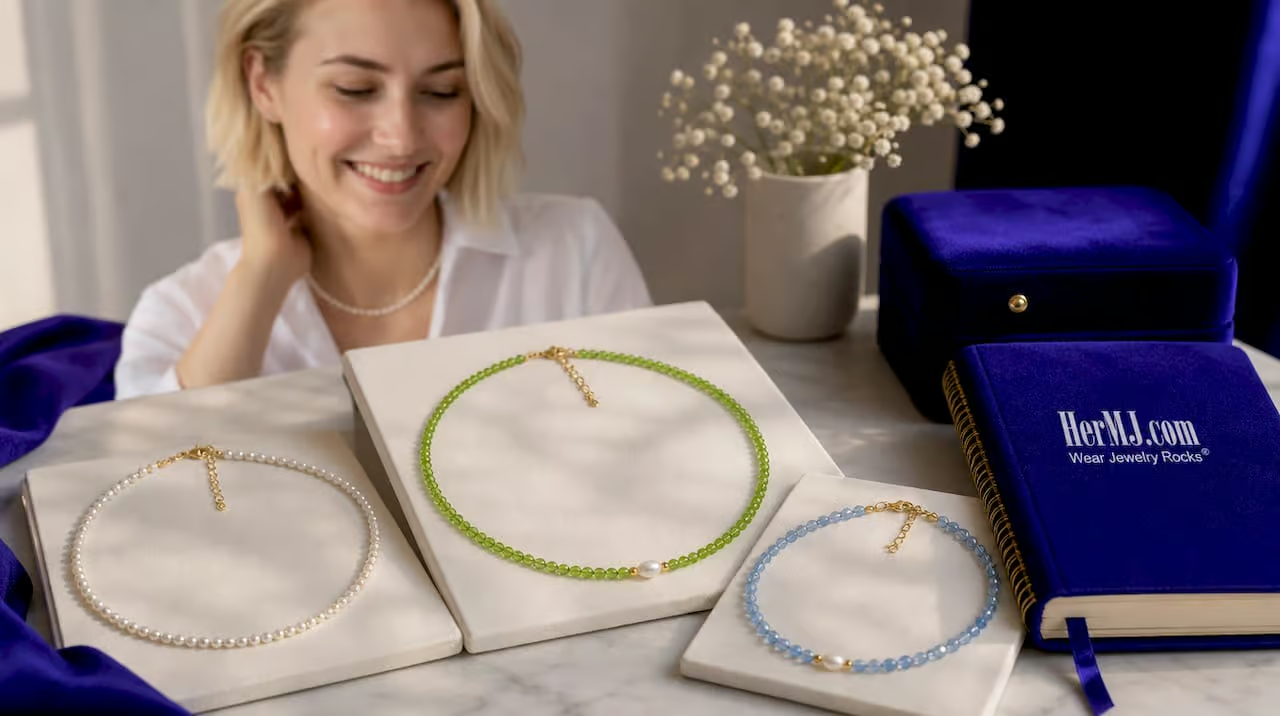
The Elegant Freshwater Pearl Necklace is a natural starting point for first-time pearl buyers or anyone looking for a reliable everyday strand.
The Peridot And Pearl Fusion Necklace and the Pearl And Aquamarine Necklace offer something more personal: genuine gemstone accents paired with freshwater pearls, handcrafted in small batches.
Every U.S. order ships free with no minimum. Browse HerMJ’s freshwater pearl jewelry collection to find a piece that fits your budget and your style, or reach out directly for custom work.
An Editorial Perspective on Pearl Necklace Pricing
The price conversation most buyers are having is the wrong one
Most people shopping for a pearl necklace ask “how much should I spend?” when the more useful question is “what quality signals should I be able to verify at my budget?” Those are different questions, and the second one protects you far better.
The pearl market has a transparency problem that price guides alone don’t solve. A $400 freshwater strand from a maker who publishes nacre thickness, treatment disclosure, and matching criteria is a better purchase than a $400 strand from a seller who offers none of that information.
The price is identical; the value is not. Buyers who shop on price alone, without asking the verification questions, are the ones who end up disappointed.
There’s also a persistent myth that saltwater pearls are categorically “better” than freshwater. They’re different, not superior. Modern freshwater pearl cultivation has produced rounds with luster that rivals Akoya at a fraction of the price.
The idea that you need to spend $1,000 to own a genuinely beautiful pearl necklace is outdated. What you need to spend $1,000 on is a specific size, a specific luster grade, or a specific type that only saltwater cultivation produces. If those aren’t your priorities, freshwater delivers extraordinary quality at a fraction of the cost.
My strongest advice: learn to read a drill hole photo before you buy anything. It’s the single most honest piece of information a seller can give you, and the sellers who offer it without being asked are almost always the ones worth buying from.
Sources
The sources below are the most authoritative references used to build this guide. Each covers a distinct part of the pearl pricing and grading picture, and all are worth bookmarking if you’re making a significant purchase.
Jewelers of America’s member directory is the right starting point for finding vetted sellers who commit to ethical sourcing and verified disclosures.
For a practical breakdown of what different budgets buy, The Pearl Source’s price guide is one of the clearest resources available, covering the $100 to $1,000+ range with specific examples.
Brilliant Earth’s pearl value guide provides a clean explanation of the six primary grading factors and how saltwater types compare.
For high-end and auction context, 1stDibs’s pearl pricing overview shows the full spectrum from accessible to collector-grade. Honho Jewelry’s type-by-type price guide is useful for per-type range comparisons.
For the mother-of-pearl question specifically, Mark Schneider’s formation guide explains the nacre vs pearl distinction clearly.
And for context on ongoing maintenance costs, ThePricer’s pearl necklace cost breakdown covers restringing and ownership costs in practical terms.
For a deeper look at what separates a $200 pearl necklace from a $2,000 one at the quality level, HerMJ’s guide on pearl value and the most expensive pearls covers the premium end of the spectrum with the same practical framing used throughout this guide.
- Jewelers
- Pearl Jewelry Price Guide: What You Can Actually Get for $100, $300, $500, and $1,000+ – TPS Blog
- How Much Does A Pearl Necklace Cost?
- How Much Are Pearls Worth? | Pearl Price & Value Guide
- How much does a real pearl necklace cost?
- How Much Are Pearls Worth? 2026 Price Guide by Type
Recommended
- Why Pearl Jewelry Is Undervalued: What Buyers Miss
- Pearl Value: What is the most expensive pearl?
- Pearl Statement Necklace Options for Modern Elegance
- Style Pearl Jewelry with Everyday Outfits: Easy Looks