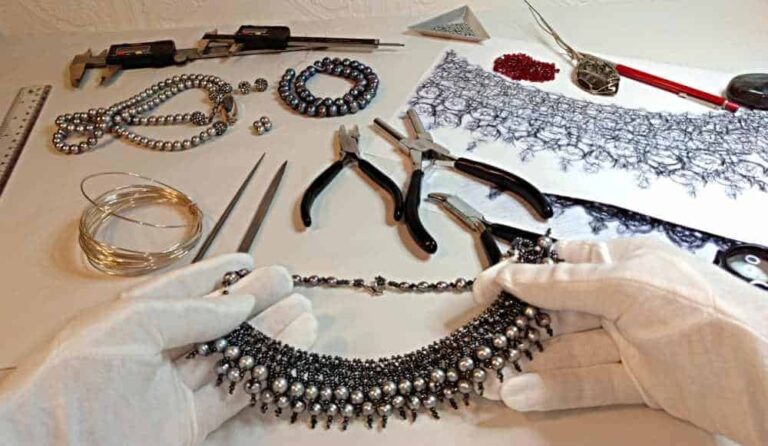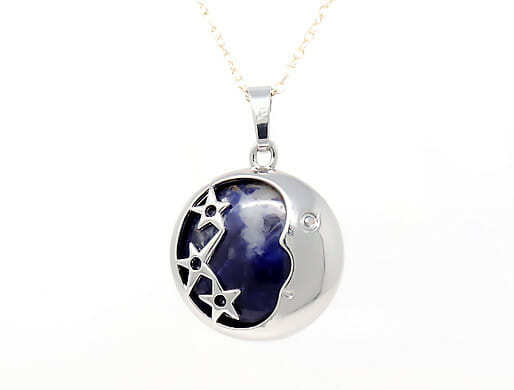

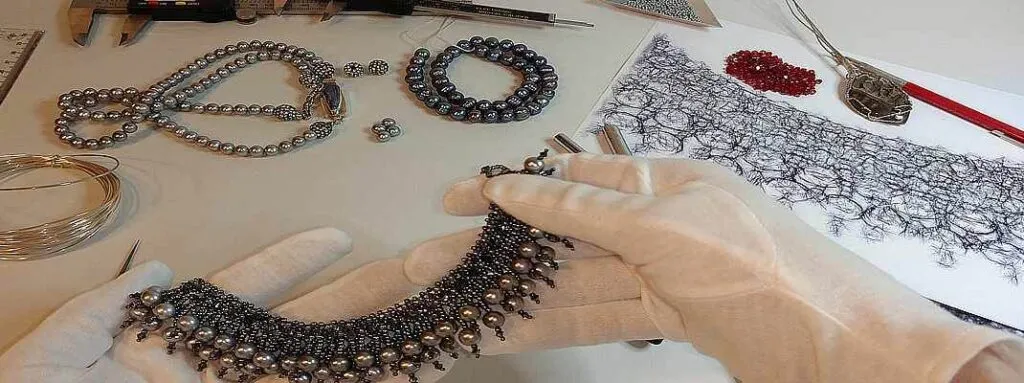
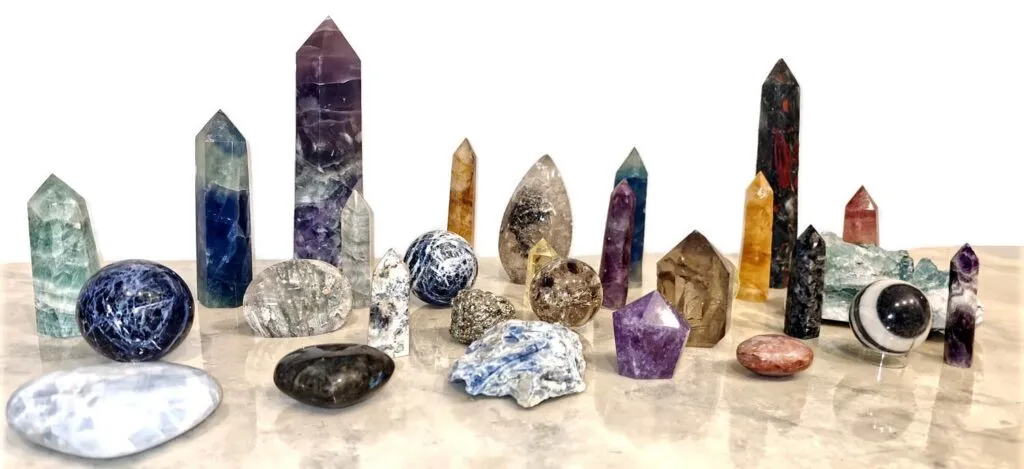


Why Handmade Jewelry Takes Longer: Craftsmanship Explained
The Edit
- Handmade jewelry takes longer because each stage involves skilled, manual work that automation cannot replicate efficiently. The process typically spans six stages, adding up to several weeks for complex pieces, with quality checks and custom fittings requiring expert attention. The extended timeline reflects the craftsmanship and personal touch that make these pieces unique and durable.
Handmade jewelry takes longer to produce because every stage requires skilled, hands-on labor that no machine can replicate at the same level of care.
Unlike factory production, where automation handles thousands of identical pieces in minutes, artisan jewelry moves through a sequence of manual steps, each demanding focused attention and expertise.
A single piece can take anywhere from several days to several weeks, depending on its complexity. That time isn’t delayed. It’s the cost of quality, and once you understand what happens at each stage, the wait makes complete sense.
Why handmade jewelry takes longer: a stage-by-stage breakdown
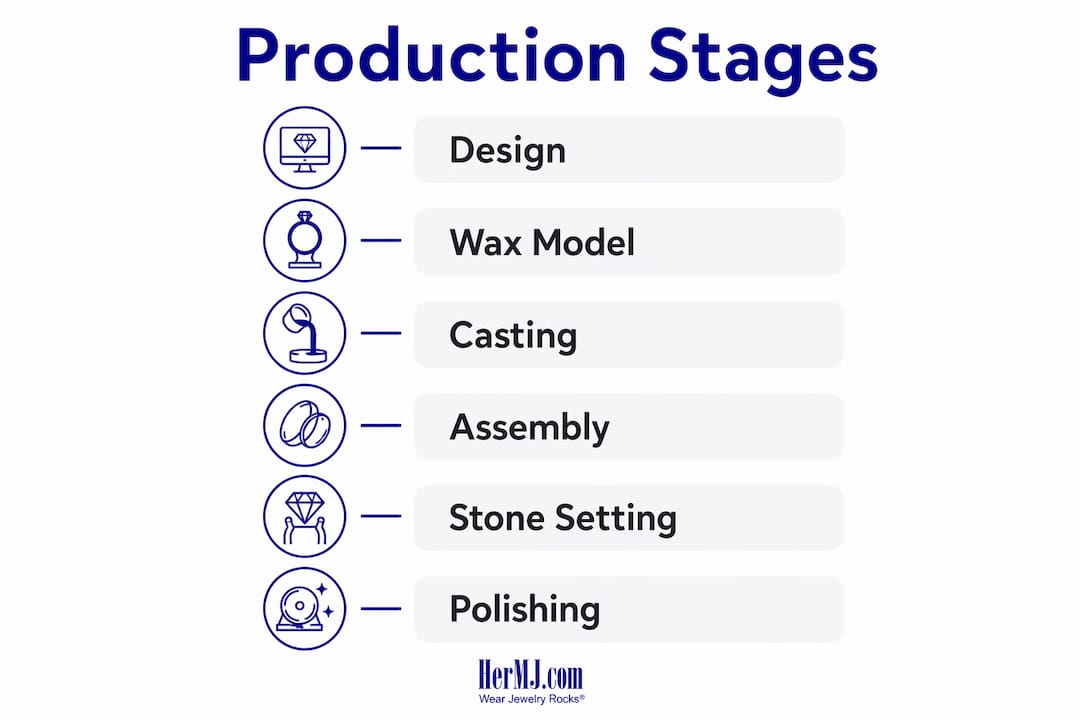
The handmade jewelry production time accumulates across six distinct stages, and each one adds real hours to the clock. There’s no shortcut between them, and skipping any step shows up in the finished piece.
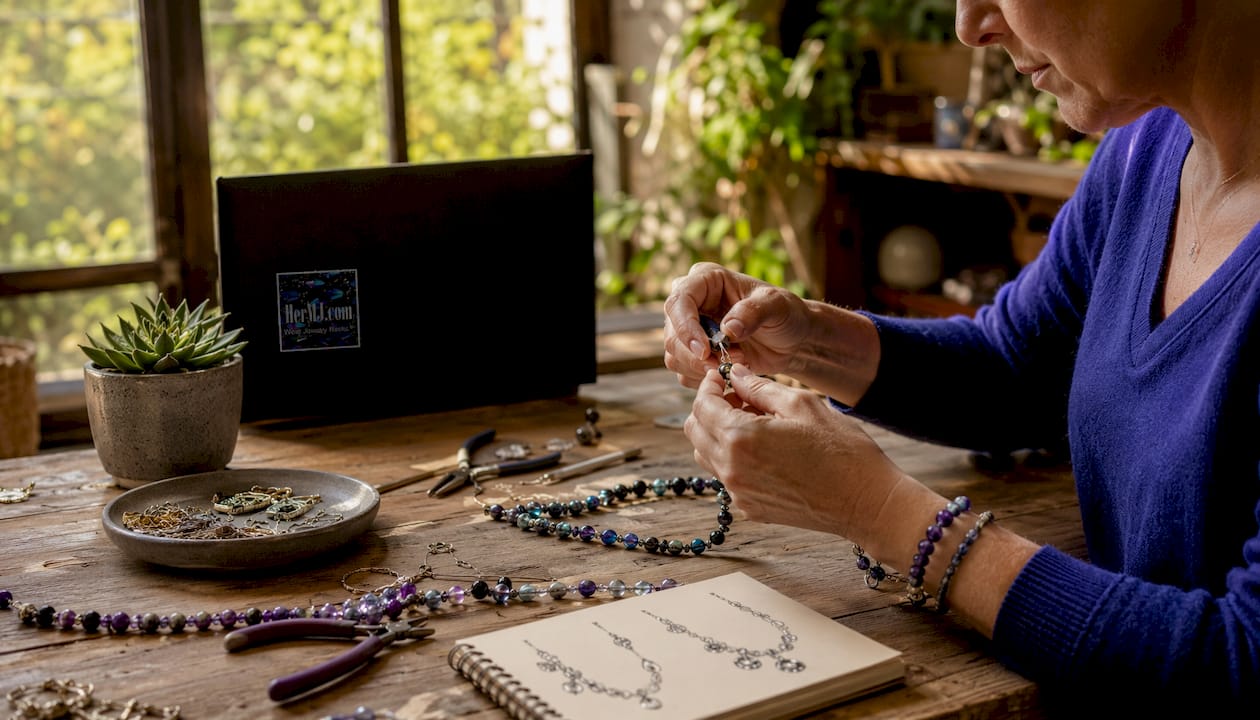
Here’s how the time breaks down across a typical artisan piece, based on labor time estimates from the craft:
| Stage | Typical time | What happens |
|---|---|---|
| Design and sketching | 1–3 days | Concept drawings, client revisions, and material planning |
| Wax modeling | 1–5 days | A wax prototype is carved or sculpted by hand to test form and fit |
| Casting or forging | 1–2 days | Metal is poured or hammered into shape from the wax model |
| Assembly and soldering | 1–3 days | Components are joined with heat and solder under close inspection |
| Stone setting | 1–4 days | Each stone is seated and secured individually by hand |
| Polishing and quality control | 1–2 days | Surface finishing and a final check of every detail |
Add those ranges together and you’re looking at a minimum of six days for a simple piece, and potentially nineteen days or more for something complex. That’s before accounting for any custom requests, revisions, or sourcing delays on materials.
What makes this process genuinely time-consuming isn’t just the number of stages. It’s the expertise required at each one. Wax carving, for instance, demands the kind of three-dimensional spatial thinking that takes years to develop.
Stone setting requires steady hands and an understanding of how metal behaves under pressure. These aren’t skills you pick up in an afternoon.
Pro Tip: When you commission a custom piece, ask your artisan for a stage-by-stage timeline. Knowing where your piece is in the process makes the wait feel purposeful rather than uncertain.
What artisan challenges add even more time?
Beyond the standard stages, several craft-specific challenges further delay the timelines for handmade jewelry production. These aren’t inefficiencies. They’re the natural result of working with real materials and genuine skill.
Casting defect and scrap rates. Scrap rates between 5% and 15% are common in handmade jewelry casting. That means an artisan may need to recast a component, restart a stage, or source additional material before the piece can move forward. Each rejected casting adds time and cost.
Custom stone fitting. Setting stones, especially irregular or antique cuts, requires cutting a metal seat custom-fit for each individual stone. No two antique-cut gems are exactly alike in dimension, so the artisan adjusts the metal seat by hand until the fit is secure and the stone sits at the right angle to catch light. Machines can’t do this reliably.
Kinetic and moving parts. Jewelry with moving components, such as articulated pendants or lockets with working mechanisms, requires manual tension adjustment that factory tolerances simply can’t achieve. Too loose and the piece rattles. Too tight and it breaks. An artisan tests, adjusts, and retests by feel.
Hybrid production approaches. A number of skilled artisans outsource casting to specialized foundries but perform all finishing, stone setting, and assembly by hand. This actually improves structural integrity while preserving the piece’s artisan character. It also adds coordination time between the artisan and the foundry.
One thing worth knowing: “handmade” doesn’t always mean every single component was made from raw metal by one person in one studio. What it does mean is that the critical decisions, the fitting, the finishing, and the quality judgment were made by a skilled human being who cared about the outcome.
Pro Tip: Ask your jeweler whether they use a hybrid approach. Outsourced casting with hand finishing is a legitimate and often superior method. What matters is who controls the quality at every stage.
How does handmade compare to mass-produced jewelry?
The core difference between handmade and factory-made jewelry isn’t just time. It’s the entire philosophy of production.
Factory production achieves a fast turnaround by spreading fixed costs across thousands of identical units and relying on automation to ensure consistency.
A factory can produce a simple pendant in minutes. That speed comes at a real cost: no customization, minimal per-piece quality control, and designs constrained by what machines can replicate efficiently.
Handmade pieces, by contrast, undergo quality checks between stages. Each inspection point adds time, but it also catches problems before they compound. A stone that’s slightly off-center gets corrected at the setting stage, not discovered by the customer after purchase.
A single artisan controls most or all stages from start to finish. That continuity means the person polishing the piece also set the stones and knows exactly where the metal is thinnest. That knowledge produces better outcomes than a factory assembly line where no single worker sees the full picture.
Material waste also differs significantly. Factories optimize for volume and accept a certain level of uniformity.
Artisans work with the specific material in front of them, adapting their technique to the grain of the metal or the character of the stone. That responsiveness takes time. It also produces pieces that last decades rather than seasons.
You can learn more about identifying truly handcrafted pieces to know what to look for when evaluating quality before you buy.
How to set realistic expectations for custom jewelry timelines
Understanding the time required for custom jewelry makes the experience far more satisfying. Frustration usually comes from mismatched expectations, not from the wait itself.
Typical lead times for handmade jewelry range from a few days for simpler ready-to-ship pieces to 4–12 weeks for fully custom engagement pieces. The more complex the design, the more stages require individual attention, and the longer the timeline extends.
Here’s a practical approach to managing the waiting time for handmade jewelry:
- Clarify the timeline upfront. Ask your artisan for a realistic estimate before you commit. A good artisan gives you a range, not a fixed date, because handwork doesn’t follow a factory schedule.
- Build in buffer time for gifts or occasions. If you need a piece for a specific date, add at least two weeks to the quoted timeline. Stone sourcing, casting delays, and revision rounds all happen.
- Request progress updates. Many artisans are happy to share photos of work in progress. Seeing your piece take shape makes the wait genuinely enjoyable.
- Understand that revisions add time. Changing a design mid-process can mean restarting a stage. Finalize your design before production begins.
- Recognize what you’re waiting for. A piece that took three weeks to make by hand will outlast a factory piece by years. The advantages of handmade jewelry include durability, uniqueness, and a personal connection to the object that mass-produced pieces can’t offer.
Transparency from your artisan builds trust. The best makers communicate proactively, flag delays early, and treat your patience as something worth honoring with quality.
Key Takeaways
Handmade jewelry takes longer because skilled artisans complete six distinct manual stages, each requiring expertise, quality checks, and custom fitting that automation cannot replicate.
| Point | Details |
|---|---|
| Six production stages | Design through polishing takes 6–19+ days depending on complexity and custom requirements. |
| Scrap rates add time | Casting defect rates of 5%–15% mean artisans often redo stages before moving forward. |
| Custom stone fitting is labor-intensive | Irregular and antique-cut stones require hand-cut metal seats that machines can’t produce reliably. |
| Quality checks multiply touchpoints | Each handmade piece is inspected between stages, unlike factory sampling of batch production. |
| Realistic timelines prevent frustration | Custom pieces typically take 4–12 weeks; building in buffer time improves the experience. |
The wait is the point
During my years in the industry, the question I hear my colleagues addressing is some version of “why does it take so long?” People ask it with genuine curiosity and anticipation. And I understand. We live in a world where most deliveries are walked up your driveway in two days.
But here’s what I’ve come to believe: the time is the work. When an artisan spends four days setting stones by hand, they’re not being slow. They’re being careful in a way that a machine physically cannot be.
Every adjustment they make to a metal seat, every tension check on a moving part, every polish pass on a surface. That’s judgment applied in real time by someone who cares about the outcome.
It’s a product you’ll immediately notice the difference when compared to something that came out of a machine.
The misconception I see most often is that speed equals efficiency. In mass production, it does. In artisan craft, speed is often the enemy of quality. A rushed stone setting cracks. A hurried solder joint fails. The craftsmanship behind artisan jewelry is inseparable from the time it demands.
I’d encourage you to reframe the wait. You’re not waiting for a product to be shipped from a warehouse. You’re watching something made for you by a skilled person, with an appreciation that quality comes first and always. That’s genuinely rare. When the piece arrives, you hold it. You’ll definitely feel the difference.
— Veronique
HerMJ’s artisan collection: craftsmanship worth waiting for
HerMJ creates every piece with the same care and attention this article describes. Each item in the collection uses genuine pearls and gemstones, selected and set by hand to bring out their natural character.
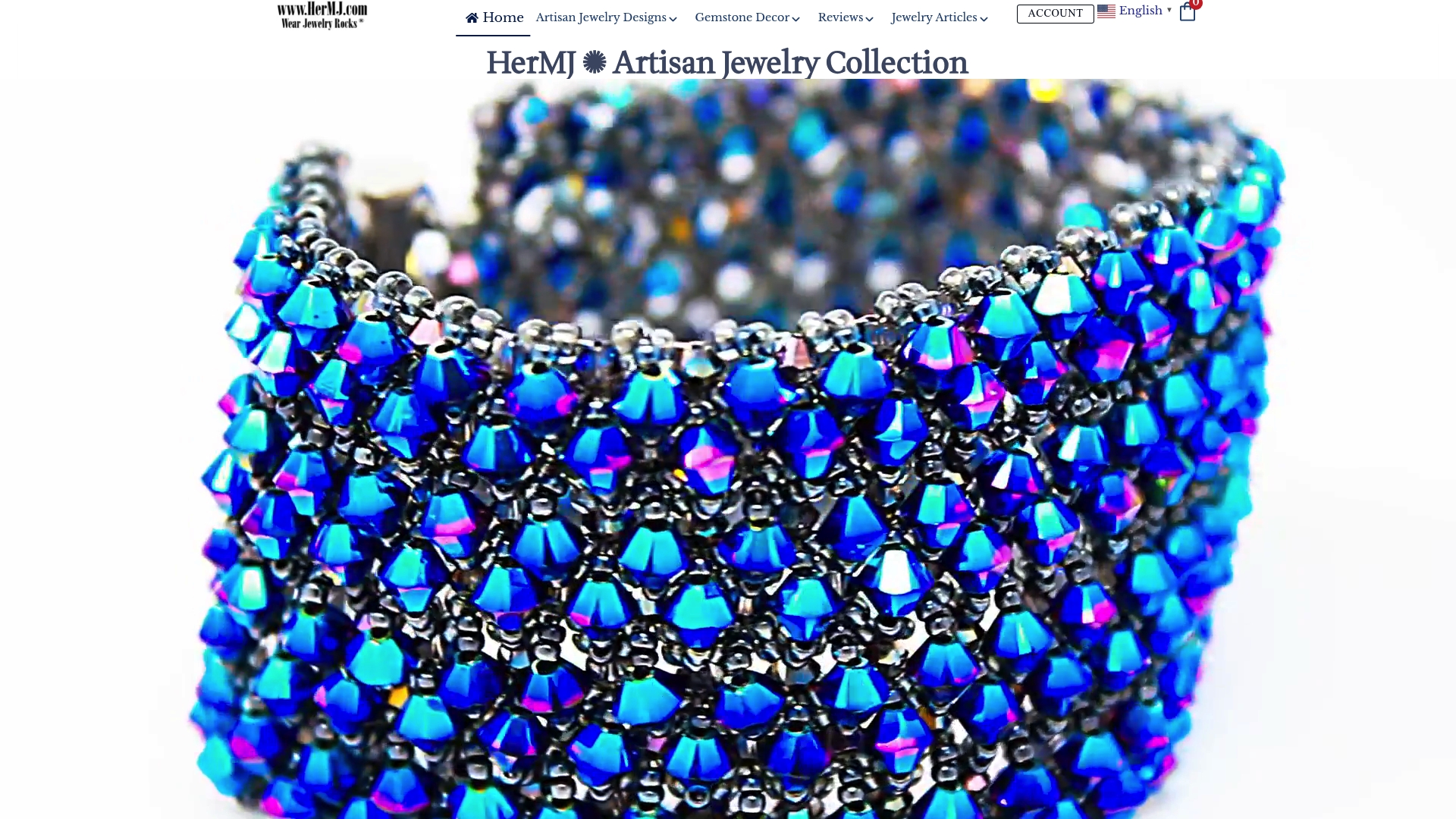
The Elegant Freshwater Pearl Necklace and the Pearl and Aquamarine Necklace both reflect the kind of artisan detail that takes real time to achieve.
For gemstone lovers, the Faceted Garnet Gemstone Necklace and the Strawberry Quartz Gemstone Bracelet showcase hand-finished quality at an accessible price.
US orders ship free with no minimum. International orders ship free for orders of $150 or more.
FAQ
Why does handmade jewelry take so much longer than store-bought?
Handmade jewelry passes through six manual stages, from design to polishing, each requiring skilled labor and individual quality checks. Factory jewelry skips most of these steps through automation, sacrificing customization and per-piece inspection.
How long does it take to make a custom handmade piece?
Simple handmade pieces take as few as six days, while fully custom pieces typically require 4–12 weeks from design approval to delivery. Complexity, stone sourcing, and revision rounds all extend the timeline.
Why does handmade jewelry cost more?
Labor costs for handmade jewelry reflect the hours of skilled work at each stage, plus higher material costs from scrap rates of 5%–15%. You’re paying for expertise, quality control, and a piece made specifically for you.
Can artisans speed up the process without losing quality?
Some artisans use a hybrid production approach, outsourcing casting while handling all finishing and setting by hand. This can reduce total time without compromising the artisan quality of the final piece.
What makes handmade jewelry worth the wait?
Handmade pieces undergo individual quality checks at every stage, use materials fitted to each specific design, and last significantly longer than mass-produced alternatives. The result is a unique object with a direct connection to the skill of the person who made it.
Recommended
- How to Identify Truly Handcrafted Jewelry Pieces
- How to Appreciate Artisan Jewelry Craftsmanship Details