


What Is Art Deco Jewelry Style? A Design Guide
The Edit
- Art Deco jewelry is characterized by bold, geometric, and architectural designs, with symmetry and angular motifs dominating its style. It uses materials like platinum, diamonds, and calibrated-cut stones to create precise, high-contrast visual effects, reflecting modernity and confidence from the 1920s and 1930s. Recognizing features like bilateral symmetry, geometric stone settings, and distinctive metalwork helps authenticate genuine Art Deco pieces.
Art Deco jewelry style is defined as a bold, geometric, and architectural design movement that flourished primarily during the 1920s and 1930s, characterized by sharp symmetry, repeating angular motifs, and a precise material palette of platinum, diamonds, and calibré-cut colored stones.
The style broke decisively from everything that came before it, trading organic curves for drafted lines and floral softness for architectural confidence. If you’ve ever held a piece and thought it looked more like a blueprint than an ornament, you were probably holding Art Deco.
Understanding what makes this style distinct, from its visual grammar to its historical roots, gives you a genuine framework for recognizing and appreciating these pieces wherever you encounter them.
What visual motifs and geometric patterns define Art Deco jewelry?
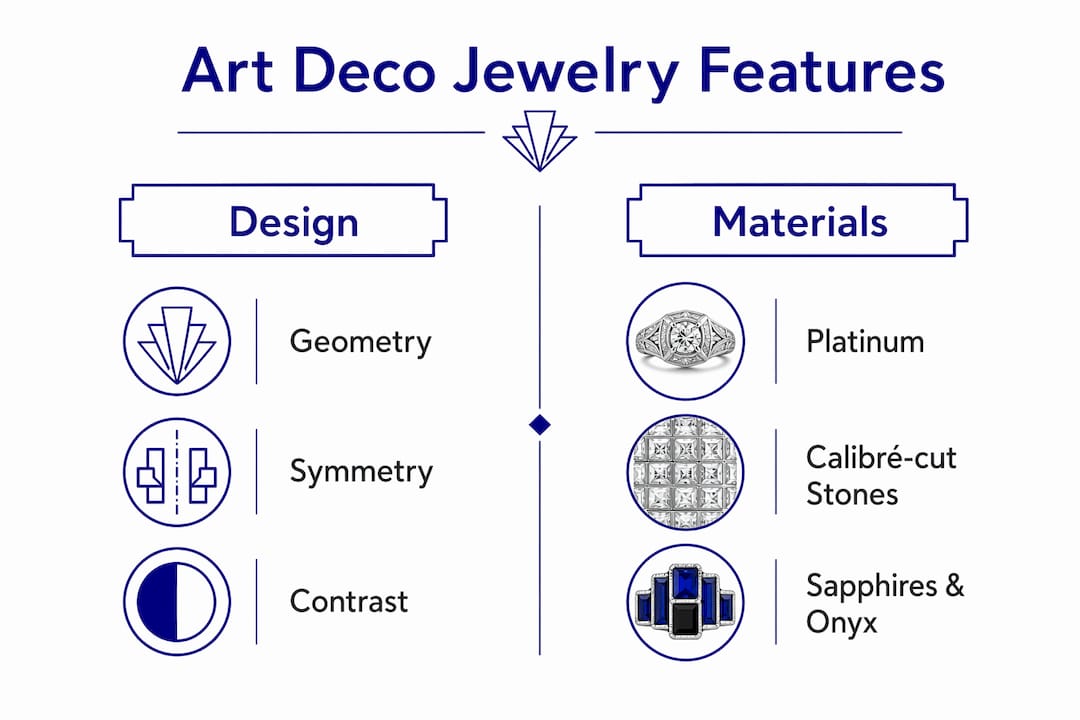
Art Deco jewelry is built on a visual grammar of geometry, using bilateral symmetry and repeated angular motifs as its core design language. Every element in a well-made Deco piece feels intentional, as if the designer started with a grid and worked outward.
That sense of architectural order is what makes the style so instantly recognizable, even to an untrained eye.
The most common motifs you’ll find include:
- Chevrons and zigzags: Sharp V-shapes and stepped zigzag lines that create visual rhythm across a surface
- Sunbursts and fan shapes: Radiating lines from a central point, often used in brooches and pendants to suggest energy and modernity
- Stepped and tiered forms: Layered geometric shapes that create depth without organic curves, borrowed partly from Egyptian and Aztec architecture
- Hexagons, triangles, and rectangles: Used as both the overall silhouette of a piece and as the framing device for individual stones
Bilateral symmetry is the rule, not the exception. A Deco piece divided down its center axis produces two near-identical halves. This isn’t accidental. It reflects the movement’s broader belief that beauty and order are the same thing.
Pro Tip: When examining a piece you suspect is Art Deco, hold it at arm’s length and look for a central axis. If both sides mirror each other precisely, that’s one of the strongest visual indicators of the style.
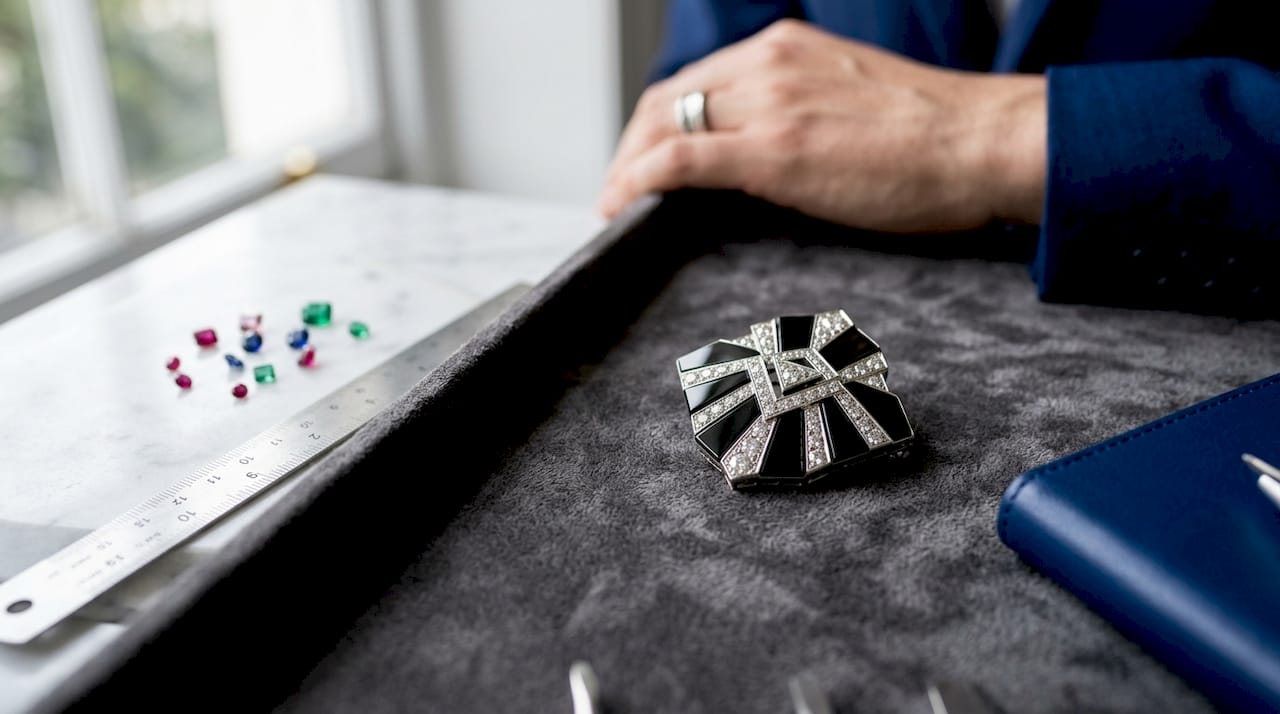
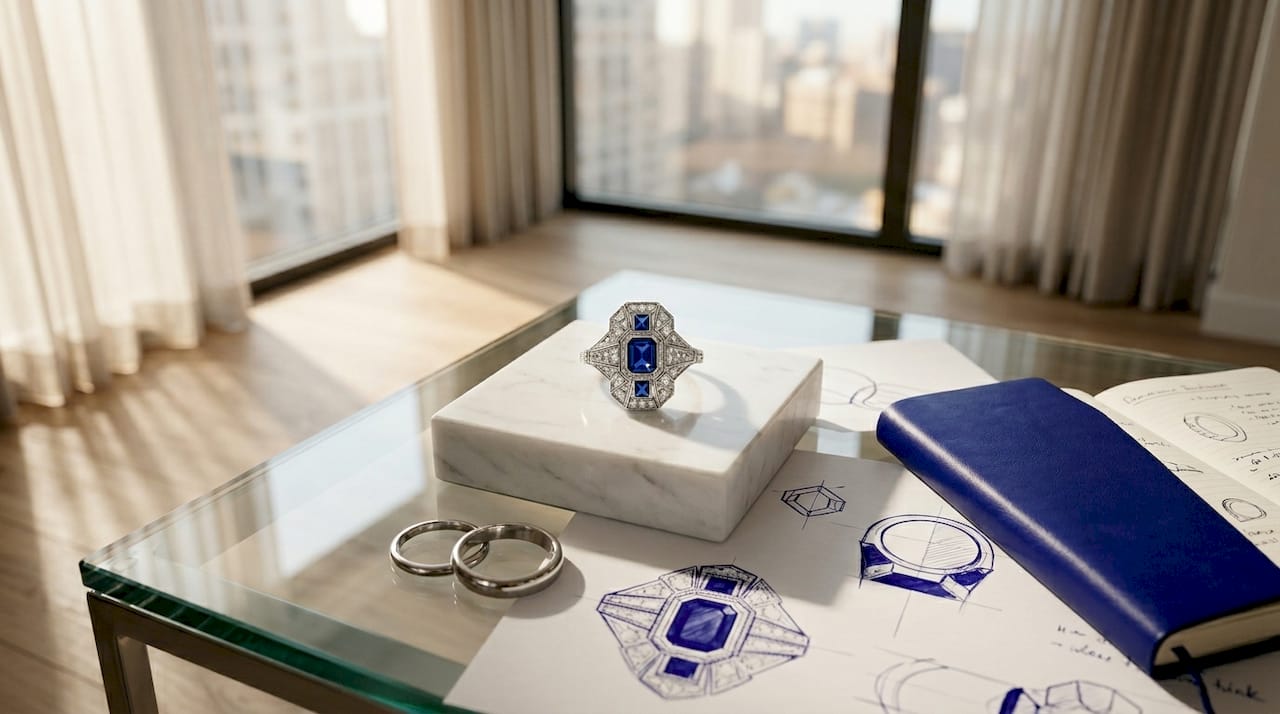
Color contrast is equally defining. The pairing of black onyx against white diamonds, or deep sapphire blue against platinum, creates a graphic quality closer to a modernist poster than a Victorian brooch. This high-contrast palette is one of the features that makes Art Deco jewelry design feel so contemporary, even a century later.
How does Art Deco jewelry differ from Art Nouveau and Edwardian styles?
Art Deco contrasts sharply with Art Nouveau by replacing flowing, organic curves and naturalistic motifs with sharp lines, bilateral symmetry, and high-contrast color schemes. The difference isn’t subtle. Art Nouveau jewelry looks like it grew from nature. Art Deco looks like it was engineered.
The table below captures the key distinctions across all three styles:
| Feature | Art Nouveau (1890–1910) | Edwardian (1901–1915) | Art Deco (1920–1935) |
|---|---|---|---|
| Line quality | Flowing, organic curves | Delicate, lacy filigree | Sharp, angular, geometric |
| Motifs | Flowers, insects, female figures | Garlands, bows, scrollwork | Chevrons, sunbursts, stepped forms |
| Primary metal | Gold and silver | Platinum and silver | Platinum and white gold |
| Color palette | Soft, naturalistic tones | Pale whites and pastels | High-contrast black, white, vivid color |
| Symmetry | Asymmetric, naturalistic | Loosely symmetrical | Strict bilateral symmetry |
| Overall feeling | Romantic, flowing | Refined, delicate | Bold, architectural, modern |
Edwardian jewelry shares platinum with Art Deco but uses it for lace-like delicacy rather than structural precision. Transitional pieces from roughly 1915 to 1925 combine Edwardian delicacy with emerging Deco geometry, which makes them genuinely interesting for collectors but tricky to categorize. If you’re browsing a guide to jewelry styles and a piece seems to straddle two eras, it probably does.
The clearest shortcut for distinguishing these styles: Art Nouveau whispers, Edwardian murmurs, and Art Deco announces itself.
What materials and gemstones are characteristic of Art Deco jewelry?
Platinum is the defining metal of Art Deco jewelry. Its strength enabled the crisp, architectural settings that give Deco pieces their precision aesthetic, and its malleability allowed craftsmen to achieve fine details that gold simply couldn’t hold as cleanly.
White gold became a more affordable substitute as platinum was restricted during World War II, which is why some later Deco pieces use it instead.
The gemstone palette is equally specific:
- Diamonds: Cut styles like baguette, emerald cut, and Asscher cut dominate, all chosen for their flat, geometric faces that align perfectly with Deco’s angular settings
- Onyx: Deep black onyx creates the high-contrast graphic quality that defines the style’s color language
- Jade and coral: Used for their vivid, saturated color, often in calibré-cut form to fill geometric channels precisely
- Sapphires, emeralds, and rubies: Calibré-cut and channel-set to maintain the grid-like precision of the overall design
Calibré-cut stones are custom-shaped to fit precise geometric channels, making them structurally integrated rather than decoratively placed. This technique requires hand-fitting and is one of the clearest signs of authentic Art Deco craftsmanship.
A stone that looks like it was designed as part of the architecture of the piece, rather than dropped into a pre-made setting, is almost certainly calibré-cut.
Pro Tip: Examine the colored stones in a suspected Deco piece under magnification. If they’re cut to fit the exact shape of their channel rather than rounded or faceted in a standard way, you’re likely looking at genuine calibré work, which is a strong authenticity marker.
Typical Art Deco materials always serve the geometry first. The stones aren’t the star. The design is.
How did historic events and cultural influences shape the Art Deco jewelry style?
The 1925 Paris Exposition Internationale des Arts Décoratifs was the pivotal moment that brought Art Deco worldwide attention and consolidated its design language into a recognizable movement.
Interestingly, the term “Art Deco” itself only entered common usage among dealers in the late 1960s, decades after the style had already peaked. The 1925 Exposition essentially standardized the geometric rules that make the style instantly recognizable today.
Several distinct cultural currents fed into Art Deco’s design vocabulary:
- Egyptian Revival: The 1922 discovery of King Tutankhamun’s tomb sent Egyptian motifs flooding into Western design. Art Deco absorbed Egyptian iconography as stylized geometry rather than realistic scenes, fitting scarabs, lotus flowers, and pyramidal forms into the movement’s grid and symmetry
- Cubism and Bauhaus: Pablo Picasso’s fragmented geometric forms and the Bauhaus school’s belief that art and industrial design should merge both pushed Deco toward its architectural sensibility
- Japanese design: The clean lines and asymmetric balance of Japanese decorative arts influenced European designers who were already moving away from Victorian excess
- Aztec and Mesoamerican architecture: Stepped pyramid forms and bold geometric stonework from pre-Columbian cultures appeared in Deco brooches, bracelets, and pendants
The spirit of the era mattered just as much as any single influence. The 1920s were a period of genuine optimism about modernity, technology, and speed. Art Deco jewelry reflected that energy. It looked forward, not backward, and it wore that confidence visibly. You can read more about how ancient Egyptian design shaped jewelry history in HerMJ’s piece on ancient Egyptian jewelry.
What are the best ways to identify authentic Art Deco jewelry?
Reliable identification of authentic Art Deco pieces rests on a triad of bilateral symmetry, geometry-driven stone placement, and architectural metal settings that look drafted rather than ornamented after the fact. If a piece feels like it was designed from the inside out, with the metalwork and stones forming a unified structure, that’s a strong signal.
Here’s a practical identification process:
- Check for bilateral symmetry. Divide the piece mentally down its center axis. Both halves should mirror each other with precision. Asymmetry is a red flag for Deco attribution.
- Examine stone placement. Stones in authentic Deco pieces are set to reinforce the geometric design, not simply fill space. Look for baguette diamonds in straight channels, calibré-cut colored stones in shaped recesses, and Asscher or emerald cuts in rectangular settings.
- Look for hallmarks. Marks like PLAT or 950 confirm platinum content. 18K or 750 indicates 18-karat gold. The absence of a hallmark doesn’t automatically disqualify a piece, but modern laser inscriptions on supposedly antique jewelry should raise questions.
- Assess construction method. Die-struck filigree shows slight, consistent variations under magnification that wax-cast reproductions can’t replicate. The metalwork should feel precise but not machine-perfect.
- Evaluate wear patterns. Genuine period pieces show consistent age across all surfaces, including the back and clasp mechanisms. Uneven wear or a pristine back on an otherwise aged piece warrants scrutiny.
The table below summarizes key identification markers:
| Marker | What to look for |
|---|---|
| Symmetry | Precise bilateral symmetry across the central axis |
| Stone cuts | Baguette, emerald, Asscher, or calibré-cut colored stones |
| Metal marks | PLAT, 950 for platinum; 18K or 750 for gold |
| Construction | Die-struck filigree with slight hand-finishing variations |
| Wear | Consistent, even aging across all surfaces including the reverse |
Early Art Deco pieces from 1920 to 1925 show transitional traits with lighter forms and traces of Edwardian design. Later pieces from 1925 to 1935 are bolder and more architectural. Knowing which phase you’re looking at helps you assess a piece accurately rather than dismissing a hybrid as inauthentic.
Pro Tip: Always examine the back of a suspected Art Deco piece as carefully as the front. Authentic period construction shows the same level of precision on the reverse, including how stones are secured and how the metalwork is finished.
Learning to identify handcrafted jewelry more broadly will sharpen your eye for the construction details that separate genuine period pieces from later reproductions.
Key takeaways
Art Deco jewelry is defined by geometric precision, bilateral symmetry, and a material palette of platinum and calibré-cut stones that together create an architectural aesthetic unlike any other jewelry style.
| Point | Details |
|---|---|
| Geometric design language | Chevrons, sunbursts, stepped forms, and fan shapes create a repeating visual grammar. |
| Material precision | Platinum and calibré-cut stones are structurally integrated, not decoratively placed. |
| Historical anchors | The 1925 Paris Exposition and the 1922 Tutankhamun discovery both shaped the style’s vocabulary. |
| Style distinctions | Art Deco is angular and symmetrical where Art Nouveau is organic and Art Nouveau is flowing. |
| Identification triad | Look for bilateral symmetry, geometric stone placement, and architectural metal settings together. |
Why Art Deco jewelry still speaks to me after all these years
I’ve spent years studying jewelry across periods and movements, and Art Deco remains the one style that genuinely rewards the more you know about it. Most people encounter it as “geometric vintage jewelry,” which is accurate but misses the point. What makes
Art Deco extraordinary isn’t just how it looks. It’s the conviction behind it.
These pieces were made during a period when designers genuinely believed that precision and modernity were beautiful in themselves. That confidence comes through in every calibré-cut stone and every drafted metal setting. You’re not looking at decoration. You’re looking at a design philosophy that’s wearable.
What I find most compelling for collectors today is that Art Deco’s clarity of form means it ages without becoming dated. A bold geometric brooch from 1928 reads as confidently contemporary in 2026 as it did when it was made. That’s rare in any decorative art form. My advice: don’t wait until you’re “ready” to collect Deco. Start by learning to read the geometry, and the pieces will start speaking to you on their own.
— Veronique
Explore artisan craftsmanship and jewelry history with HerMJ
Art Deco jewelry rewards those who understand the craftsmanship behind it. At HerMJ, I believe that knowing how a piece is made changes how you see it entirely.
If you’re drawn to the Egyptian Revival motifs that shaped Deco’s design vocabulary or you want to understand what genuine artisan construction looks like up close, HerMJ has resources built for exactly that curiosity. My guide to artisan jewelry craftsmanship walks you through the material and technical details that separate exceptional pieces from ordinary ones.
And if the Egyptian influences in Art Deco caught your attention, my piece on ancient Egyptian jewelry history goes deep into the iconography that Deco designers reinterpreted so brilliantly. Good jewelry always has a story. This helps you read it.
FAQ
What is Art Deco jewelry style in simple terms?
Art Deco jewelry style is a geometric, architectural design movement from the 1920s and 1930s defined by sharp symmetry, angular motifs like chevrons and sunbursts, and a material palette centered on platinum and diamonds.
How do I tell Art Deco apart from other vintage jewelry?
Look for strict bilateral symmetry, geometric stone placement using baguette or calibré-cut stones, and platinum or white gold settings with high-contrast color. Art Nouveau curves and Edwardian lace-like filigree are the clearest contrasts.
What gemstones are most common in Art Deco pieces?
Diamonds in baguette, emerald, and Asscher cuts are most common, alongside calibré-cut onyx, sapphires, emeralds, rubies, and jade set into precise geometric channels.
When did Art Deco jewelry first appear?
The style emerged in the early 1920s, with the 1925 Paris Exposition Internationale des Arts Décoratifs serving as the key moment that consolidated and spread its design language internationally.
Is Art Deco jewelry considered vintage or antique?
Pieces made before 1926 qualify as antique by the 100-year rule as of 2026. Pieces from the late 1920s and 1930s are classified as vintage. Both categories are actively collected and valued by enthusiasts worldwide.
Recommended
- What Is Avant Garde Jewelry? A Collector’s Guide
- Jewelry Styles Explained: Know What’s Important
- What Is Gemstone Cluster Jewelry: Style Guide 2026