


Handmade vs. Mass-Produced Jewelry: What Really Differs
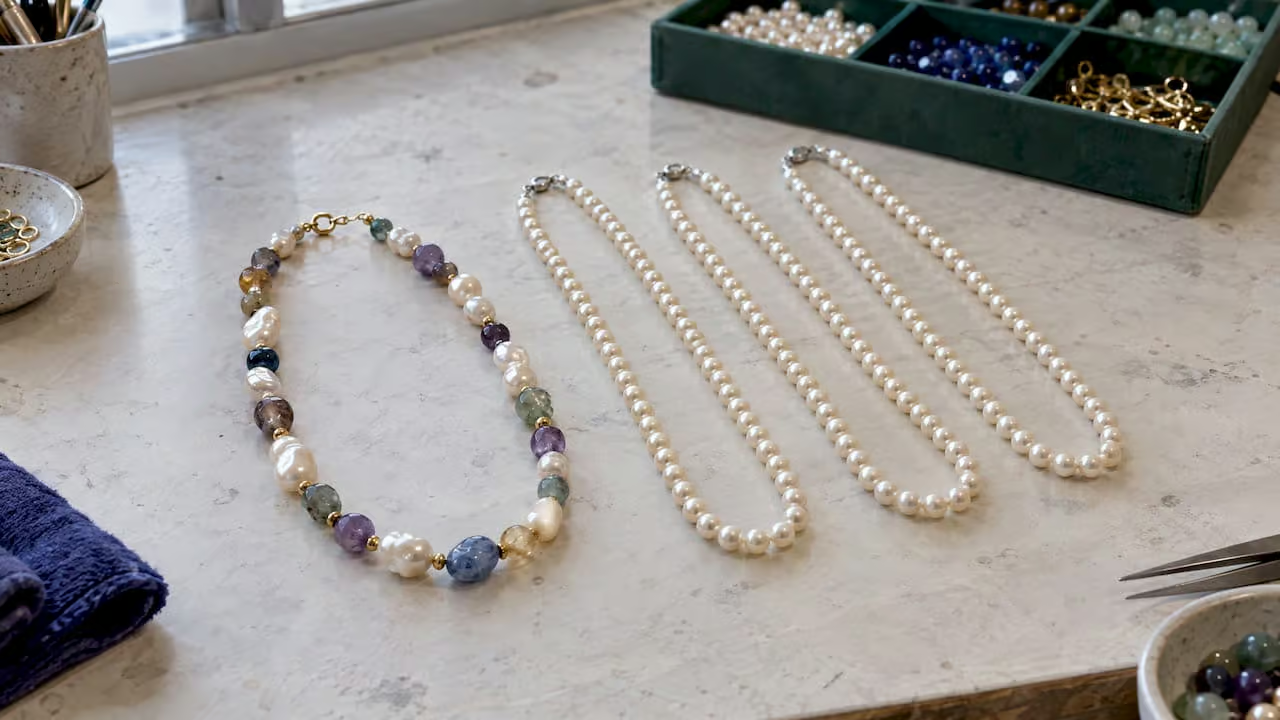
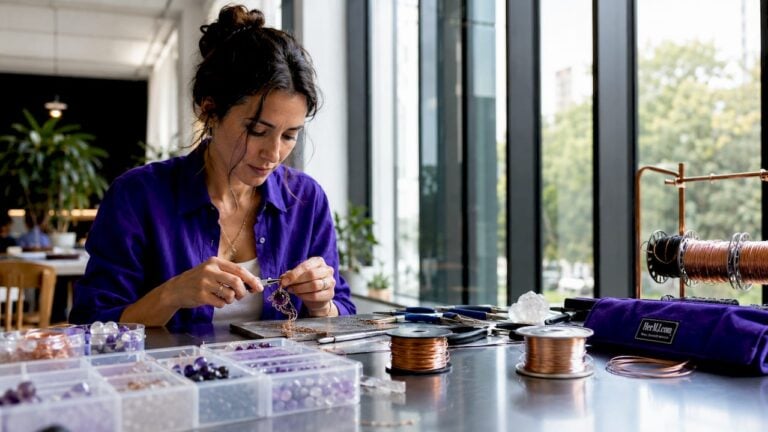
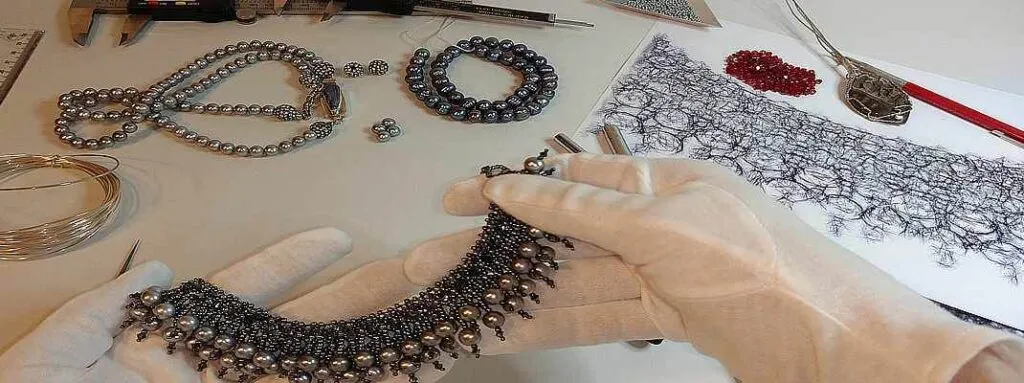
Handmade jewelry is shaped and finished by an artisan’s hands and tools, one piece at a time.
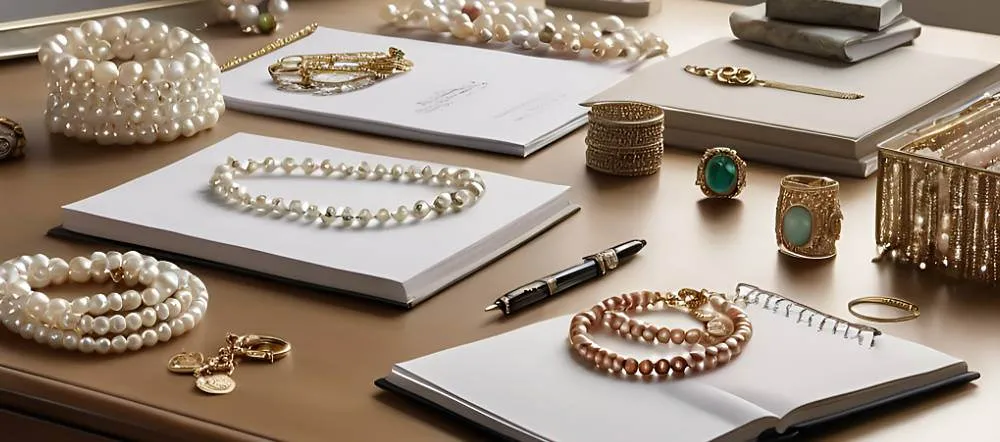
Mass-produced jewelry is made in large runs by machines and divided labor.
That difference shows up in the details you can see and feel: the variation from piece to piece, the way stones are set and strung, and the story behind what you’re wearing. If you want jewelry that’s yours alone, made from genuine freshwater pearls and natural gemstones at accessible prices, HerMJ’s pearl and gemstone collection is a good place to start.
TL;DR:
- Handmade means a maker controls the shape, design, and finish of each piece. Mass production means machines and repeated steps turn out many identical items.
- In the U.S., the Federal Trade Commission sets a legal meaning for “handmade” in jewelry, so the word isn’t just marketing.
- Natural pearls and gemstones vary in color, shape, and luster, which is why one-of-a-kind pieces are easiest to build by hand.
- Judge any piece on construction, materials, and finish, not just the label.
- HerMJ ships U.S. orders free with no minimum, and international orders free at $150 or more.
What Handmade and Mass-Produced Actually Mean
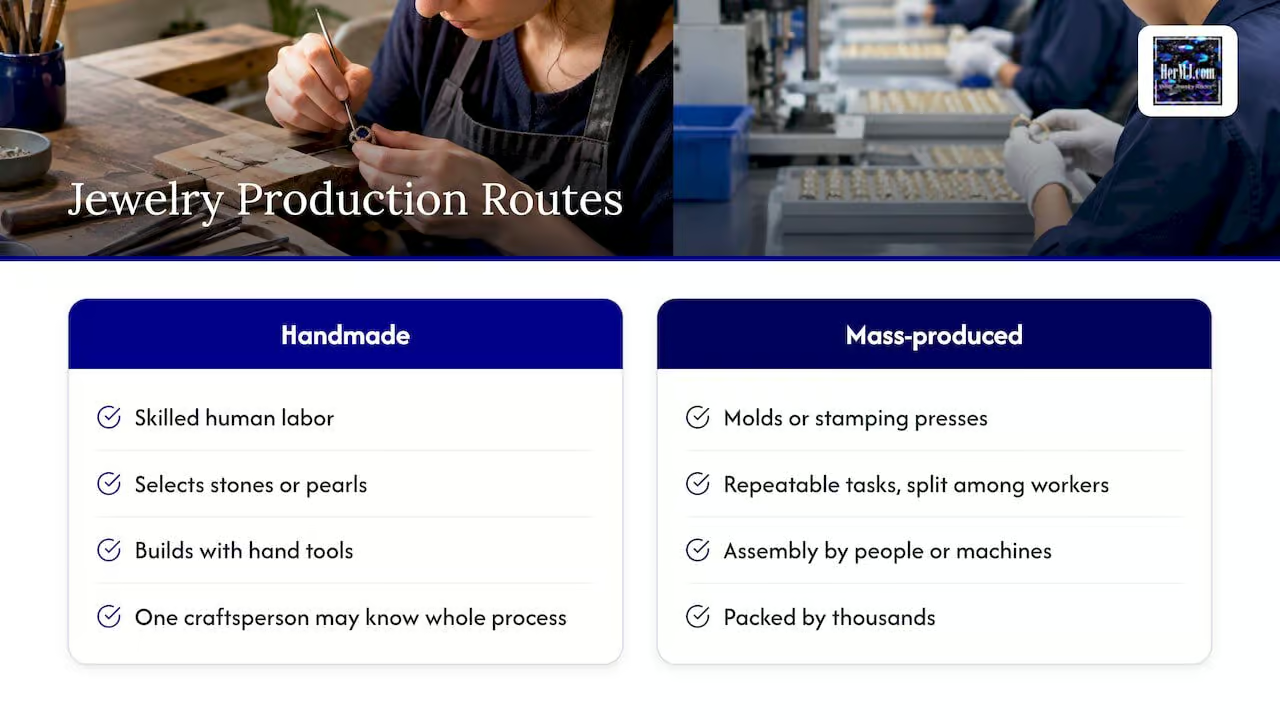
The National Park Service offers the plainest explanation. Craft production relies on skilled human labor, and often one craftsperson knows the whole process from raw material to finished object. Industrial production splits the work into repeatable tasks done by different people, which raises speed and output.
Apply that to jewelry and the picture is easy to follow. A mass-produced necklace might come from a mold or stamping press, be assembled by several workers or machines, and be packed by the thousands.
A handmade necklace begins with a person choosing stones or pearls, laying them out, and building the piece with hand tools. The difference results in a product for sale rather than a work of art.
Neither approach is a villain. Mass production exists because it makes goods consistent and affordable at scale. Handmade work exists because some things, especially natural materials, reward a human eye. When you’re shopping for pearls and gemstones, that human eye matters more than almost anywhere else.
Why Natural Pearls and Gemstones Favor the Human Hand
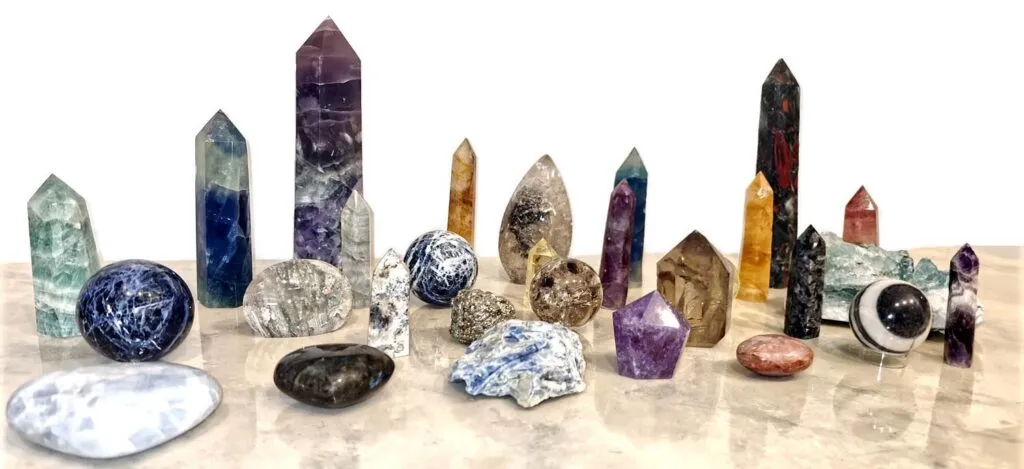
No two freshwater pearls are the same. They differ in shape, surface, overtone, and luster, and gemstones carry their own banding, inclusions, and color shifts. A machine works best when every input is identical. Natural materials aren’t.
That’s the quiet reason I believe in handmade for this category. When someone builds a bracelet by hand, they can match a Lapis Lazuli bead to its neighbor by color depth, or choose which pearl sits at the center of a strand because its glow is the best in the batch. An assembly line can’t make those decisions. It can only make the same decision thousands of times.
You can see this in pieces like the Lapis Lazuli bracelet with a Tahitian pearl accent, where deep blue stone meets the soft shimmer of a pearl. Natural variation isn’t a flaw in that kind of jewelry. It’s the whole point.

How Handmade and Machine-Made Jewelry Compare
Here’s a side-by-side view of what typically differs. These are general patterns in how the two approaches work, not rules about any one brand.
| Factor | Handmade | Mass-produced |
|---|---|---|
| Who shapes it | A maker, using hand tools and manual methods | Machines, molds and divided labor |
| Consistency | Each piece varies slightly | Pieces are near-identical |
| Batch size | Small runs or single pieces | Large runs |
| Materials | Easy to select stone by stone | Chosen for uniform supply |
| Lead time | Longer, because each piece takes hands-on time | Short, because stock is made ahead |
| Feel | Personal, with visible character | Uniform and predictable |
If you’d like the maker’s side of that time question, I wrote about why handmade jewelry takes longer and what’s happening at the bench while you wait.
Construction you can actually see
Turn a piece over. On a well-made handmade necklace or bracelet, you’ll often notice small, deliberate choices: how a clasp is attached, how wire is finished, how each stone is secured. These are where a maker’s attention shows.
The Gemological Institute of America notes that jewelry problems such as lost stones, distortion, and damage can come from workmanship errors, wrong materials, or poor design, with rough wear adding to the list. In other words, quality depends on how carefully a piece is built and what it’s made from, and you can look for that no matter how a piece is made.
GIA’s benchmarks also consider things like proper dimensions and whether the metal is strong enough for the piece. Those are the same questions a thoughtful maker asks at the bench.
If you enjoy the technical side, nine handcrafted construction techniques are worth a read before your next purchase. You’ll start noticing how pieces come together.
Price: what you’re really paying for
Mass-produced jewelry usually costs less per piece because machines spread the cost of making across huge quantities. Handmade jewelry involves more direct labor.
One jewelry-pricing breakdown from a custom studio’s blog estimates that materials and labor each account for roughly 30 to 40 percent of a custom piece’s price, with design, overhead, and margin making up the rest. That’s one maker’s view of custom work, not a universal formula, but it explains why hands-on time shows up on a price tag.
This is where HerMJ’s approach matters to me. Our whole idea is artisan craftsmanship at accessible prices, so you aren’t forced to choose between something distinctive and something you can afford. You can browse necklaces, bracelets, and modern drop earrings and see how that plays out.
What “Handmade” Legally Means in the United States
Most shoppers assume “handmade” is a loose phrase. In U.S. jewelry, it isn’t. Under the FTC’s Jewelry Guides, it’s unfair or deceptive to call a jewelry product handmade unless the entire shaping, forming, finishing, and decoration from raw materials was done by hand labor and manually controlled methods.
Those methods must let the maker control and vary the construction, shape, design, and finish of each part of each individual product.
The guide also defines raw materials as bulk items such as sheet, strip, wire, precious metal clays, ingots and casting grain that haven’t yet been cut, shaped or formed into jewelry parts or blanks. That’s a useful yardstick. It tells you the word describes a genuine way of working, with the maker steering the result.
There’s a wrinkle worth knowing, though. The Associated Press has reported that shoppers can’t always tell whether an item is truly handcrafted, and that no single fair-trade certification process covers handicrafts as a category. So the label alone won’t settle things, which is why a few good habits help.
How to Tell Whether Jewelry Is Really Handcrafted
You don’t need a loupe or a gemology degree. Here’s the routine I’d follow.
- Look for small, natural differences. Handmade pieces made from natural stones and pearls shouldn’t look cloned. Gentle variation in color, shape, and spacing is a good sign.
- Read the description for specifics. A maker who built the piece can usually say what the stones are, what they’re strung or set on, and how the piece came together. Vague phrases such as “artisan style” say little.
- Check the finish at the edges. Clasps, connections and the backs of settings tell you how carefully a piece was finished.
- Ask what the materials are. Genuine freshwater pearls and natural gemstones should be named as such, not hidden behind “pearl-like” or “stone-effect” wording.
- Consider how the seller presents the work. Makers who sell at markets and shops often rely on thoughtful artisan product displays to show off each piece’s character, and good online listings do the same with clear, close photos.
I put together a full checklist for identifying truly handcrafted jewelry pieces, and if you’d like to train your eye, appreciating the details of artisan jewelry craftsmanship walks you through what to notice up close.
Machine-Made Jewelry: Where It Fits
Machine-made jewelry has a real place. It’s consistent, easy to replace if you lose an earring, and well-suited to trend pieces you’ll wear for a season. Matching sets are simple when every piece comes from the same mold.
The trouble comes when you want something with presence. Uniform pieces are, by design, the same as everyone else’s. If you’re buying a gift for someone who loves things that feel chosen, or a statement piece you’ll wear for years, you’re really after the individuality that comes from handmade work.
That’s also why many shoppers who start with fashion jewelry move toward gemstone and pearl pieces over time. They start wanting materials with depth and a maker who pays attention.
Which One Is Right for You?
Here’s a simple way to decide.
- Choose handmade when you want a distinctive piece, a meaningful gift, or jewelry built around natural pearls or gemstones. A handmade piece suits an everyday signature look or a special occasion.
- Choose mass-produced when you need an exact match, a very low price for a short-lived trend, or an easy replacement.
For most people building a jewelry collection they love, a few handmade anchor pieces make the biggest difference. A pearl strand, a gemstone bracelet, and a pair of drop earrings can carry a wardrobe for years. If you like a bolder look, the European crystal jewelry collection adds sparkle without losing that handmade character.
And it’s not only about what you wear. The same appreciation for natural materials carries into the home. Our room jewelry brings gemstone and crystal accents to shelves and desks.
Understanding Artisan Jewelry More Broadly
“Artisan” gets used loosely, so it helps to anchor the idea. In jewelry, it points to work shaped by a skilled maker’s decisions rather than by an assembly line. If you’d like the fuller definition and a sense of where value comes from, what artisan jewelry is covers it in depth.
Value also means how a piece lives with you. Pearls are organic and, in a sense, living gems, so they reward a little attention. Our pearl care guide covers storage and upkeep, so your pieces keep their luster for years.
My Perspective At HerMJ
I’ve spent years around pearls and gemstones, and what I’ve learned is simple: natural materials ask to be treated as individuals.
A freshwater pearl has its own glow. A piece of carnelian or lapis has its own pattern. When we design and assemble jewelry at HerMJ, my whole aim is to let those qualities show, and to offer pieces made by hand at prices that don’t put them out of reach.
That’s the difference I’d ask you to look for. It isn’t about snobbery toward factory goods. It’s because you want something with a point of view, something that feels chosen for you and not stamped out in the thousands.
When you wear a handmade pearl necklace, you own something with character, and people notice. That’s why we focus on genuine freshwater pearls, natural gemstones and crystals, and why we want every customer to feel good about what arrives in the box.
Veronique
Find Your Handmade Piece at HerMJ
HerMJ makes handmade artisan jewelry from genuine freshwater pearls, natural gemstones, and crystals, including necklaces, bracelets, earrings, and limited edition pieces, plus gemstone and crystal decor for the home.
Prices stay accessible, and U.S. orders ship free with no minimum. International orders ship free on orders of $150 or more.
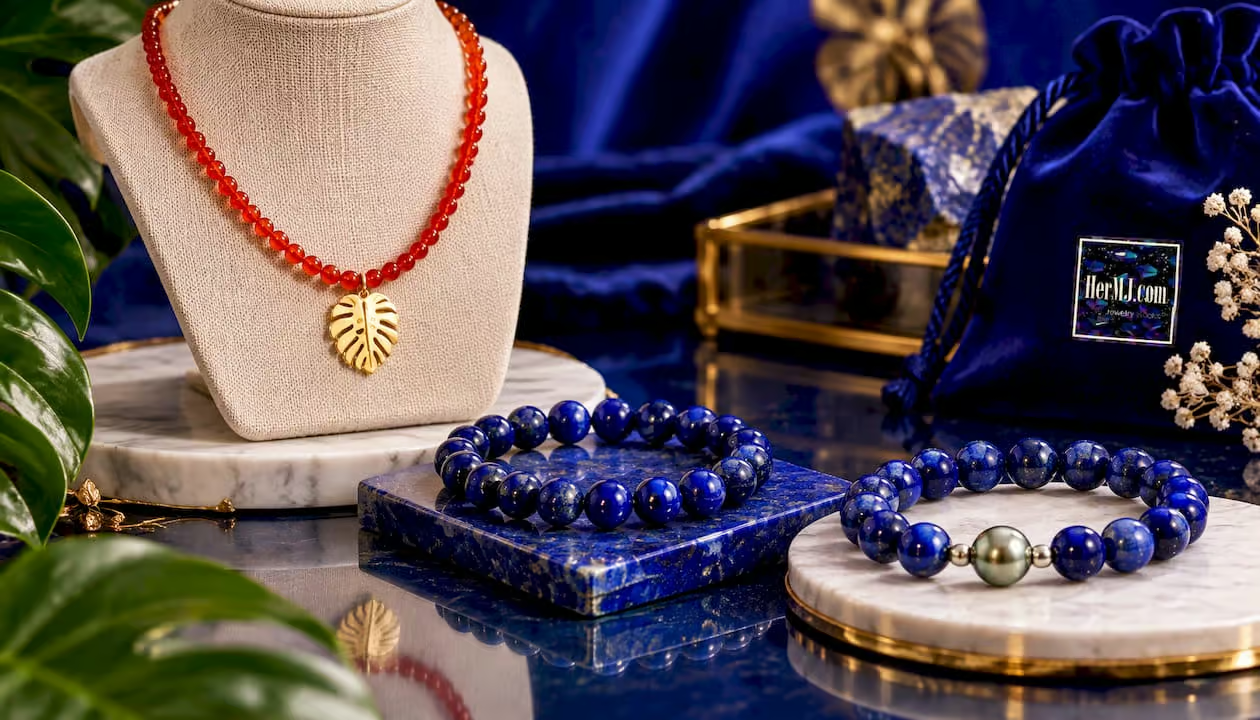
Start with the Carnelian necklace with a Monstera pendant or the Lapis Lazuli stretch bracelet, or browse the full pearl and gemstone jewelry collection.
FAQ
What is the difference between handmade and mass production?
Handmade work relies on skilled people, often following a piece from raw material to finished object. Mass production uses machinery and divided tasks to make large quantities quickly, as the National Park Service describes. For jewelry, that means handmade pieces vary slightly, while mass-produced ones are nearly identical.
How does handmade jewelry differ from machine-made jewelry?
Handmade jewelry is built by a maker who controls the shape, design, and finish of each piece. Machine-made jewelry comes from molds, presses, and automated steps repeated across a run. As a result, handmade pieces tend to show more individual character, especially with natural pearls and gemstones.
Can a seller legally call jewelry handmade?
In the U.S., the FTC’s Jewelry Guides say a product can be called handmade only if its shaping, forming, finishing and decoration were done by hand labor and manually controlled methods. That makes the word a meaningful standard, not a style choice.
Why does handmade jewelry cost more than mass-produced jewelry?
Handmade work involves more direct labor and smaller batches, while factories spread costs over large volumes. At HerMJ, the goal is to bring artisan craftsmanship to you at accessible prices, so a distinctive piece doesn’t have to be a splurge.
Sources
- Craft Production – Teachers (U.S. National Park Service)
- Federal Trade Commission, 16 CFR § 23.2 (Jewelry Guides)
- Authentically handmade? How to know amid mass production (Associated Press)
- What are the Quality Assurance Benchmarks? (GIA)
- Jewelry Detectives: Students Search for Clues to Quality (GIA)
- How Much Does Custom Jewelry Really Cost? A Price Breakdown
- What Are Artisan Product Display Units
Recommended
- Why Handmade Jewelry Takes Longer: Craftsmanship Explained
- Real Benefits of Handmade Jewelry Craftsmanship Explained
- What Is Hand Fabricated Jewelry? Craftsmanship Explained
- How to Identify Truly Handcrafted Jewelry Pieces