


Freshwater Pearl Prices: Your U.S. Buyer’s Guide
Freshwater pearl prices in the U.S. typically run from a modest amount for a basic strand to several thousand dollars for a well-matched, high-grade necklace, with individual loose pearls varying widely depending on size and quality. Goodstone’s pearl price guide confirms that freshwater strands commonly fall between $50 and $2,000 across the full quality spectrum. Finished jewelry adds metal, design, and labor costs on top of those pearl values, so a pendant or bracelet at a boutique can easily reach $150 to $500 for mid-grade pieces.
Here’s a quick snapshot of what you’re likely to see at U.S. retail:
- Commodity/low-grade (A): Loose pearls $1–$5 each; strands $25–$80
- Mid-grade (AA): Loose $5–$30 each; strands $80–$400
- High-grade (AAA): Loose $30–$100+ each; strands $300–$1,200
- Edison/large-format (10mm+): Loose $50–$300 each; matched strands $800–$5,000
- Finished jewelry (pendants, bracelets): $80–$600 for mid-grade; $500–$2,500+ for premium
A matched large-format strand of 10mm+ Edison pearls sits at the very top of the freshwater market and can overlap with entry-level saltwater pricing.
Key Takeaways
Freshwater pearl prices in the U.S. range from about $25 for a basic strand to $5,000 for a fine-matched large-format necklace, with nacre thickness and matching quality driving the biggest value differences at every price point.
| Point | Details |
|---|---|
| Price bands by grade | AA strands typically run $80–$400; AAA strands $300–$1,200; Edison matched strands up to $5,000. |
| Nacre thickness matters most | Thick nacre determines long-term luster and durability; always ask before buying for everyday wear. |
| Retail markup is large | Markups of 400–600% above wholesale are common; direct artisan brands often offer better per-pearl value. |
| Grade labels aren’t standardized | A/AA/AAA vary by seller; verify with macro photos, return policies, and nacre documentation. |
| HerMJ for handcrafted value | HerMJ’s hand-selected freshwater pearl pieces offer genuine quality at direct-to-consumer pricing, with free U.S. shipping. |
What do freshwater pearl prices look like by size and grade?
Size and grade together are the fastest way to estimate whether a listing is priced fairly. Gem Society’s freshwater pearl guide notes that most pearls on the market today are cultured and that size-based pricing follows a fairly predictable curve once you account for quality grade.
| Size range | Grade A (loose per pearl) | Grade AA (loose per pearl) | Grade AAA (loose per pearl) | Typical finished strand (retail) |
|---|---|---|---|---|
| 2–6mm | $1–$3 | $3–$8 | $8–$15 | $25–$120 |
| 6–8mm | $3–$10 | $10–$25 | $25–$60 | $80–$350 |
| 8–10mm | $8–$25 | $25–$60 | $60–$120 | $200–$800 |
| 10mm+ (Edison) | $20–$60 | $60–$150 | $150–$300+ | $500–$5,000 |
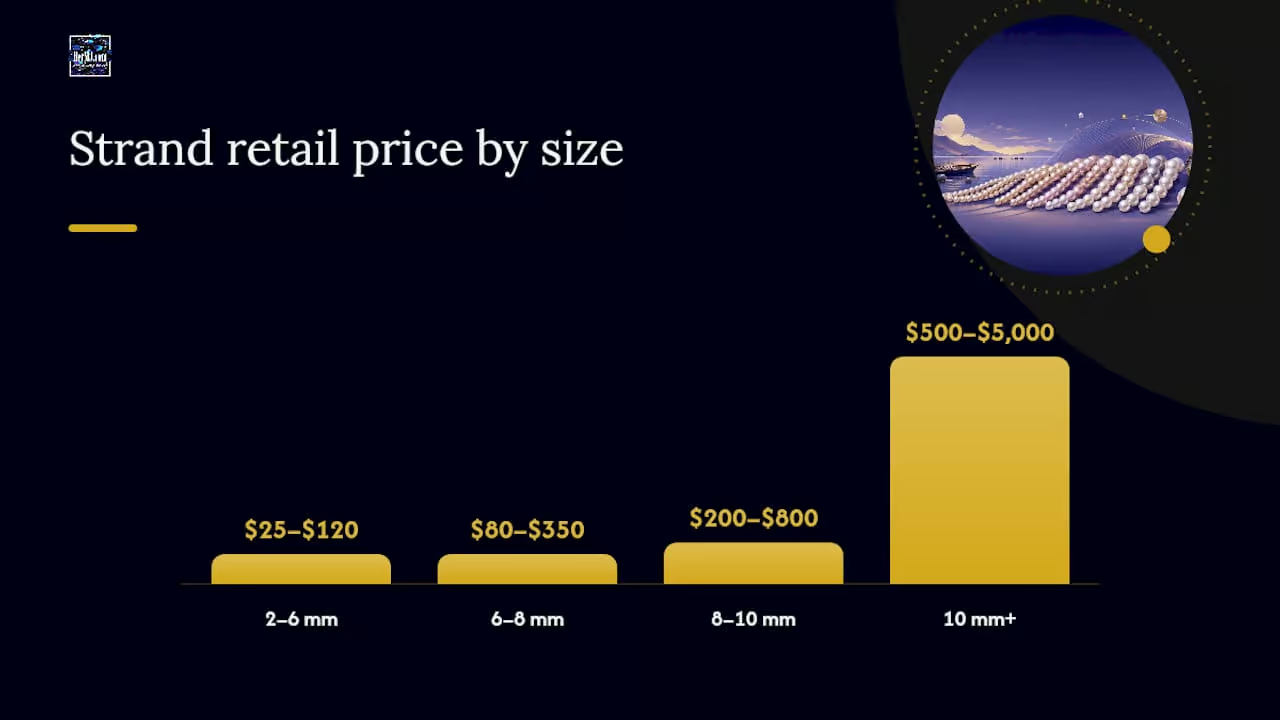
Per-pearl ranges sourced from Grace Studio’s beginner price guide and Moissanite by Aurelia’s 2026 retail snapshot, which places fine-matched 10.5–11.5mm strands up to $5,000.
Grade labels translate roughly like this:
- A: Visible blemishes covering more than 25% of the surface; low to moderate luster; often off-round or baroque shapes
- AA: Fewer blemishes (under 25% surface coverage); good luster; mostly round to semi-round
- AAA: Minimal blemishes (under 10%); high luster with sharp reflections; near-round to round
- AAAA/AAAAA: Used by some retailers for top-tier inventory; expect mirror-like luster, clean surfaces, and near-perfect roundness — though these labels aren’t standardized industry-wide
A practical example: a 16-inch strand of 7–8mm AA pearls might retail for $180–$280, while the same length in AAA rounds could run $400–$650. Step up to 9–10mm AAA and that strand often crosses $800 at a U.S. boutique.
What actually determines the value of a freshwater pearl?
The gap between a $15 pearl and a $150 pearl of the same diameter comes down to six factors. Understanding them helps you read any listing with confidence.
Size (mm) is the most visible driver. Every millimeter of diameter adds meaningful cost because larger pearls take longer to grow and are statistically rarer. An 8mm pearl isn’t just slightly bigger than a 6mm pearl; it’s often two to three times the price per pearl.
Luster is the quality most buyers notice first. It’s the sharpness and depth of the reflection on the pearl’s surface. GIA describes nacre thickness and luster as the primary gem-quality factors that determine both visual appeal and long-term durability. A pearl with high luster looks almost lit from within; a low-luster pearl looks chalky or flat.
Nacre thickness matters for durability, not just appearance. Thin nacre chips, peels, and loses its glow within a few years of regular wear. Thick nacre, by contrast, deepens in beauty over time, much like a fine piece of art that rewards close attention.
Shape categories run from round (most valuable) through near-round, semi-round, off-round, baroque, and keshi. Perfectly round freshwater pearls command a significant premium because they’re genuinely rare in nature.
Surface quality is graded by the percentage of the pearl’s surface that shows blemishes, pits, or spots.
Matching is the hidden cost in strands. Assembling 40 to 50 pearls that share near-identical size, color, luster, and shape requires sorting through hundreds of candidates. That labor and selection process is a real cost, and it’s why a matched strand costs significantly more than the same number of loose pearls purchased individually.
Color and overtone add nuance. White with a rose overtone is the classic U.S. market preference and typically commands a small premium. Lavender, peach, and metallic colors can be natural or dyed; natural color always prices higher than treated color.
Pro Tip: Ask any seller specifically about nacre thickness before you buy. Many retail descriptions mention luster but skip nacre depth entirely. A pearl with brilliant luster but thin nacre is a short-term beauty; one with thick nacre is a piece you’ll still love in 20 years. For deeper technical grounding, what makes pearls valuable is worth reading before you shop.
How do you read retail grade labels and marketing terms?
Grade labels in the freshwater pearl market aren’t regulated by any single governing body, which means the same “AAA” label can mean different things at different retailers. Here’s how to translate what you see.
Common grade meanings and their limits:
- A: Entry-level; expect visible surface marks and moderate luster. Fine for fashion jewelry worn occasionally.
- AA: Mid-market standard; good luster and cleaner surfaces. The sweet spot for everyday wear.
- AAA: High-end retail standard; sharp luster, minimal blemishes, near-round shape. What most fine jewelers mean by “quality.”
- AAAA / AAAAA: Proprietary grades used by some sellers to signal their best inventory. Treat these as marketing descriptors and verify with photos and return policies rather than taking the label at face value.
Terms you’ll see in product listings:
- Edison pearls: Large-format nucleated freshwater pearls, typically 9–16mm, grown with a bead nucleus like saltwater pearls. They achieve rounder shapes and higher luster than traditional non-nucleated freshwater pearls. Honho Jewelry’s 2026 guide notes that top nucleated freshwater pearls over 9mm can reach prices comparable to entry-level saltwater pearls.
- Nucleated freshwater: Any freshwater pearl grown with a bead nucleus inserted before the nacre layers form. Rounder and often higher-luster than non-nucleated types.
- Dyed or treated: Color enhanced through dyeing, irradiation, or coating. Treated color fades faster and prices lower than natural color. Always ask if color is natural.
- Farm origin: Most freshwater pearls come from China’s Zhejiang and Jiangsu provinces. Origin alone doesn’t determine quality, but it’s useful context for understanding supply chain and pricing.
Red flags to watch for:
- No return policy or “all sales final” on an online listing
- Grade claims with no photos showing luster and surface up close
- “Natural pearl” language on what is clearly a cultured pearl (virtually all market pearls are cultured; cultured doesn’t mean fake)
- Shell pearls offered as attractively priced natural pearl gemstones
- Prices dramatically below the size/grade bands above with no explanation
Pro Tip: If a listing uses five A’s (“AAAAA”) but shows no macro photography of the surface and luster, treat it as unverified. Real top-grade pearls photograph beautifully; sellers with genuine AAA+ inventory almost always show it.
How does pricing differ between loose pearls, strands, and finished jewelry?
The format you buy in changes the price per pearl dramatically, and understanding those multipliers helps you compare listings that look similar but aren’t.
Loose pearls are the baseline. You’re paying for the pearl itself, nothing else. A single 8mm AAA freshwater pearl might cost $60–$120 loose from a wholesale or semi-wholesale source.
Matched strands cost more per pearl than loose equivalents because of the sorting and matching labor. Pearl necklace cost also shifts with strand length: a 16-inch choker uses fewer pearls than a 36-inch opera length, so the total price difference between lengths is significant even at the same per-pearl rate.
Finished jewelry adds metal, clasp, setting design, and brand margin on top of the strand cost. A sterling silver clasp adds relatively little; an 18k gold clasp or a pavé diamond setting can add $200–$800 to the retail price before factoring in the pearls.
Typical multipliers from loose pearl to finished retail piece:
- Loose pearl → matched strand: roughly 1.3x–1.6x per-pearl equivalent
- Matched strand → finished necklace (silver setting): roughly 1.5x–2.5x strand cost
- Matched strand → finished necklace (gold setting): roughly 2x–4x strand cost
A concrete comparison: a single loose 8mm AAA freshwater pearl at $80, a 40-pearl matched strand of the same grade at approximately $4,000–$5,000 retail, and a 7–8mm pearl pendant in sterling silver at $120–$250. The pendant uses one or two pearls but the setting and labor account for most of its retail price.
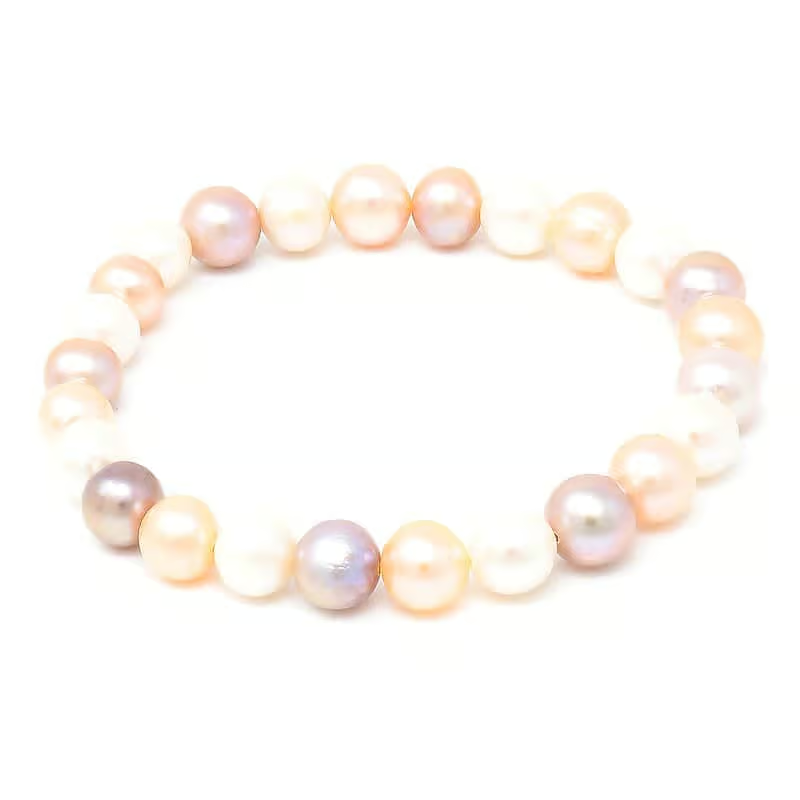
A piece like HerMJ’s Lustrous Freshwater Pearl Bracelet for Elegance illustrates this well: a handcrafted finished piece where the artisan matching and setting work is part of the value, not just the pearl count.
Pro Tip: When comparing two finished pieces, ask for the pearl count and size. Divide the retail price by the number of pearls to get a rough per-pearl cost, then check that against the loose price bands above. A large gap usually means you’re paying for metal, brand, or design, which may or may not be worth it to you.
Why do retail prices vary so much for the same pearl?
Two listings for “8mm AAA freshwater pearl necklace” can differ by $300 or more, and the reasons are worth knowing before you commit to a purchase.
PearlsWholesaler’s 2026 market report documents a meaningful production decline in Chinese freshwater pearl farming driven by environmental regulations, and it shows wholesale prices rising alongside even larger retail moves.
Where prices vary most:
- Size and grade: The biggest single variable. Moving from AA to AAA in 8mm pearls can double the retail price.
- Brand and retail channel: A boutique jewelry store carries higher overhead than a direct-to-consumer artisan brand, and that overhead shows up in the price.
- Setting metal: Sterling silver, gold-filled, 14k gold, and 18k gold each add different cost layers to a finished piece.
- Matching quality: A perfectly matched strand of 50 pearls with identical luster, size, and overtone costs more to assemble than a loosely matched one, even when the individual pearls are similar grade.
- Country of origin and supply timing: The 2024–2025 supply contraction in China’s major freshwater regions shifted available inventory toward mid and high grades, tightening supply of top-quality pearls and pushing retail prices upward.
- Where you shop: Mass-market online retailers, artisan direct sellers, estate sales, and auction houses all price the same pearl differently.
The freshwater pearl market’s rise in quality is also worth noting. As Gem Society points out, modern high-quality freshwater pearls can achieve luster and roundness approaching entry-level Akoya, which means you’re sometimes getting near-saltwater visual quality at a freshwater price.
That’s a genuine buyer opportunity, especially in the AA–AAA range. For a side-by-side look at how freshwater and saltwater pearls compare visually and in value, saltwater vs. freshwater pearls is a useful reference.
The demi-fine jewelry market has also pushed freshwater pearl pricing upward at the fashion end, as designer jewelry trends show freshwater pearls appearing in higher-margin fashion contexts that command brand premiums well above the pearl’s intrinsic value.
What should you check before buying freshwater pearls?
Whether you’re shopping online or in a store, a short checklist protects you from overpaying or buying something that won’t last.
- Ask about origin and treatment. Is the color natural or dyed? Are the pearls nucleated or non-nucleated? Where were they farmed?
- Request grade documentation or a grading description. A reputable seller can tell you the surface quality percentage, luster rating, and nacre thickness estimate.
- Check the return policy. A seller confident in their quality offers at least 14–30 days for returns. No-return policies on pearl jewelry are a red flag.
- Verify nacre thickness. For finished jewelry, ask if the nacre is at least 0.4mm thick. Thinner nacre is a durability risk for everyday wear.
- Look at macro photos. Good luster photographs as a sharp, bright reflection. Surface blemishes show clearly in close-up shots. If a listing has only distant or heavily filtered photos, ask for unedited close-ups.
- Check the drill hole (for strands). A clean, centered drill hole with no cracking around the edges indicates quality processing. Rough or off-center holes suggest lower-grade handling.
- Feel the weight. Real pearls have a satisfying density. Plastic or glass imitations feel noticeably lighter.
Inspection tips for in-person shopping:
- Hold the pearl near a light source and look for depth in the reflection, not just surface shine
- Gently rub two pearls together; genuine pearls feel slightly gritty (the nacre surface), while imitations feel smooth
- Check the overtone in natural daylight, not just store lighting
Pro Tip: For online purchases, always search the seller’s return policy before you add to cart. Pearl quality is genuinely hard to assess from photos alone, and a good return window is your safety net.
Real-world price examples: what fair value looks like in practice
These examples show how the size/grade bands apply to actual listings and help you judge whether a price is reasonable.
- Loose 6–7mm AA freshwater pearl, single: $10–$20 is fair retail. Under $5 suggests low-grade A or dyed. Over $35 for a single non-round pearl is a brand premium, not pearl value.
- Mid-grade strand, 7–8mm AA, 16 inches: $120–$280 is a reasonable U.S. retail range. A listing at $80 likely reflects grade A quality or a short strand. Above $400 for this spec usually means a premium brand or gold clasp.
- Top-quality matched strand, 8–9mm AAA, 18 inches: $400–$900 is realistic retail. A matched strand at this grade from a reputable artisan or fine jeweler is worth the premium because the matching labor is real.
- Finished pendant, 9–10mm AAA freshwater pearl, sterling silver: $150–$350 is typical. The pearl itself might wholesale for $40–$80; the rest is setting, design, and retail margin.
- Large-format Edison strand, 10.5–11.5mm, matched: Moissanite by Aurelia’s 2026 retail snapshot places fine-matched strands at this size up to $5,000, which reflects both the pearl rarity and the matching difficulty at large formats.
A note on brand and metal: Two strands with identical pearls can differ by $500 or more based solely on the clasp metal and the brand’s retail positioning. Neither is necessarily overpriced; they’re serving different buyers. Know which part of the price you’re paying for before you commit.
The wholesale-to-retail gap is real and large. A pearl that costs $15 at wholesale can retail for $75–$90 once it reaches a boutique, per PearlsWholesaler’s markup documentation. Buying from a direct artisan or a direct-to-consumer brand often closes that gap meaningfully without sacrificing quality.
Why handcrafted freshwater pearl jewelry from HerMJ can be a better-value option
At HerMJ, we work directly with genuine freshwater pearls and hand-select each piece for luster, surface quality, and matching before it becomes part of a finished design. That curation step, which a mass retailer often skips, is what separates a piece that looks beautiful for years from one that disappoints after a season.
HerMJ’s approach to pearl jewelry is rooted in artisan selection and direct-to-consumer pricing. Because we’re not carrying boutique overhead, the price you pay reflects the pearl and the craft, not a retail floor lease.
A few things that shape the value you get from a handcrafted piece:
- Curated matching: Each strand or multi-pearl piece is assembled by hand, with attention to luster consistency and size uniformity that mass production skips.
- Genuine nacre: HerMJ uses genuine freshwater pearls, not shell pearls or coated imitations, so the luster you see in photos is the luster you receive.
- Customization: Pieces can be tailored to individual preferences, which is rare at the price points HerMJ offers.
- Customer confidence: Positive reviews consistently highlight the quality and beauty of each item, which reflects the care that goes into selection and finishing.
For buyers who’ve read about why pearl jewelry is undervalued, HerMJ’s model is a direct answer to that gap: genuine quality at a price that doesn’t require a boutique budget.
Pro Tip: When you’re evaluating any handcrafted pearl piece, ask whether the maker selects pearls individually or buys pre-sorted lots. Individual selection, even at small scale, produces noticeably better matching and more consistent luster across a strand.
My recommendation for three types of buyers
I get asked often whether freshwater pearls are “worth it” compared to saltwater options, and my answer is always the same: it depends entirely on what you’re buying them for.
For the budget shopper: A 7–8mm AA freshwater strand in the $150–$250 range is genuinely good jewelry. You’re getting real pearl luster, a wearable size, and a piece that looks polished without requiring a significant investment. Don’t chase AAA if your budget is tight; a well-matched AA strand beats a poorly matched AAA every time.
For the everyday wearer: Focus on nacre thickness and matching above grade label. A piece you wear three times a week needs nacre that can handle contact with skin, perfume, and occasional knocks. Mid-grade pearls with verified thick nacre outlast high-grade pearls with thin nacre by years. HerMJ’s collections are built with this kind of longevity in mind.
For the heirloom buyer: This is where matching and nacre become non-negotiable. A matched strand of 9–10mm AAA freshwater pearls, properly knotted on silk, with a quality clasp, is a piece that holds its beauty and its value. Edison pearls at this level are where freshwater pricing genuinely overlaps with saltwater, and the visual result justifies it. I’d also suggest looking at the difference between freshwater and saltwater pearls before committing to a high-end purchase, so you’re choosing with full context.
HerMJ focuses its collections on the everyday wearer and the thoughtful gift buyer: pieces with genuine pearl quality, handcrafted finishing, and pricing that doesn’t punish you for wanting something beautiful.
HerMJ’s pearl collections worth exploring
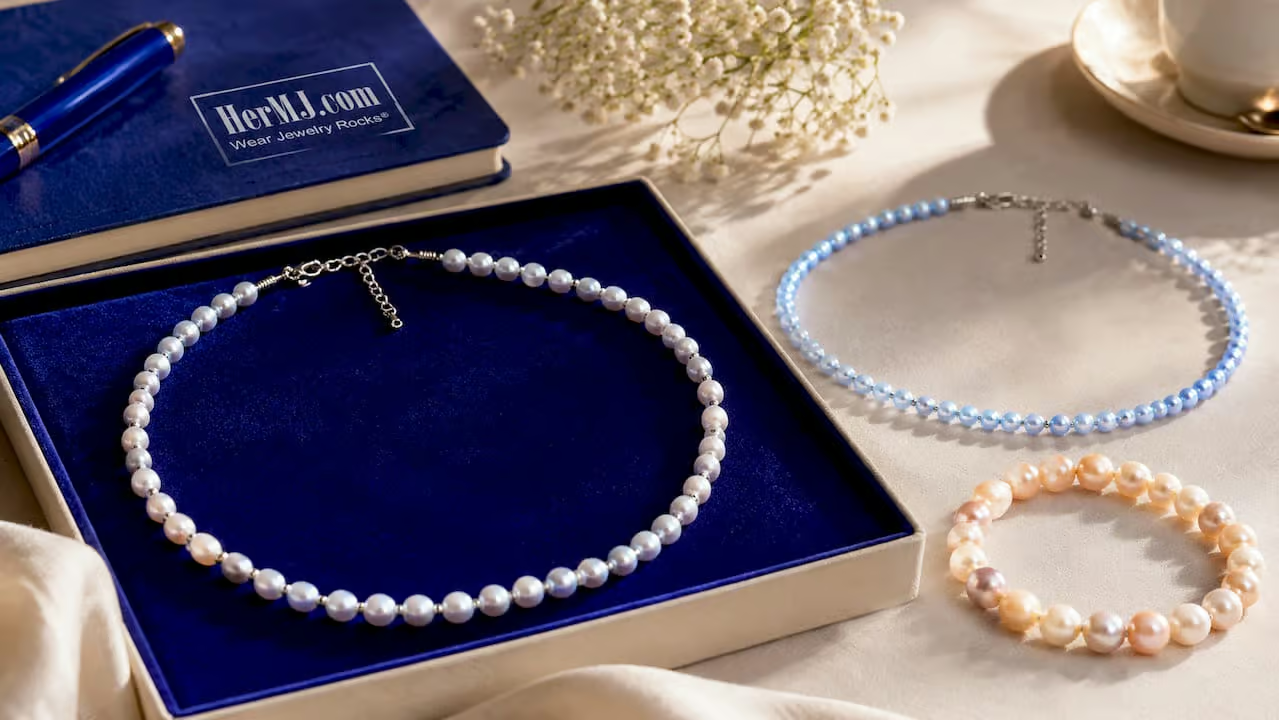
If this guide has helped you understand what fair freshwater pearl pricing looks like, the next step is finding a piece that fits your budget and your style. HerMJ’s handcrafted collections are built around the value principles covered here: genuine pearls, careful matching, and artisan finishing at prices that reflect the craft rather than boutique overhead.
Three pieces worth starting with:
The Elegant Freshwater Pearl Necklace is a classic strand that delivers the clean, luminous look most buyers picture when they think of pearl jewelry. It’s the kind of piece that works for everyday wear and special occasions without asking you to choose.

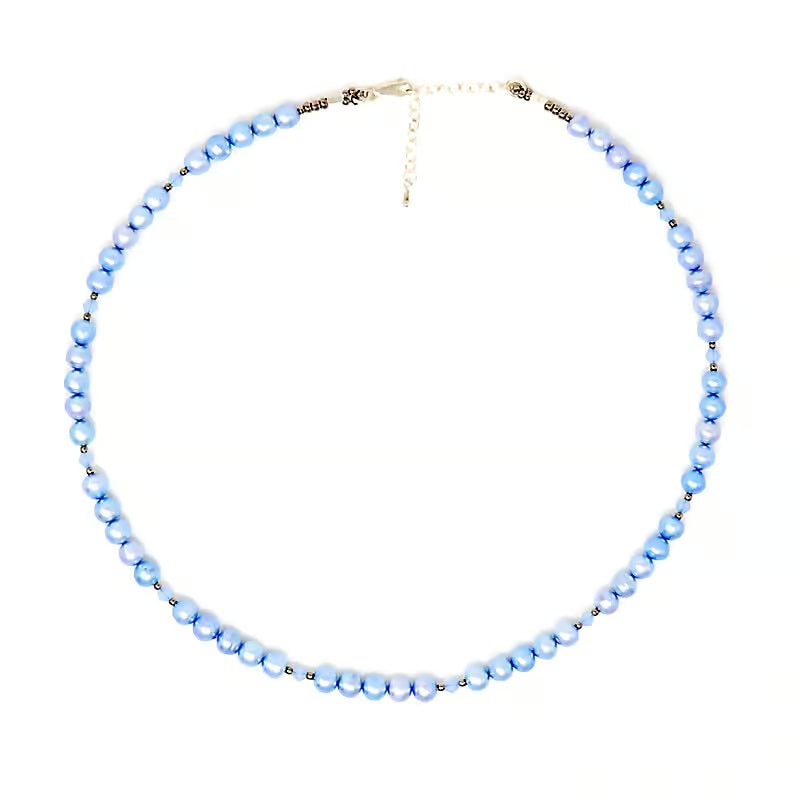
For something with more personality, the Blueberry Gelato Collection Freshwater Pearl Necklace shows what natural color can do. The soft lavender and blush tones are natural, not dyed, which means the color you see is the color that lasts.
The Lustrous Freshwater Pearl Bracelet for Elegance is a strong starting point if you want to test the quality of HerMJ’s pearl selection before committing to a necklace. U.S. orders ship free with no minimum order, and international orders ship free at $150+. Browse the full collection and find the piece that resonates with you.
Sources
These are the primary sources used for price bands and market context in this guide.
- GIA: Pearl description
- Gem Society: Freshwater pearls — Value, price and information
- Moissanite by Aurelia: Freshwater Pearl Guide: Real Prices, Value & What to Buy
- Goodstone: How Much Are Pearls Worth? Full Guide
Recommended
- The difference between freshwater and saltwater pearls
- Pearl Necklace Cost: What Your Budget Actually Buys
- Pearl Value: What is the most expensive pearl?