


Druzy for Jewelry Buyers: Identify Real Pieces, Protect Their Sparkle
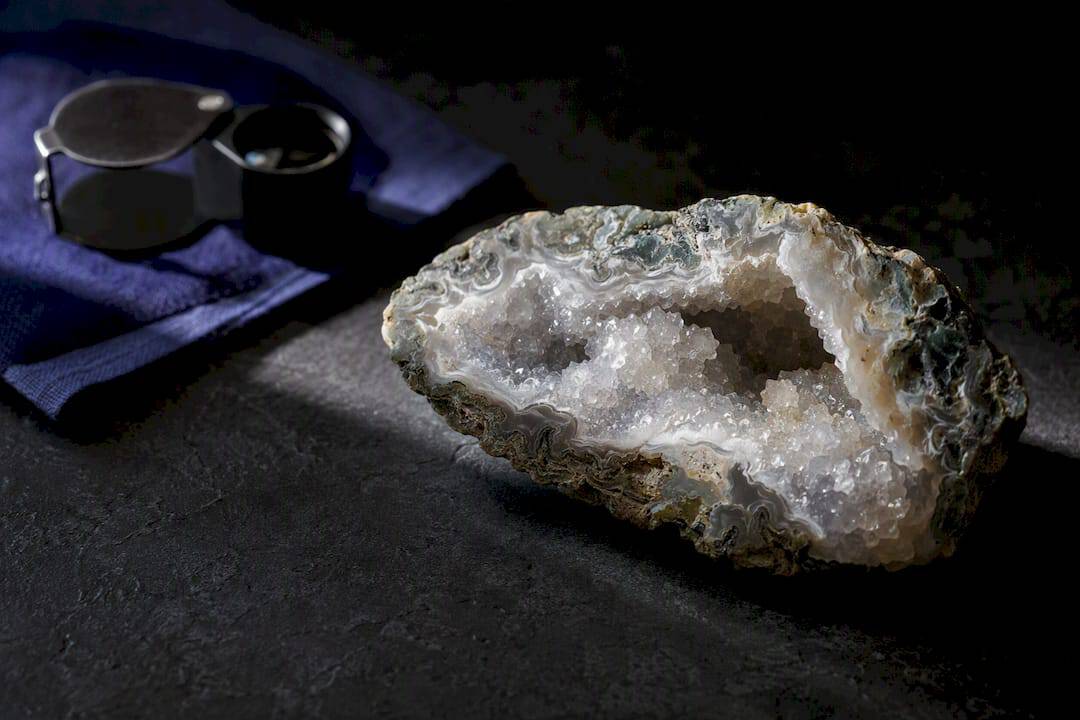
Druzy, sometimes spelled drusy, is a natural crust of tiny sparkling crystals that forms on the surface of a host rock or mineral, most often inside a geode, vug, or cavity.
You’ll usually find it growing on quartz, agate, or calcite, and its shimmering texture is exactly why jewelry designers love it. Colors can be natural or lab-enhanced, with care instructions varying accordingly.
The Edit
- Most druzy jewelry uses quartz or agate as the host mineral, which creates durable, fine-textured crystal coatings suitable for daily wear.
- Natural druzy colors come from the host mineral and trace elements, but many pieces are enhanced with coatings or dyes that should be disclosed by ethical sellers.
- Genuine druzy features irregular, fused crystals on the surface, while imitations often appear too smooth or uniformly patterned, especially with metallic coatings.
- Druzy works best in pendants and earrings with protective settings like bezels, as the crystals sit on the surface and are vulnerable to impact and abrasion.
- Proper care involves gentle cleaning with soap and water, avoiding ultrasonic cleaners, steam, and harsh chemicals that can damage the crystals or coatings.
How druzy forms inside geodes, vugs, and rock cavities
Druzy begins its life as a mineral-rich fluid moving through cracks and hollow spaces in rock. As the fluid cools or its chemistry changes due to the minerals within the structure, tiny crystals begin to precipitate onto the cavity’s inner walls.
Given enough time, thousands of these microcrystals grow side by side, creating that telltale sugary, glittering surface.
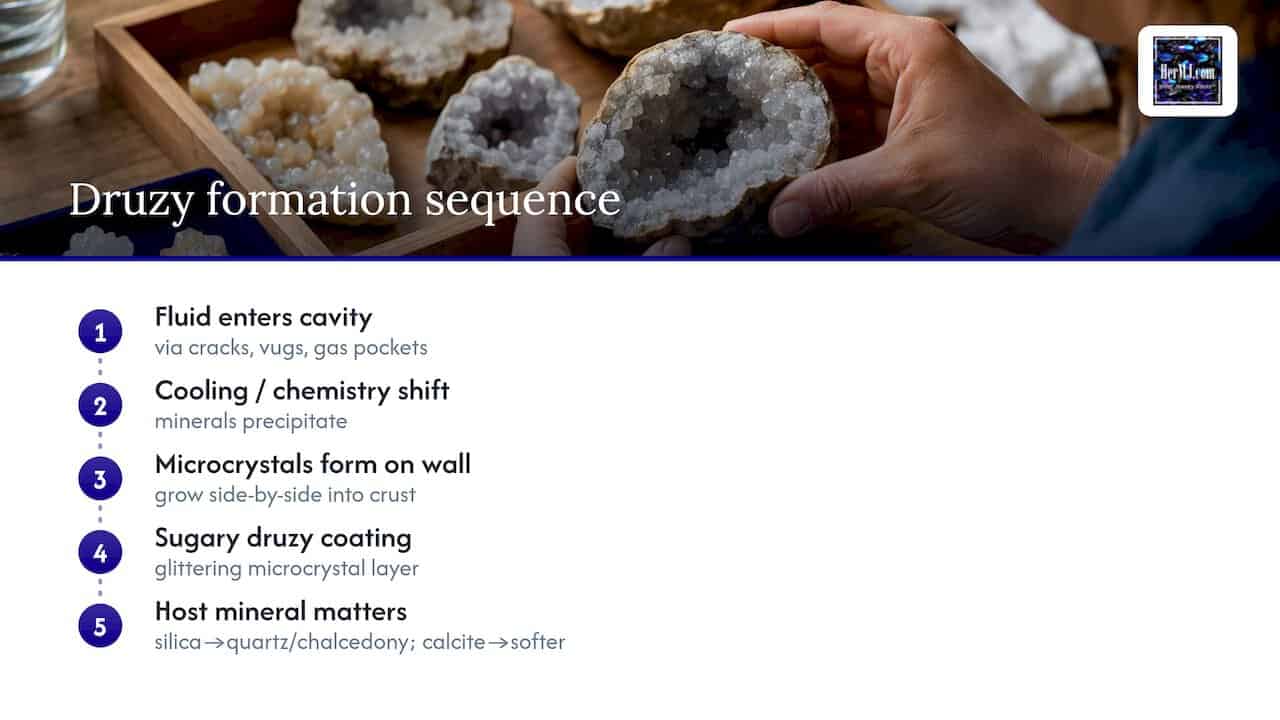
This process happens most often in geodes and vugs, which are essentially pockets left behind by gas bubbles, dissolved minerals, or decayed organic material.
Veins in rock and, occasionally, fossil replacement sites offer similar opportunities.
As mineral-bearing water seeps in and evaporates or cools gradually, crystals gain the stability they need to form in place rather than being washed away.
The host mineral matters because it shapes the druzy’s final appearance and durability. Silica-rich fluids tend to produce quartz or chalcedony druzy, the type you’ll most often see in jewelry.
Calcite forms under different conditions, resulting in a softer, more fragile crust. According to Wikipedia’s entry on druzy formations, this refers to the fine coating on a fracture surface, vein, or cavity wall, distinguishing it from larger, single-crystal growths.
Druzy colors and how vendors enhance them
Natural druzy color comes from the host mineral itself along with trace elements and inclusions trapped during crystal growth.
An amethyst druzy gets its purple tone from iron impurities. In contrast, an agate druzy often shows soft grays, browns, or banded colors influenced by the surrounding stone.
Because natural druzy can look pale or inconsistent, many pieces on the market are enhanced.
Vapor deposition coatings involve applying a thin layer of titanium or cobalt inside a vacuum chamber, resulting in the electric blues, golds, and rainbow finishes often seen in jewelry.
Dyeing and electroplating are other common methods, each of which changes the intensity of sparkle and color.
The GIA’s overview of gem treatments notes that vapor deposition and dyeing are standard practices in the trade, and ethical sellers are expected to disclose them.
When you’re shopping, ask directly whether the color is natural or treated. A druzy piece with a suspiciously uniform metallic sheen across every facet is frequently coated, and there’s nothing wrong with that as long as the seller tells you so.
Types and common host minerals you’ll encounter
Quartz and agate druzy, which are prized for their fine, even crystal texture and their ability to hold a coating well, are the most common types you’ll see in jewelry.
According to GIA’s buyer’s guide on quartz varieties, quartz-based stones, including chalcedony and agate, are the most frequently encountered druzy hosts because silica forms such stable, small crystals.
Calcite druzy looks similar at a glance but tends to be softer and more prone to scratching or dissolving when exposed to acidic cleaners, so it shows up less often in wearable pieces.
Rarer variants are prized by collectors, who also look for fossilized drusy shells, in which the shell’s structure is replaced by chalcedony and then coated in quartz crystals.
Gem news from GIA’s coverage of fossilized drusy shells documented these unusual specimens as a niche but genuine draw for mineral collectors.
How to tell if druzy is real and what drives its value
A little detective work goes a long way when you’re deciding whether a piece is natural, treated, or entirely fake.
Real druzy has an irregular, slightly uneven crystal surface because it grew organically over time, while glass or resin imitations often look too smooth or too perfectly patterned.
- Look closely at how the crystals sit on the host stone. Genuine druzy crystals should appear fused directly into the surface, not layered on top like a coating.
- Check the weight and backing. Natural druzy jewelry often has a solid stone base, while cheap imitations may feel unusually light or hollow.
- Ask the seller whether the color has been enhanced. Reputable sellers disclose vapor coatings, dyes, or electroplating without hesitation.
- Examine the piece under magnification if you can. Tiny, irregular crystal faces catching the light differently are a strong sign of the real thing.
Value depends on several factors working together: the host mineral, the size and evenness of the crystal surface, whether the color is natural, and how well the jewelry setting protects the stone.
A piece with vivid natural color and clean craftsmanship in the mounting will usually command more than a heavily treated or poorly set counterpart.
If you want a quick way to separate genuine quartz-based druzy from glass look-alikes, these simple identification tests can help.
How druzy shows up in jewelry and how it’s best protected
Druzy’s texture makes it a natural fit for statement pieces rather than delicate, everyday accents. You’ll most often find it in pendants, drop earrings, and pendant-style necklaces, where the crystal surface can catch light from multiple angles.
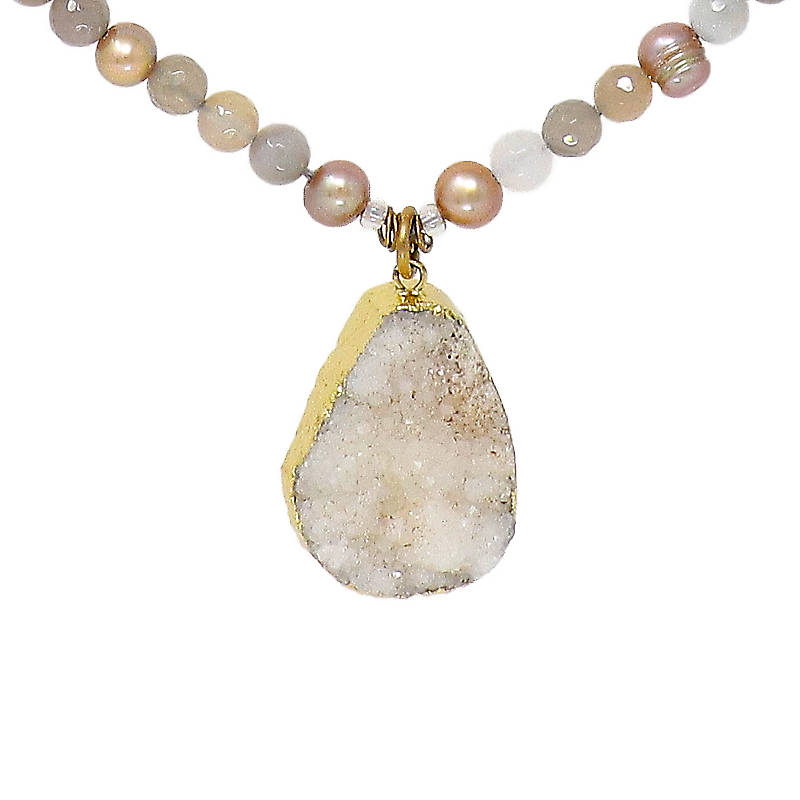
- Pendants and necklaces let druzy hang freely, showing off its sparkle without much risk of impact.
- Earrings, especially drop styles, work well because they rarely brush against hard surfaces during the day.
- Decorative accents, like small druzy slices set into home decor pieces, avoid wear entirely and let the crystals shine undisturbed.
Because druzy crystals sit right on the surface, a bezel or partial bezel setting offers real protection by wrapping metal around the vulnerable edges.
This is one reason druzy rarely appears in rings; a piece worn on the hand takes far more daily impact than one worn at the ear or throat.

Pairing druzy with warm metals like gold-tone brass tends to soften its glitter, while silver-tone settings sharpen the contrast against darker hosts like agate.
Pro Tip: Save your druzy pieces for occasional wear rather than daily rotation, especially if the coating is a treated metallic finish, since repeated friction can dull the surface over time.
Caring for druzy: durability and safe cleaning habits
Durability in gemstones comes down to three separate qualities: hardness, toughness, and stability.
Quartz-based druzy scores reasonably well in hardness, but the individual crystal points are still prone to chipping if struck against a hard surface.
The GIA’s guidance on gemstone durability notes that these three factors together determine how a stone should be set, cleaned, and repaired, and that some materials require more conservative handling than others.
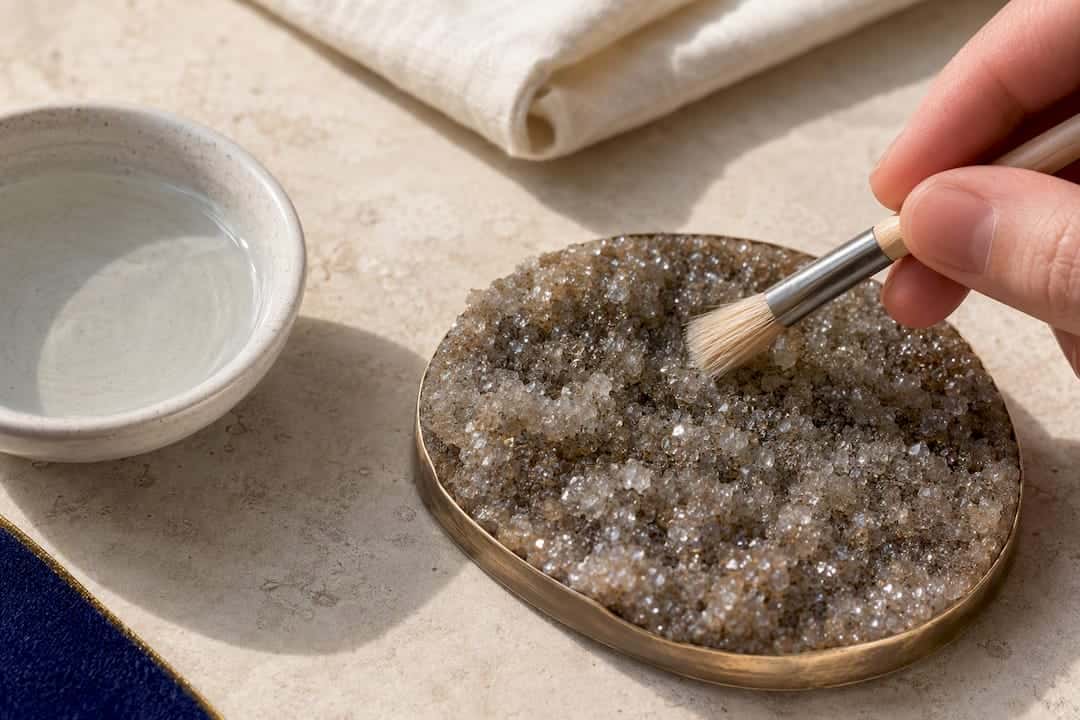
For everyday cleaning, stick with mild soap, lukewarm water, and a soft brush to loosen any dust caught between the crystals.
Like with similar stones and porous gems, skip ultrasonic cleaners and steam, since both can loosen a metallic coating or stress the tiny crystal points.
Harsh chemicals, including vinegar or ammonia-based cleaners, can dull or dissolve the surface, particularly on calcite druzy.
For more detail on gentle methods that work across gemstone types, our guide on caring for handmade gemstone jewelry covers the basics well. If a setting loosens or a stone shifts in its bezel, a bench jeweler is always the safer choice over a DIY fix.
HerMJ’s approach to selecting and setting druzy accents
Every gemstone we work with at HerMJ gets chosen with its natural texture and durability in mind, and druzy is no exception.
I favor settings that protect the crystal surface, using bezel-style mounts and thoughtful metal pairings that let the sparkle show while keeping delicate crystal points protected.
What druzy actually means in mineralogy
The word druzy, also spelled druse or drusy, refers to both a geological feature and a jewelry material, and it helps distinguish the two uses.
In geology, a druse is defined by Mindat’s glossary as an irregular cavity or opening in a vein or rock, lined on its interior surface with small projecting crystals. The term covers the cavity itself and the crystalline coating inside it.
In jewelry and retail settings, druzy usually refers specifically to that crystalline coating once it’s been cut away from its host cavity and polished into a wearable slice.
It’s not a mineral in its own right, as quartz or garnet are; it’s a texture and growth pattern that can occur in several different minerals.
That’s why you’ll hear people talk about “quartz druzy” or “agate druzy” rather than just “druzy,” since the base mineral still matters for hardness, color, and how the piece should be cared for.
This dual meaning can confuse new collectors who expect druzy to behave like a single, consistent gemstone. It doesn’t.
A druzy pendant made from agate will hold up differently than one made from calcite, even though both might be labeled simply as “druzy” on a listing.
Knowing the host mineral behind the sparkle gives you a much clearer picture of what you’re actually buying and how long it will last with normal wear.
Why I look past the sparkle before I buy
I’ve always found druzy fascinating because it rewards a closer look. The sparkle is the first thing that grabs you, but the host mineral and any color treatment tell you what you’re really getting.
My own preference leans toward natural color for pieces I want to wear often, and treated color for fashion pieces I know I’ll rotate out.
Whatever you choose, ask about the treatment, check the setting, and let the stone’s texture guide how gently you handle it.
— Veronique
Where to find druzy-inspired pieces and gemstone jewelry at HerMJ
If druzy’s texture has you thinking about adding more natural stone pieces to your collection, our handmade European Crystal Jewelry line and broader gemstone jewelry collection are worth a look.
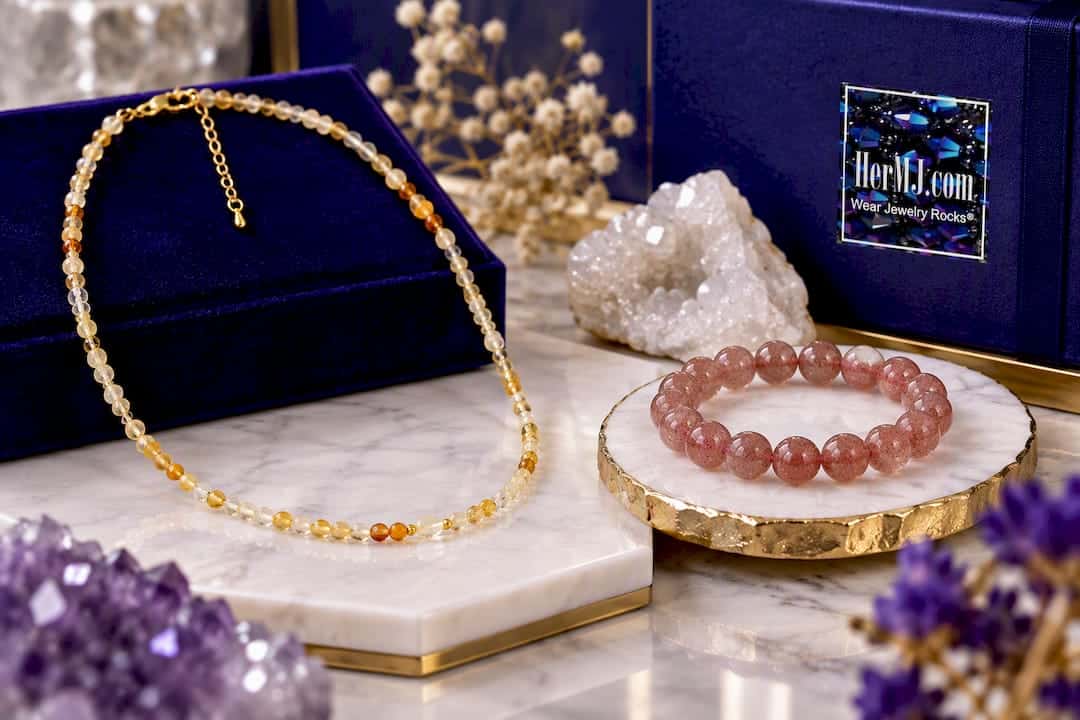
Pieces like our Faceted Garnet Gemstone Necklace, Tiger Eye Bracelet, and Terahertz Bracelet show the range of natural materials we work with, all set with the same care we’d give a druzy piece.
If you’d rather pair gemstones with our pearl work, the Pearl And Aquamarine Necklace is a favorite.
Browse our Bracelets and Necklaces collections built around a stone you love. US orders ship free with no minimum, and international orders ship free on orders of $150 or more.
Sources
FAQ
Is druzy a real stone?
Druzy isn’t a single stone but a crystal texture that forms on minerals like quartz, agate, or calcite, so it’s real in the sense that it’s a genuine natural formation. The base mineral underneath determines its actual composition and hardness.
Is druzy worth anything?
Druzy’s value depends on the host mineral, the size and quality of the crystal surface, and whether the color is natural or treated. Well-crafted jewelry settings that protect the crystal surface also add to a piece’s overall worth.
How can you tell if druzy is real?
Genuine druzy shows an uneven, organically grown crystal surface fused directly to its host stone, while imitations often look too smooth or artificially uniform. Checking the piece under magnification and asking the seller about any color treatment are both reliable ways to confirm authenticity.
What does druzy jewelry symbolize?
Druzy jewelry doesn’t have a single universal meaning, but many wearers are drawn to its raw, unpolished sparkle as a symbol of natural beauty formed slowly over time. Its appeal tends to be more aesthetic and personal than tied to a fixed tradition.
How is druzy different from agate?
Agate is a banded form of chalcedony, while druzy refers to a crust of tiny crystals that can form on the surface of agate or other host minerals. In other words, agate can be the host, and druzy can be the sparkling coating found on its surface.
Recommended
- What Is an Investment Jewelry Piece? A Buyer’s Guide
- How to Identify Truly Handcrafted Jewelry Pieces
- How to Compare Gemstone Jewelry Online Marketplaces
- Designer Crystal Jewelry Guide